By Michaela Wang ‘21, Feature Editor
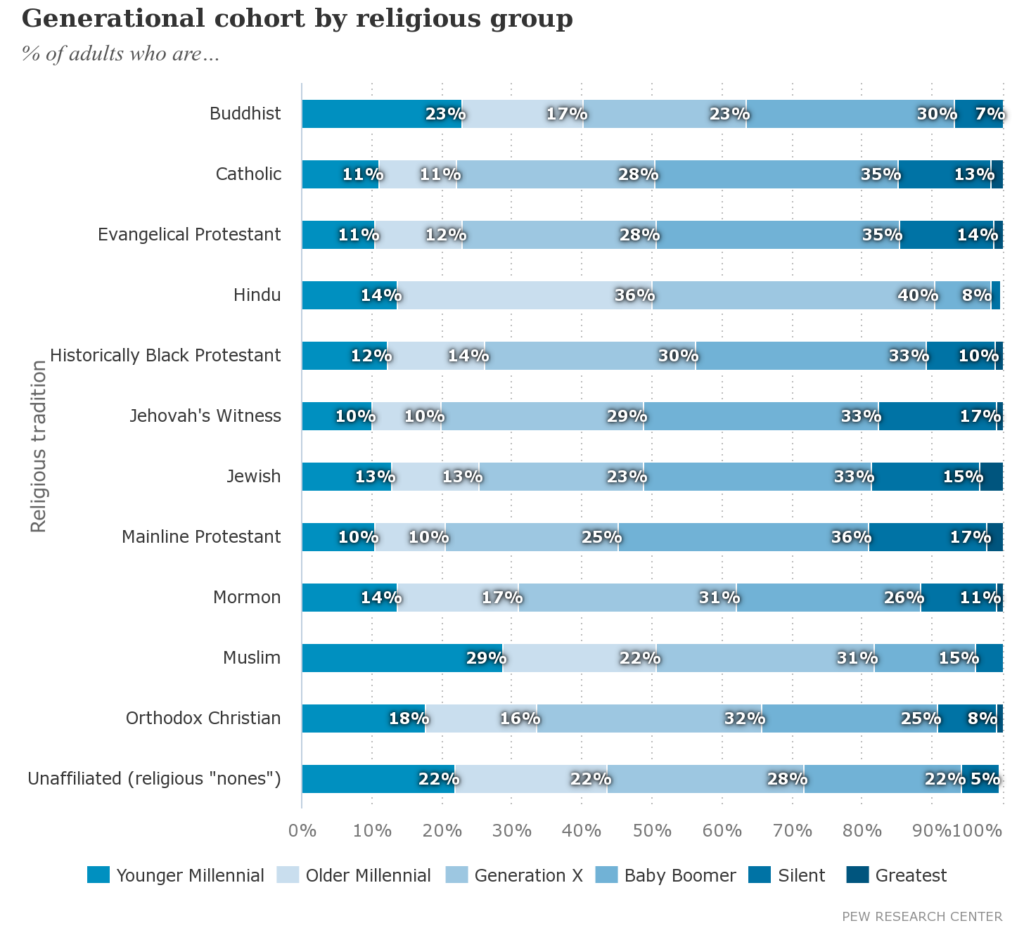
Pew Research Center’s Religious Landscape Study, 2019 https://www.pewforum.org/religious-landscape-study/generational-cohort/
You may have driven behind an Ichthys bumper sticker – those intersecting arcs that form a fish symbol of Jesus Christ – or rotated through Bat Mitzvah sweatshirts each day of the week. But did you know what those symbols and milestones meant? For many of today’s younger generation, religion appears from time to time, but fails to persist in our lives the way it did during the boomer generation.
Pew Research Center recently surveyed more than 35,000 Americans from varying age groups about their religious affiliations, the strength of their beliefs, and the frequency of their practices. The data is convincing: about half of baby boomers attend religious services at least once a month, while a little less than 40% of millennials seldom or never attend. Around 60% of boomers find religion very important in their lives, while the numbers fall to 40% for millennials. These sharp declines may limit emotional or social connectivity between boomers and younger generations and drive families apart. Why does religion, like a fashion trend, come and go? And how can we mend these tears while also accepting a new generation of thought?
Religion can be compared to an heirloom passed on from each generation, shaping identities and testing one’s loyalty to their roots. Many followers find security and fulfillment in their faith, while others feel restricted. After all, any ideology may define everyday lifestyle and restrict personal freedom for the rewards of devotion. But “the kids these days” aren’t so attracted to obedience, and for many justified and unjustified reasons, would rather develop their own beliefs or cherry-pick principles of a religion.
An anonymous Newark Academy student disclosed: “I was raised Muslim, so my legs never felt the wind of public air conditioning, always concealed by leggings like an additional skin I had to bring everywhere. Then I stopped dressing how my parents, my religion, and tradition told me to. Initially, it was not taken well by my family.” This quote depicts the struggle between adhering to family tradition and pursuing one’s individual path.
My free-minded thinking, a quintessential trait of Generation Z, countered my boomer mother’s abidance to traditional Christian values. Raised in Taiwan, her family converted to Evangelicalism when moving to the Dominican Republic and later the United States. Suffering the rigid culture shock of American high school, she found security in her devotion to God. Despite marrying my Atheist father who remained impartial on her faith, my mother taught my sister and me the gallant tales of the Bible, dropped us off at Sunday School, contributed to church potlucks, and blinded us from potty words and Disney movie kiss scenes. I liked attending church until I realized I only liked attending church– I didn’t believe in particular concepts others praised. As I became a self-centered, insecure teen, I felt forced into Christianity by my mother. While one can mature and attain their own views, an undeveloped teen cannot abandon religion simply out of rebellious impulse or because it’s out of trend, like shoulder pads and choker necklaces. My mother owned the right to inherit her religion to me, but I also owned the right to leave it as long as I was justified. Understanding is crucial in grappling with a generational divide– religion is never supposed to hurt people, only promote acceptance and unconditional love beyond differences. To cope with natural rifts among generations, we must admit that we can’t control what others believe, but we can try to understand. I have now balanced individual thought and Christianity, attending youth groups every Friday to discuss religion in a more relatable perspective. I’ve accepted and rejected particular principles, and found that religion empowers through its restrictions.
“I believe in a higher power, but I don’t necessarily believe in a specific god. And I think that’s perfectly fine– life is controlled but I still have control too,” says an anonymous NA student. As humans, we want to rely on something, an omnipotent force to alter our situation when we cannot. While this belief persisted in the majority of boomers, religion has now become the minority for more recent generations. But just because our generation experiences differences doesn’t mean we must diverge; there is always room for acceptance, communication, and wanting to understand.
Leave a Reply
You must be logged in to post a comment.