By Oliver Adelson ’21, Commentary Writer
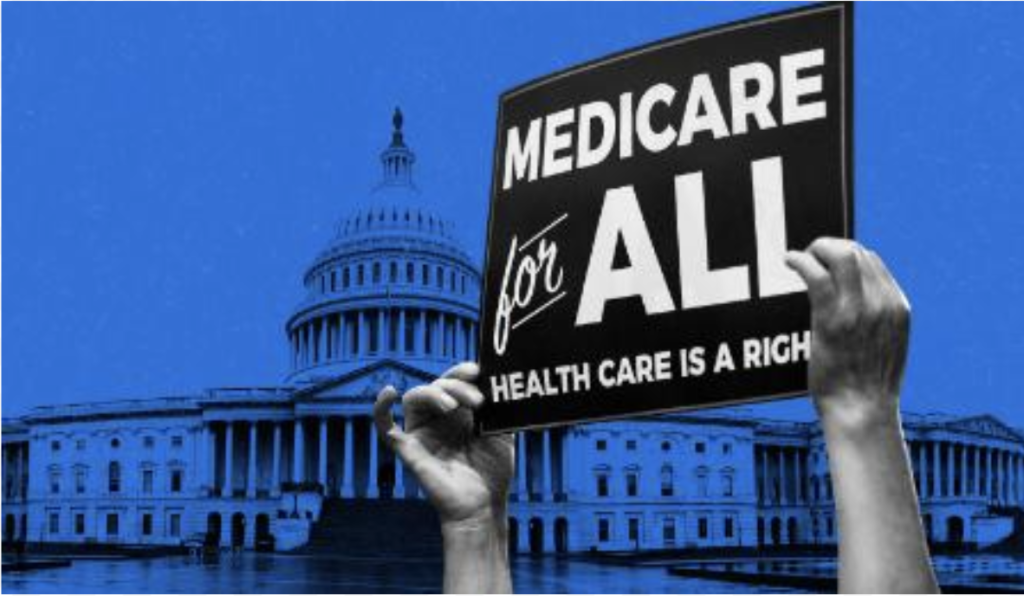
Since the advent of the 2020 Democratic Primaries, few issues have divided the party as much as healthcare reform. The more progressive candidates have proposed sweeping reforms through single-payer healthcare, while more moderate candidates have proposed gradual change through the introduction of a public option. And some candidates, such as Pete Buttigieg, have vacillated between the two. With drastic reform needed to fix the broken U.S. healthcare system, the question of which policy to pursue is more important than ever.
All of the Democratic candidates believe that healthcare is a fundamental right; the health of a country’s citizens is a prerequisite for civilized life, and thus accessible healthcare is imperative. So the question then becomes how to best provide high-quality health coverage to all Americans, regardless of income. While a public option and Medicare for All are both being proposed as solutions to this problem, Medicare for All would be far more successful.
If a public option is created, it will be doomed to fail. Fundamental to the healthcare crisis in the United States is the prevalence of pre-existing conditions. Estimates of adults in the United States with preexisting conditions range between 50 and 129 million. If the United States were to establish a public option, a disproportionate number of those who sign on would be the sickest and most elderly members of society. Insurance companies increase their profits by having healthier customers, and one can be sure that they would exert influence through lobbying and advertising to move sick customers onto the government plan. Since the public option insurance pool would have a less healthy population than that of private insurance, it would result in higher costs, vitiating the public option. With the failure of a public option, those who oppose universal healthcare would have their example of why “the government can’t run healthcare,” when in reality, the system would have been designed to fail.
To evaluate the potential for success of single-payer healthcare in the United States, it is helpful to consider examples of other countries in which similar healthcare systems have already been implemented. If we look north to Canada, we find an example of a country that has successfully implemented a single-payer healthcare system that is very popular and provides healthcare to all of its citizens. Since the establishment of the Canada Health Care Act of 1984, the Canadian health care system has garnered so much support among Canadians that any attempt to privatize health care is essentially a political non-starter. One poll conducted by the Toronto-based Nanos Research found that 80% of Canadians support the Canadian health care system with only 3.5% in opposition. The longevity of their healthcare system can be greatly attributed to the single-payer system, shown by the most frequently cited “key strength” of Canadian health care: universality.
The transition into a single-payer healthcare system would increase innovation in the U.S. economy. One barrier towards entrepreneurship in the United States is the reliance on employers to provide employees with health insurance. On the employee’s side, the fact that they would lose their health insurance if they were to leave their job hinders innovation and the ability to start businesses. On the employer’s side, having to pay for their employees’ health insurance burdens the business with high costs. The single-payer system would ameliorate both of these problems.
Critics of Medicare for All frequently cite the fact that Medicare for All would cost taxpayers trillions of dollars every year. The canard that single-payer healthcare costs much more than the current system has believers even in the Democratic Party. While taxes would rise to fund Medicare for All, the overall cost for the American people would be less. A 2018 study by the University of Massachusetts Amherst found that under Medicare for All, estimated yearly costs would total $2.93 trillion, 10% less than the $3.24 trillion under the current system. This case against single-payer healthcare advocates fiscal austerity even when Medicare for All would save money.
Healthcare is the bedrock upon which all other issues rest in the United States. It is essential that the chosen policy prescription lowers costs and provides healthcare to all Americans. Single-payer health care is the best way to accomplish these goals.
Leave a Reply
You must be logged in to post a comment.