By Kira Lu ‘20, Editor-in-Chief
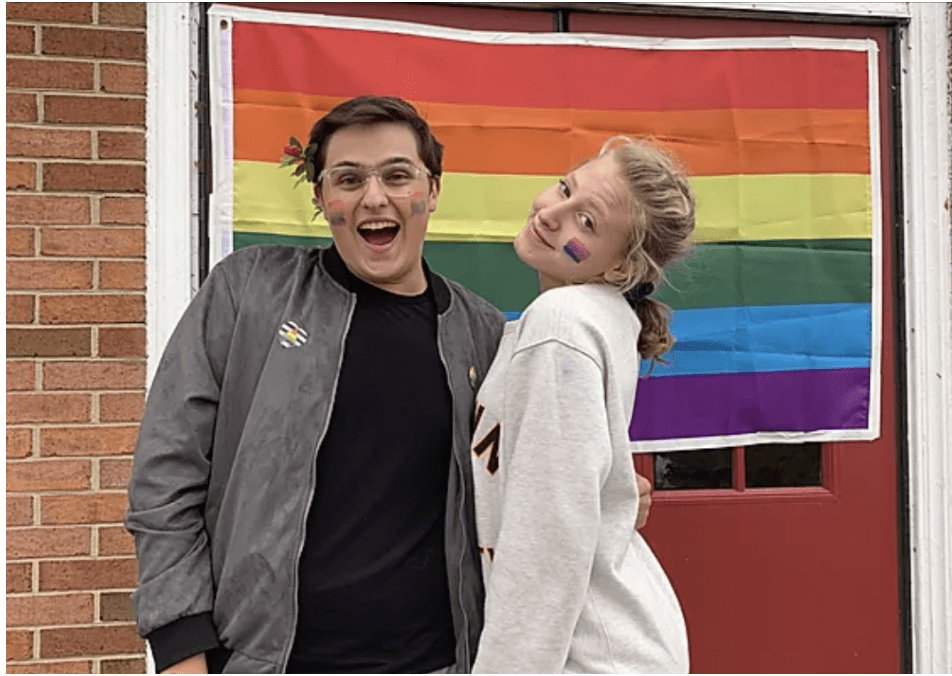
“Hurt but not surprised” by the lack of LGBTQ+ representation in history textbooks, Henry Chandonnet ‘21 and Olivia Madreperla ‘21 created The Untold Story to spotlight LGBTQ+ activists, issues, and artists in New Jersey.
Could you tell us a little bit more about your interviews? How do you choose people to interview?
Olivia Madreperla ‘21: The interviews we do seek to represent a diverse array of people across New Jersey that are queer activists, so, in our interviews, we like to highlight the individual we are talking to. For example, in our most recent interview with Cathy Renna we talked a lot about the impact of media, news, and representation of events in popular news sources, because Renna is a media specialist who has worked in the field for the last thirty years. In contrast, our first interview with William Placek was based around his work with LGBTQ+ youth as that is his profession as president of PFLAG in South Jersey. As the name of our organization describes, we focus on highlighting the stories that we wouldn’t ever see if not for an organization like ours.
As far as how we choose people for interviews, it is really based on whoever we can connect with. Our only criteria in choosing people to interview is that they are somehow a part of the LGBTQ+ community in New Jersey. The “New Jersey” aspect is very important as that is a primary aspect of our entire project. Both Henry and I have resided in New Jersey our entire lives and it was important to us that we focus our efforts in the place of our upbringing.
Henry Chandonnet ‘21: It’s also important to mention that our spotlights are not necessarily predicated on a history of activism. Every queer person has a story to tell, an opinion to share, and advice to give. We want to hear about your story, about what being queer in New Jersey means to you.
What’s one thing you learned from the interviews? Why did it stick with you?
OM: In our most recent interview with Cathy Renna, she told us that her friends often joke with her that the words, “Hm… I never thought about it that way,” would be engraved on her headstone. I have always thought of myself as an activist for LGBTQ rights, but one thing she did say really stood out to me as something I really hadn’t thought of. Before our meeting, I saw the fight for equal marriage rights as a fight for equality in love and the ability to marry for love. However, she presented it to me in a different light; marriage also has practical purposes. For example, marriage allows both partners the ability to make decisions regarding the health of their counterpart in the case that they are sent to the hospital and are unable to speak for themselves. In addition, without marriage, one is not able to enter a hospital room unless they are the direct family of the sick or injured. Hence, marriage isn’t simply a proclamation of love, it’s literally a partnership of life and death. Imagine not being able to see the person you love most if they got hit by a car and not being able to hold their hand before they went into life-saving surgery. Marriage is as simple as the legal implications of it.
This stuck with me because I really thought that I knew what I needed to know about the LGBTQ+ community in order to advocate for it correctly. However, I obviously had overlooked things that are extremely important to telling the story of those who cannot tell it for themselves.
HC: Another common theme that we’ve found is how simple it is to be an activist, and how easy it is to stand up for your own community. Almost all of our interviewees have mentioned in their “action plans for activism” that being out is in of itself an act of activism. Living, breathing, and maintaining your life how you choose, and not hiding your own identity, is an act of activism. This itself is difficult to grapple with: when we think of activism, we think of protests, petitions, frontline work. However, the message of almost all of our interviewees reigns true: being out in your community is an action, an action that allows for further inclusivity.
How does spotlighting LGBTQ+ artists, books, and movies align with your mission? Who are some of your favorite LGBTQ+ artists?
OM: Our original plan was to simply compile a set of interviews as an oral history to donate to college libraries, however, with the current health crisis, travel and live interviews are much harder to obtain. So, we decided it would be best to branch out a little bit into queer art and media. Although it wasn’t a part of the original plan, I do think it adds to our mission as our mission is to tell the “untold story.” A lot of times, the artists that we highlight are noticed for their music, but their identity is often overlooked; we try to tell the story of not only their art, but of how their identity relates to their art.
Some of my current favorite LGBTQ+ musicians include Myylo, Jordy, and King Princess. As far as movies, I recently watched “The Miseducation of Cameron Post,” which was a phenomenal film that I suggest everyone watches. I actually reviewed it on our website if you want to get a taste of the film before watching it! Finally, as far as books, Henry actually put me onto a book called On Earth We Are Briefly Gorgeous which tells the tale of a Vietnamese immigrant and his experiences in America as a queer, 1st generation kid and young adult.
HC: At the end of the day, art and pop culture are how we see ourselves, or at least where we want to see ourselves. As someone who often consumes queer media and art, I can tell you that there’s a wide vareity in terms of quality. We want to weed out the best, and recommend it to our audience, so that they can consume the best queer media alongside us.
How do you think we can add more LGBTQ+ representation to the NA curriculum (in history and in other subjects as well)?
HC: I think, at the end of the day, it’s about normalizing queer matters. I know we have a Gender and Sexuality Studies course, and that we’re trying to introduce queer narratives into our American History and Health curriculum. What I want to see, and where I think the school is pushing, is the full inclusion of queer matters into all curriculum, not as an add-on but as an integrated matter.
OM: One event that I think is a little bit looked over is the Stonewall Riots. Although I know that it is addressed in APUSH curriculums, it usually overlooks what happened as a result: a new wave of LGBTQ+ activism in America. Secondly, I think history curriculums are entirely missing information on the AIDS epidemic. While it is barely mentioned in the pages of APUSH textbooks, it was an international crisis that affected millions. It is also reflective of governmental policy towards the LGBTQ+ community in the 1980s and it shows how policy has changed over time. I also think that the “Don’t Ask Don’t Tell” policy isn’t talked about nearly enough. That piece of legislation, while it seemed progressive at the time, silenced hundreds of soldiers leaving them in fear of being forced to leave the army as a result of their sexuality.
In your own words, what do you think is the importance of representation?
OM: I think representation is important because it acknowledges that we are a diverse species. We are seven billion strong, but certain communities are still marginalized and kept in the dark. I think representation also allows us to realize that we all have our differences and similarities, but it is those differences that allow for innovation. And, in our similarities, we find that we all have our smaller communities but we are all apart of humanity which I believe is the most important community that needs to be coveted and nourished
HC: That’s the end goal of this project, right? Give representation to a body of people who don’t often see it, whose stories too often go untold. We hope that, through these spotlights and art and media reviews, we may shine a light on those who don’t always find that light themselves.
What article would you recommend to those who are new to your website that best encapsulates your mission?
OM: To be honest, take a look at any of our interviews. Henry and I spent a long time transcribing those, so we would really appreciate it you all would take a look at them! We have summative articles that go along with each transcription if you are looking for a shorter way to get involved in our site! For those of you that either saw or participated in Newark Academy’s production of The Laramie Project, I suggest checking out our recent interview with Cathy Renna as she was a huge help to the cast in procuring that production.
HC: Just peruse! Look around, see what strikes your interest. Just you taking the step to read one of our articles, read one of our reviews, is in itself an act of advocacy. Learn about our community, and hear these untold stories.
You can check out Henry and Olivia’s interviews and articles at https://www.lgbtquntoldstory.com/ and follow their Instagram for more updates @untoldstorynj.
Leave a Reply
You must be logged in to post a comment.