By Jeffery Keys ’21, Feature Editor
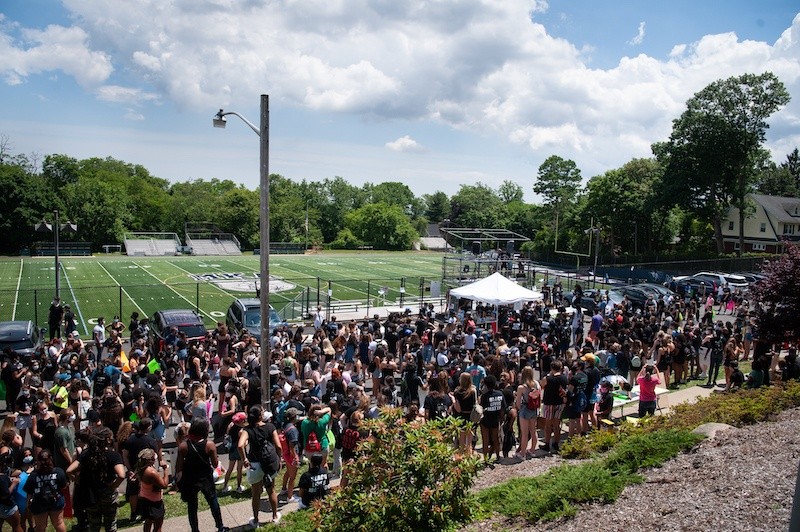
Courtesy of Kate Albright, published on MontclairLocal.news
On the 155th anniversary of Juneteenth, a movement was brewing on Lloyd Road. Just in front of Montclair Kimberley Academy, an aura of restlessness from the congregation of protestors emanated throughout Montclair — restless both to hear the voices of peers and mentors joined in song and speech and for their own voices to finally be heard and recognized by the rest of America. As my father, my younger sister, and I, dressed in black and carrying a Black Lives Matter sign drawn by my sister, walked to join the bustling crowd, the magnitude of this gathering became increasingly clear.
Not long after our trio settled in, a voice boomed from the announcer’s booth kicking off a series of speakers: a performance of “Lift Every Voice and Sing” as heartfelt as it was refined. A passionate call-and-response prompting everyone to shout George Floyd’s final words, “I can’t breathe!” A devastating testimonial describing a student’s encounter with the ignorance of a once-loved teacher, with the true sadness in the story laying in how lost the student felt not knowing how to respond.
Each word uttered by every speaker was regarded with the utmost respect and attention. It seemed a far cry from the neglect the Black speakers have experienced that led to this moment, emblematic of the historical neglect against their Black ancestors. Among the speakers announced was a familiar name, and as I explained who it was to my sister and father, Jordan McCray-Robinson began to speak.
I had the opportunity to ask Jordan some questions about her experience on that Juneteenth rally. Her insightful responses speak for themselves:
JK: How did you become involved with the MKA BLM rally?
JMR: I had come across the MKA BLM movement through social media. During the “thick” of it, there was an abundance of information on social media at one time, so I took a glance at the flyer but hadn’t proceeded with what I was reading and the importance of the rally. Once again, one of my friends from a neighboring PWI [Predominately White Institution] brought the rally to my attention, felt like I would be a good speaker from my past experiences, and contacted the organizers.
JK: What was your experience finding the right words to say and actually standing in front of the crowd to say them?
JMR: This is a good question…I don’t think it was a matter of saying the “right words”; it was more of speaking my truth. I believe that the killings of [George] Floyd and Breonna [Taylor] were very telling about the society we live in. As a young person who was talking to other young people, it was imperative to find the words that depicted my existence as not only a Black person but as a Black woman. Finding the words was challenging because there were so many emotions swirling throughout my head, and I had so much to say. Still, I knew by the end of the testimonial [that] I wanted the audience to walk away with an understanding of the intersectionality of being Black and…female. I wanted to highlight the importance of education of Black students everywhere and especially at [a] PWI.
JK: You spoke about your intersectional experience as not only being Black, but being a Black woman. Can you talk about your relationship with the politics of respectability and the Angry Black Woman stereotype?
JMR: My first paragraph of my speech was “Above all, I’m Black, but I’m also a woman. My intersectionality can be challenging at times. Because of this intersection from time to time, I found myself trying to ‘control’ both sides of me because I wanted people to respect me. I didn’t want my anger to cause people not to hear the things that I was trying to say.” I think this speaks for itself and how time and time again Black women have been silenced or people have attempted to silence Black women by highlighting them or mitigating their trauma/feelings in [everywhere] possible.
JK: What are your thoughts on the Louisville settlement in response to the shooting of Breonna Taylor?
JMR: If I’m being quite honest, although the settlement money is a huge win for Breonna Taylor’s family, I think it’s absolutely appalling that the cops who shot a woman in her sleep have not been arrested and it’s been more than 6 months since her passing [–] no, murder and there has been no justice. It’s also extremely upsetting that America has painted “BLM” on streets, made shirts, masks, named a law after Breonna but still hasn’t served her or her family justice.
JK: If you could extract just one takeaway or message from your speech for the Newark Academy community specifically, what would it be?
JMR: A direct quote from my speech is “[we] are done with accepting ‘good enough’ or ‘I’m not racist’ from institutions, silence is unacceptable, neutrality is unacceptable — if you are not actively an anti-racist, you have already chosen your side.” I think this is pretty self-explanatory. Black Lives Matter is not a political statement, and it has never been. Institutions should never “hide” or “standoff to the side” when Black lives are under attack. Black Lives is a question of humanity and morality. I believe that all PWI[,] not only NA[,] have an obligation to [not only] academically teach their students[,] but also foster learning to become compassionate people of the world….
JK: Being such an involved member of the NA community, how do you and how will you continue to implement the ideals reflected in your speech in the groups you are a part of?
JMR: I try [to] encourage all groups I am [a part of] to “think outside of themselves.” I think no matter what our backgrounds may be, to a certain extent, there are privileges that we all have. Sometimes, living in our NA bubble, the injustices we see…happening in other places seem so [distant]. Still, on the contrary, social injustice happens everywhere, so I think it’s essential that as a community, we’re always aware, and when the community slips, we take accountability.
Thank you for your time, Jordan!
Leave a Reply
You must be logged in to post a comment.