By Catherine Orr ‘22, Commentary Editor
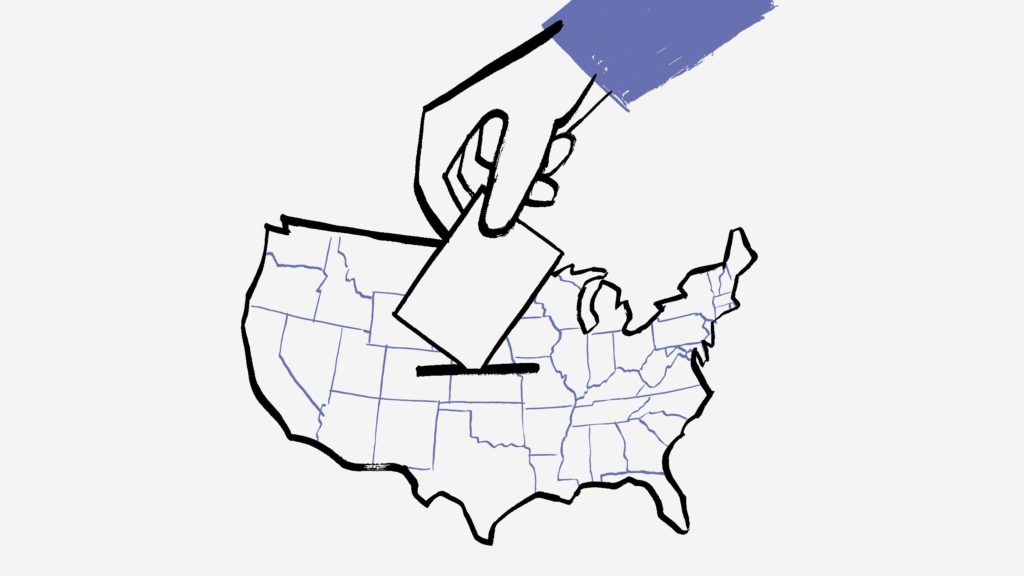
America is supposed to be the epitome of democracy, the shining beacon of hope for those lacking it. However, after this past election, we aren’t looking so democratic. You’ve probably heard of Trump’s refusal to concede defeat to Biden: complaining about the vote count, filing lawsuits to have ballots thrown out, and trying to prevent the transition of power from occurring. His refusal to leave office with no proven evidence more resembles the behaviour of a dictator. While I would entertain this effort if he had won the popular vote, I’m even more taken aback given the fact that he lost it by more than five million votes. But this effort to delegitimize Biden’s win by ignoring and overruling the will of the people and the results, is not new. The electoral college system has been imitating this behaviour for centuries. Our voting system is outdated, and has flaws that, frankly, outweigh its benefits.
Five times in the past the president has been elected based not on the popular vote, but on the work of the electoral college system. Most recently in 2016, Hillary Clinton received almost three million votes over Trump, yet the electoral college secured his win. This is because a state’s number of electors is based on total population, not actual voters. As of this year, a state like Wyoming has three electoral votes, one for every 190,000 residents. California, on the other hand, has fifty-five electoral votes, one for every 715,000 residents. This means each individual Wyoming vote weighs 3.6 times more than an individual Californian’s vote. In fact, a study done by the Washington Post found that, “if you average the 10 most populous states and compare the power of their residents’ votes to those of the least 10 populous states, you get a ratio of 1 to 2.5.” Because all but two states (Maine and Nebraska) use the winner-take-all system, it allows someone who won the popular vote to lose the election. It’s hard to come across this information and not wonder why we are still using a system that allows this to happen.
In fact, it makes me wonder why it was instituted in the first place. Created by the 12th amendment, the Electoral College was made to balance out the overwhelming power of states with larger populations, which, at the time, were northern states with more modern ideas, namely the abolition of slavery. And so it was brought by the founding fathers along with the three fifths compromise, counting each slave as ⅗ of a vote in order to strengthen the power of white, male slave-owners in controlling the elections. Flash forward to the present, the electoral college is still stifling the opinions of minority voters, the majority of whom live in more populous and urban areas. African Americans, Latinos, and Asian-Americans disproportionately live in populous states. Take California and Wyoming, which I’ve already mentioned have a disproportionate value of voters. The two states hold two very different populations. The difference being that Wyoming holds a less racially diverse population, with 84% being white, while California is much more diverse, with no racial or ethnic group making up a majority of the population. So, the electoral votes not only count Wyoming citizens’ votes as more than Californians, but are in turn ignoring the voices of many minority voters and instead focusing on the voices of white voters.
This is bad for an array of processes; policy making and voter turnout being two of them. Because electors are based on the total population, states have no incentive to enfranchise new groups of people or to make it easier for those already eligible to vote. Furthermore, candidates have little reason to campaign and appeal to voters in many areas other than the battleground states. In the 2016 presidential election, two thirds of the general election campaign events were held only in Florida, North Carolina, Pennsylvania, Ohio, Virginia, and Michigan, all considered battleground states. This means candidates spend more time addressing the issues of swing states than others, resulting in more policies centered around the swing states.
For the past few months, when scrolling through my instagram feed or my tiktok for-you page, I’ve seen post after post urging me to “go out and vote!” Celebrities posted wearing their “I voted” stickers, and I even passed by houses with big “VOTE” banners hanging from their porches on my way home from school. Being a seventeen year old with two green-card parents, I don’t have much experience with voting in America. One thing I do know, however, is that our right to democracy is essential, and how can we preach this democracy to everyone else if we ourselves cannot follow it? Every American voice deserves to be equally heard, and that cannot happen until the electoral college is abolished.
Leave a Reply
You must be logged in to post a comment.