By Navyaa Jain ‘23, Social Justice Writer
On November 3rd, 2020, for the first time in 100 years, a record number of Americans—nearly 160 million—voted in the presidential election. While the country had millions of people turn out to vote on Election Day, the pandemic caused many to vote early through mail-in ballots. This option gave voters the ability to cast their votes weeks in advance of Election Day by mailing in their ballot or dropping it off at a ballot drop-off site. Early voting was a popular choice among Democrats, who beat Republicans with early ballots in key states like Pennsylvania and Georgia, but the absence of Republicans was not surprising due to the disparagement of mail-in voting by President Trump and his supporters. Knowing in advance how absentee voting was a threat to Republicans, Texas’ Gov. Greg Abbott issued an order aimed at suppressing Democratic, minority, and anti-Republican votes.
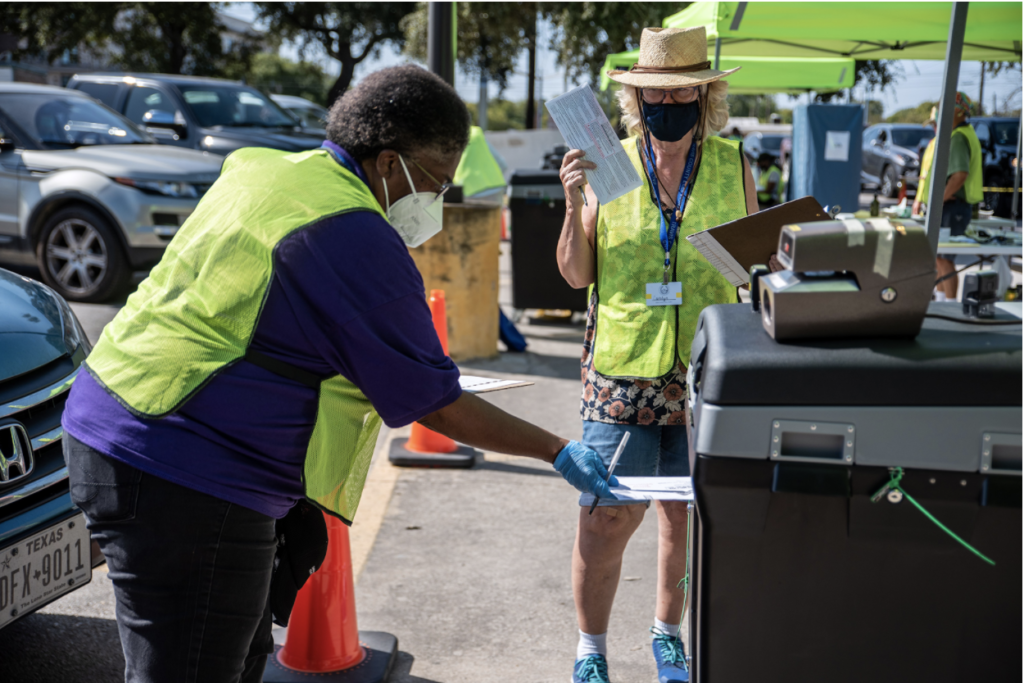
On Oct. 1st, Gov. Greg Abbott created a rule stating that only one drop-off location would be placed in each county regardless of its size or population. Defending his order, the Governor established it as a measure against election fraud and claimed it would “help stop attempts at illegal voting.” However, in a state with about 17 million eligible voters, reducing the number of drop-off sites unnecessarily leads to longer lines, delays, and greater exposure to coronavirus.
Limiting the number of drop-off sites is simply one part of the order. Rather than place the drop-off sites in places that are most convenient for large populations of voters, the government placed them in strategic locations away from democratic and minority voters. Before the order was issued, Dana DeBeauvoir, the clerk for Travis County, had planned to establish three drop-off sites in Austin, the capital of Texas, with nearly 850,000 eligible voters. However, after being blindsided with the new requirements, she was forced to reorganize her initial plans and was given the impossible task of choosing one site that would be accessible to a majority of voters.
Gov. Abbott was not only aware that this would hurt large and populous areas but passed the order specifically aiming to reduce the number of votes there. Large cities like Austin were known to lean Democratic and represented more minority voters than any other parts of the state, becoming the largest threat to Texas’ reputation as a red state.
Still, crowding drop-off sites and forcing voters to travel long distances was not the only way that the order aimed to restrict minority votes. In counties such as Harris County which have multiple Democratic districts, drop boxes were placed in predominantly white and Republican areas. Recognizing the loopholes and the intended goal of the rule, opponents of the order sued the governor on the count that it exceeded the limits of his authority and was an active attempt of voter suppression.
Unfortunately, on Tuesday, Oct. 27th, the Texas Supreme Court decided to side with the governor and allowed the rule to continue, claiming that it “doesn’t disenfranchise anyone” and mailing in the ballots was still an option, whether or not voters wanted to drive to a drop-off location. Not only did they fail to acknowledge the troubles that low-income communities have in voting by mail such as unstable housing, lack of internet access, and language barriers, but it also refused to consider the extra complications that the pandemic brought on.
By giving the second largest state in the United States the bare minimum of 12 drop-off locations, the government of Texas successfully complicated the process of voting for minorities and low-income families, allowing them to maintain the Republican reputation of the state. Although there is currently no data that allows us to analyze whether the attempt was successful, the fact that an attempt was made does not bode well for America’s leadership. The irony remains that in the attempt to ensure “election integrity,” the governor ignored his promise of integrity to all citizens of Texas.
Leave a Reply
You must be logged in to post a comment.