By Nitya Gupta ‘23, Social Justice Writer
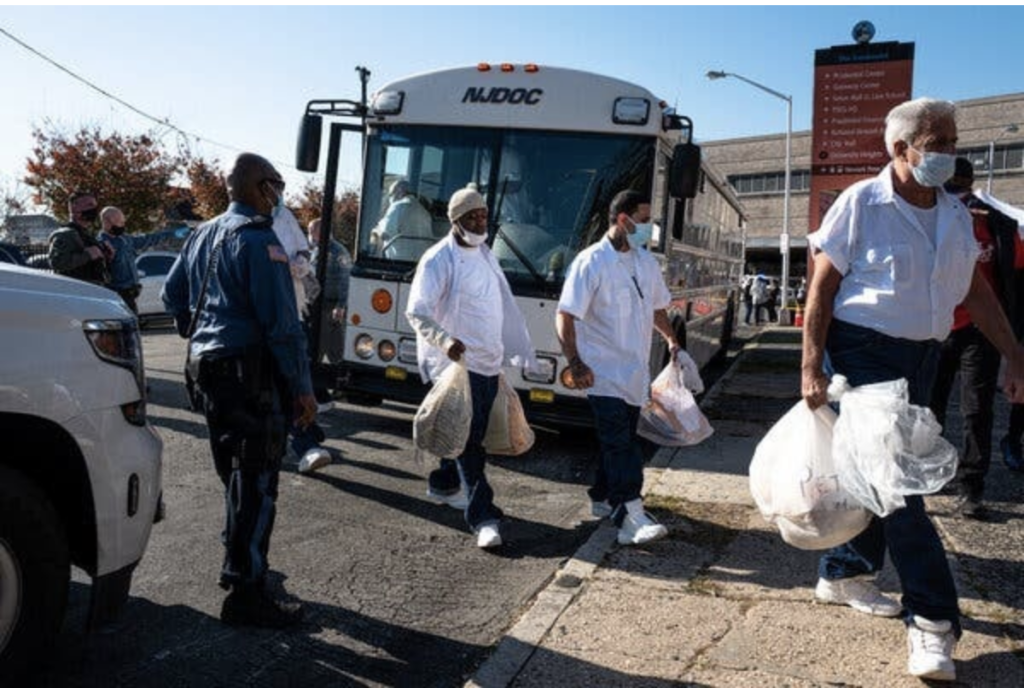
Since the COVID-19 vaccine rollout and distribution began in the United States, there has been an ongoing debate on who shall receive the vaccine first. However, it seems as if the American public and government officials have dismissed a large, yet forgotten, group of people that have been severely affected by the Coronavirus: the US prison population. The largest outbreaks in the country have been in correctional facilities and detention centers, like the Marion Correctional Institution, with 2,443 cases, Miami-Dade County Jail, with 2,099 cases, and Ohio’s Pickaway Correctional Institution, with 1,791 cases. In fact, according to the New York Times, more than 510,000 people have been infected and at least 2,200 inmates and correctional officers have died in prison since last January. With numbers on the rise, it is imperative that American jails and prisons take an active role to combat the virus, yet most are still struggling to take precautions to stop the spread.
Even before the Coronavirus, the US prison system was the subject of public health concerns with the chronic overcrowding of prisons, lack of funding for cleaning supplies, and unhealthy living conditions. “Prisons are vectors of disease, as are jails,” warned Pamela Metzger, director of the Deason Criminal Justice Reform Center at Southern Methodist University’s law school. “They are filled with people who enter with preexisting health conditions, many of which may be undiagnosed. You have cramped living conditions with exceptionally poor nutrition. Ventilation is problematic in many places. You have limited access to medical care.” Furthermore, inmates live together in extremely close proximity, making the average prisoner a massive superspreader. It’s no wonder that incarcerated people are nearly five times more likely to test positive for the coronavirus than the average American, and nearly three times as likely to die.
In an effort to get a handle on the COVID-19 situation, some correctional facilities have been taking steps to reduce the number of people exposed to the virus within their buildings. California’s San Quentin State Prison had the largest known Coronavirus cluster in the country after more than 2,600 incarcerated people and staff were infected and about 28 incarcerated people had died. A court ruling in October 2020 ordered San Quentin to reduce its population by half, about 1,700 inmates, as a way to safeguard prisoners by allowing for sufficient spacing for physical distancing, citing the Eighth Amendment for “cruel and unusual punishment.” Many experts agree that decarceration and releasing prisoners is the only way to flatten the Coronavirus curve. However, many detention centers and correctional facilities have been shut down without enough staff to maintain prison security, leading to thousands of inmates being transferred elsewhere. It has become abundantly clear that this is not an effective solution. An inmate released from San Quentin this year, James King, has said, “Merely moving people from one overcrowded prison to another overcrowded prison does not reduce the risk for outbreaks. It’s mitigating one potential hot spot by adding to others.”
Experts say that there needs to be more testing in prisons and jails, a better distribution system of personal protective equipment (PPE), and priority access to vaccines for at-risk prisoners. While many public health officials and scientists have advised that incarcerated people and correctional officers should be put on the priority list for the vaccine, there has been a public and media backlash towards this. The state of Colorado released a draft vaccine distribution proposal in October that prioritized incarcerated people, putting them at the same point in line as frontline essential workers. This policy was met by bipartisan opposition, conservative media such as Fox News declaring “convicted murders will get immunized before grandma,” and Democratic Governor Jared Polis remarking, “There’s no way it’s going to prisoners before it goes to people who haven’t committed any crimes. That’s obvious!” As of right now, only seven states are following recommendations to specifically prioritize incarcerated people, and about 20 states are prioritizing corrections staff before inmates.
This pandemic has brought many problems with the criminal justice system to the forefront. The United States has the largest prisoner population in the world due to mass incarceration, a product of systemic racism that has recently also been highlighted by the Black Lives Matter movement. Public officials have to look at the flawed prison system as a whole and change the way we treat inmates and parolees in society. “What you have is, on the one hand, a really urgent public health need to prioritize both corrections staff and incarcerated people,” says Sharon Dolovich, director of the UCLA Prison Law and Policy Program. “On the other hand, you have at least four decades of tough-on-crime rhetoric which has primed the American public to think of people in custody as somehow less than human and less deserving.”
Leave a Reply
You must be logged in to post a comment.