By Navyaa Jain ‘23, Social Justice Writer
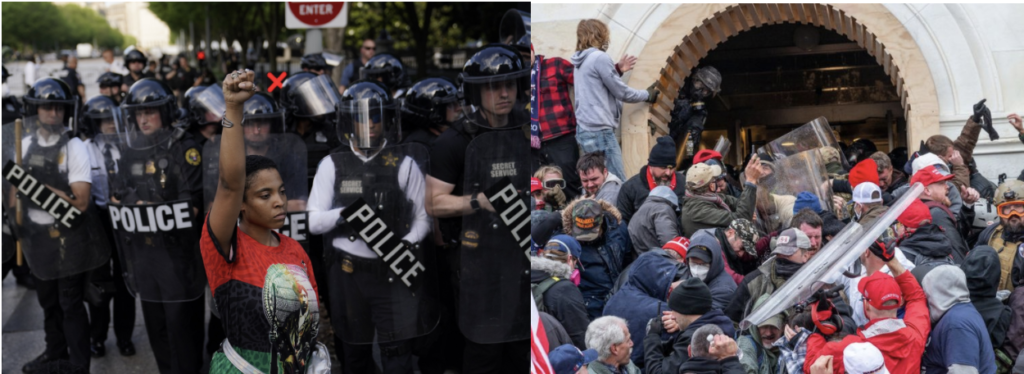
Photo Courtesy of Getty Images
On January 6, 2021, the day set by the Constitution to certify the election results, America’s Capitol, the center of its democracy, was breached for the first time in 200 years. Thousands of Trump supporters stormed the Capitol and incited chaos in the name of President Trump. The central claim of their riots: a supposedly rigged election that led to his loss. As these Trump supporters broke windows and entered the Capitol, the police response to their violence drew questions and comparisons to the Black Lives Matter (BLM) protests last year.
On May 25, 2020, Minneapolis police killed George Floyd in an act of racially charged police brutality, an act caught in a video that spread across the country and resulted in public outcry. To protest his death and the death of countless other black people like Breonna Taylor, Atatiana Jefferson, and Rayshard Brooks at the hands of a systemically racist police system, protests ensued across the country. While protesters remained peaceful and spread their message with words, about 54% of the time they were met with tear gas, rubber bullets, and arrests from local police—and even the National Guard. Overall, according to the Armed Conflict Location & Event Data Project (ACLED), more than 9% of peaceful protests regarding BLM were met with government intervention, compared to the usual 3% for any other movement, including local Trump rallies.
Police reaction to the peaceful protesters could not have been more different than their reaction to the Capitol rioters. While the police took selfies with the rioters at the Capitol, they sprayed tear gas at peaceful BLM protesters. The police helped rioters walk down the stairs of the Capitol building, but they felt no obligation to help Black protesters fighting for their lives. To prepare for the BLM protests, the DC National Guard lined the steps of the Lincoln Memorial before protesters arrived, but because the police do not consider white rioters a threat, they had already made it into the Capitol before the DC National Guard was activated. Therefore, spearheading the false claim that the 2020 election was tampered with, Trump supporters were able to break down the doors of the building and run rampant throughout the complex.
Since the riots, Republican lawmakers and supporters of President Trump have been trying to justify the Capitol rioting by misrepresenting the BLM movement as violent and destructive. In an effort to prevent Trump’s second impeachment, Republican Rep. Matt Gaetz of Florida defended Trump, saying “You can moan and groan, but he was far more explicit about his calls for peace than some of the BLM and left-wing rioters were this summer when we saw violence sweep across this nation.” This statement is not only wrong but it also represents the hypocrisy in American politics. After analyzing 7750 different BLM demonstrations across the country, the Armed Conflict Location & Event Data Project (ACLED) reported that over 93% of them were peaceful, while fewer than 220 were classified as violent. On top of that, many of the BLM protests considered “violent” were made dangerous by counter-protesters or the police who fired the first shot at protesters and instigated chaos.
Racial inequity and hypocrisy in criminal justice have been perpetuated for years, and the difference in treatment of BLM protestors and Capitol rioters is just one result of a racially biased system. According to the Economic Policy Institute, “an African American child is six times as likely as a white child to have or have had an incarcerated parent.” Being a certain race does not predispose someone to commit a crime, but it does result in differences in incarceration due to systemic racism in the criminal justice system. For example, when Congress passed the Racketeer Influenced Corrupt Organizations (RICO) Act to stop white violence and mafia crime, which largely was carried out by White men, a 2012 study found that 86% of federal prosecutions of RICO targeted racial minorities. Law enforcement and policymakers did not act uniquely with RICO and continue to act the same way, demonstrating the systemic racism in the implementation of our criminal laws and their unwillingness to accept that bias is prevalent.
The attempts to equate the BLM protests and the Capitol riots only highlight the same systematic racial bias that the BLM movement continues to speak out about. Although it is important to discuss the fact that police racially profiled black protesters as dangerous while allowing white supremacists into the capitol building, that is where the discussion should end. In no way can an act of domestic terror be equated to a civil rights movement. As President Biden said, had the protesters been black, they would have been treated “very differently than the mob of thugs that stormed the Capitol.”
Leave a Reply
You must be logged in to post a comment.