By Trisha Bala ‘22, News Editor
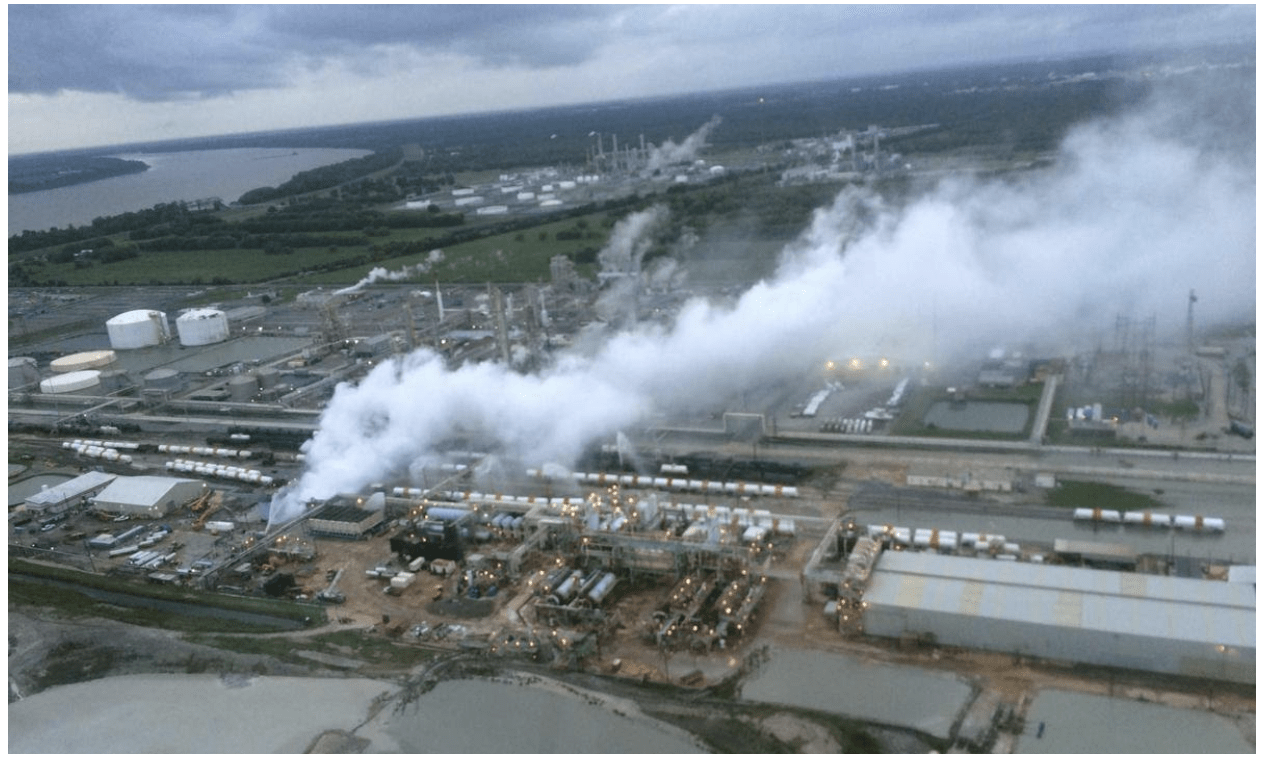
The burden of poor air quality is not evenly distributed among all communities. Lower class communities as well as certain racial and ethnic groups bear the majority of this burden. One predominantly African-American community in Louisiana is located on a part of a strip of land nicknamed “Cancer Alley” due to the heavily polluted air. Cancer Alley is an 85-mile stretch along the lower Mississippi River between Baton Rouge and New Orleans. It has served as an industrial hub for decades and has chemical facilities, plastic plants, and over 150 oil refineries. The area is also home to descendants of enslaved workers. Studies have shown that this community has suffered from cancer, diabetes, and respiratory diseases at higher rates than Louisiana as a whole and most of the country. In fact, the risk of getting cancer from air pollution in Cancer Alley is 95% higher than in the rest of the US.
In the 20th century, Louisiana underwent an economic transformation, shifting from farming to industrial production. Chemical plants were first centralized around Baton Rouge and New Orleans. As the decades passed, these plants started to spread. In the 1950’s, chemical manufacturers looking to build plants wanted to avoid densely populated areas, thus leading them to towns like St. Gabriel, a predominantly black and lower-income community. According to Craig Colten, a professor of geography and anthropology at Louisiana State University, “Given prevailing racial attitudes, these communities were, in effect, invisible.” Residents of St. Gabriel, hoping at one point that the industry would at least bring employment, instead found only 9% of their community holding full-time industry jobs.
Plans to build even more plants in or near communities that already have the most dangerous air quality in the US have caused outrage amongst community members. A hospital receptionist from St. Gabriel, Terry Frazier, said, “Out of every 10 houses, there’s a prospect of one or two people that have died of cancer.” Frazier’s grandfather and her stepmother died of cancer and Frazier has respiratory issues. She blames the 600-acre petrochemical facility near her house. Residents of St. Gabriel and the surrounding towns are not willing to let the families and children be negatively affected by the plants and have started to campaign against new chemical plant construction. Hazel Schexnayder, a resident of St. Gabriel said that by the 1990’s she was tired of seeing neighbors suffering miscarriages and dying from cancer as well as the constant stench of rotten eggs and nail polish lingering everywhere. A St. Gabriel pharmacist in the 1980’s kept track of the local pregnancies and found that one in three ended in miscarriage. The EPA (Environmental Protection Agency) modeling estimates that the danger posed by industry shows ample reason for concern. Near a neoprene plant in St. John Parish, the EPA estimated the concentrations of cancer-causing chemicals are among the highest in the country. The same is true for the section of St. Charles Parish, which is near the Union Carbide plant, a major emitter of ethylene oxide.
Community leaders started fighting for incorporation in the 1990’s. They wanted to see their town finally receive the attention it desperately needed. In 1993, a proposal by Supplemental Fuels Inc. gave the community leaders the power they needed to transform into a fully fledged movement. Residents started putting up anti-SFI posters as well as pro-incorporation posters on their yards. Then in 1994, the plan for incorporation passed. Since then, no large plants have been permitted to be built in St. Gabriel. Additionally, the leaders of St. Gabriel can decide if a property is zoned as industrial, residential, or commercial. This allows the residents to have more of a say in what is built. Additionally, the city leaders of St. Gabriel now represent the population in terms of diversity; the mayor as well as the five-member city council and the police chief are all black. To this day, St. Gabriel is seeing mixed results of its plan. The city infrastructure is better but the community still deals with other issues like crime and poverty. It is still crystal clear that to this day, the industry has brought no prosperity to communities like St. Gabriel. The poverty rate remains 29%, far above the state’s rate of 20%. However, it is important for the residents of towns like St. Gabriel to speak out and share their stories as that is the only way in which conditions will improve.
Leave a Reply
You must be logged in to post a comment.