By Dina Drogin ‘23, Commentary Writer
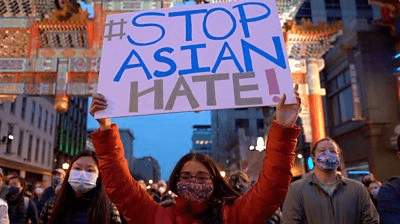
On March 30th, Newark Academy held a meeting titled “Historicizing Asian Violence” that allowed students and faculty to discuss the shooting in Atlanta and the history of Anti-Asian hate in the context of patriarchy and white supremacy. Hate crimes against Asian Americans in New York City jumped from three in 2019 to thirty-five in 2020, almost certainly due to the increase in xenophobia prompted by Donald Trump calling the Coronavirus the “Chinese Virus.” Recently, a man went on a shooting rampage in the Atlanta area, killing eight people, six of them being Asian American women. The Newark Academy zoom meeting, co-hosted by Young Women of NA, Young Men of NA, and the Equity and Inclusion Team (EIT), explored the history of Asians in America to show that violence against Asians was prominent before the pandemic and the Atlanta shooting.
Many Chinese immigrants arrived in the United States in the 1850s to work in mines and to help build railroads. At that time, Asian Americans were not allowed to testify in court, depriving them of their right to protect themselves against violence. Multiple massacres directly targeted Chinese workers. For example, in the Rock Springs Massacre, twenty-eight Chinese people were killed and another fifteen were injured. Anti-Asian sentiment began to grow. The United States stopped encouraging Chinese immigration and negotiated a trade agreement that eventually led to the Chinese Exclusion Act in 1882. Asian women were already excluded in the United States under the Page Act of 1875, which marked the end of open borders by prohibiting immigration of Chinese women. As Ms. Edwards, A.P. U.S. History teacher and Upper School Director of Equity and Inclusion, pointed out during the meeting, Asian hate and misogyny have been present in the United States since the 19th century.
After students and faculty members put the recent events in context, Mr. Guiteau, director of EIT, opened breakout groups to allow students to discuss what support and change they want to see from Newark Academy. The overall consensus from students was to incorporate a wider history in our humanities curriculums, similar to the history lesson students received during the zoom meeting by Ms. Edwards. However, the proposed curriculum change was not limited to the humanities department. Newark Academy should include stories or novels from Asian authors in English classes and highlight Asian voices in the STEM department.
It is important to take action outside of the classroom, as well. Juliet Bu ‘23, a leader of a rally in response to the Atlanta shooting, said, “Last March the initial wave of anti-Asian hate crimes made me rethink my Asian American identity. After attending the New Jersey Student of Color Conference last February, right before COVID-19, my Asian American identity moved to the forefront of my mind, and I was enraged by the lack of acknowledgment of Asian American racism. Atlanta brought forth the deadly realities of ignoring racism for so long.”
It is important to learn about the extensive history of racism. However, it is just as important to take action. As Juliet mentioned, “Accountability is a huge part of action. Sign petitions and check in with your representatives to ensure that they are making your voice heard in the places where it matters the most.” The Newark Academy community needs to take action to combat racism, whether that is in the form of an expanded curriculum, discussions, or participating in rallies. It is inspiring to witness strong Asian-American student voices directly impacting the world we will be entering. However, we must remember the long history of our country as we look to change the future.
Leave a Reply
You must be logged in to post a comment.