
By Max Gorbaty ‘22, News Writer
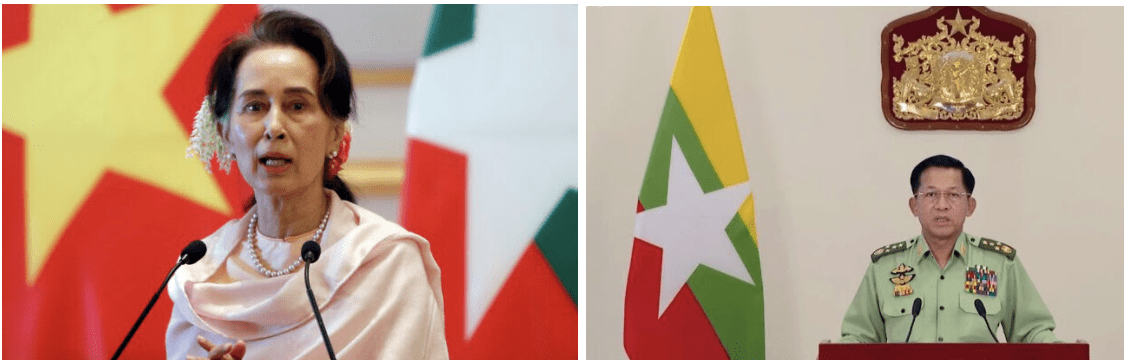
On the morning of February 1, 2021, the Tatmadaw—Myanmar’s military—seized control of the government. Democratically-elected leader Aung San Suu Kyi and members of her National League for Democracy (NLD) party were detained. Military commander-in-chief Min Aung Hlaing, the leader of the coup d’état, was put in charge of the country.
Background
Myanmar, also known as Burma, has dabbled with democracy since the military seized full control in a 1962 coup. The military attempted at democracy in 1990 after nationwide protests and civil unrest broke out. Free elections were allowed under the assumption that the military would enjoy popular support, but Aung San Suu Kyi and the NLD won in a landslide victory. The military refused to cede power and placed Aung San Suu Kyi under arrest.
In 2008, the Constitution of Myanmar was drafted. In 2011, after another 22 years of full-military control, the country began transition to a quasi-democracy in which the military maintained substantial influence over parliament. Elections were held in 2015 and resulted in victory for the NLD. During the 2020 general election, the margin of victory for the NLD was even larger than 2015—the pro-democracy party garnered 396 out of 476 seats. History seemed to repeat itself as the military claimed the election results were fraudulent and again arrested Aung San Suu Kyi, cabinet members, NLD members of parliament (MPs), and opposition writers and activists.
How it happened
The coup was announced on the military-owned Myawaddy TV station and a state of emergency was declared. The military invoked the 2008 constitution as the legal basis for its takeover but the NLD has rejected those grounds. During the coup, the government promptly suspended air travel and television broadcasts in addition to cancelling telephone and internet access in major cities. 400 MPs were placed under house arrest and a closed-door trial for Aung San Suu Kyi has begun. The trial will likely be used as justification by the military for keeping Aung San Suu Kyi in detention as long as possible.
Protests and military response
Protests, often led by younger citizens, have erupted across Myanmar in response to the coup. Protesters demand that Aung San Suu Kyi is freed and the Tatmadaw return power to civilian control. Hundreds of thousands of white and blue-collar workers have taken part in a civil disobedience campaign by leaving their jobs, putting the Burmese economy into a standstill. Many protesters have built barricades to defend neighborhoods and have started training in basic warfare techniques. Others have participated in a pot-banging protest, which consists of a group of people making noise by banging pots, pans, and other utensils to call for attention.
Troops have used water cannons, rubber bullets, and live ammunition to crack down on protests. The military has killed over 500 peaceful protesters, among them children. The Myanmar military has also conducted airstrikes in territory controlled by ethnic armed groups such as the Karen National Union (KNU). The Myanmar junta, the small group of military leaders controlling the government after the coup, has since offered a ceasefire with the KNU.
International reaction
Numerous western countries have condemned the military takeover. The US, UK, and European Union have sanctioned military officials in Myanmar. Furthermore, New Zealand has suspended diplomatic ties with Myanmar. The United Nations Security Council has urged “the restoration of democracy” and the UN Special Envoy to Myanmar has warned that anti-military protesters face a “bloodbath” if the international community does not take action.
China, one of Myanmar’s biggest investors and allies, blocked the UN Security Council statement condemning the coup. China is wary of intervening, although it has spent decades fostering a relationship with the NLD and Aung San Suu Kyi to extend its influence over Myanmar.
The military’s bid to reassert its political dominance over Myanmar has again resulted in bloodshed and chaos. However, this time, the fate of absolute military rule in Burma may very well depend on China’s decision to either back the Tatmadaw or continue practicing non-intervention.
Leave a Reply
You must be logged in to post a comment.