By Navyaa Jain ‘23, Social Justice Editor

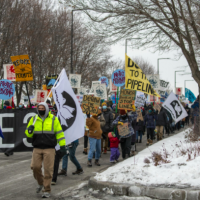
Indigenous groups protest Line 3 construction in Northern Minnesota.
Image courtesy of Michael Siluk/Education Images/Universal Images Group via Getty Images
Line 3—a crude oil pipeline extending from Alberta, Canada to Wisconsin, USA—has sparked heated debates between Enbridge Inc, a Canadian oil company, and numerous groups, including Native American tribes, environmentalists, and religious leaders. Enbridge, Canada’s largest oil corporation and operator of the pipeline, proposed a $9 billion expansion of Line 3 that would include replacing old infrastructure, increasing proportions, and transporting a million barrels of oil a day.
This expansion raises concerns about the environment, including damage to Minnesota waterways, food resources, and the climate. The Sierra Club, an environmental organization, released a statement saying “this expansion would be disastrous for the fight against climate change as it would add 193 million tons of CO₂ into our atmosphere, which is more than the entire state of Minnesota currently emits and is equivalent to adding 50 new coal power plants or 38 million new vehicles to the road.” Extending the length of the pipeline also violates Native American treaty rights by building on Anishinaabe land and threatening the safety of its residents. Enbridge’s previous issues with safety also heighten concerns. According to the National Transportation Safety Board, Enbridge was responsible for over 800 spills from 1999 to 2010 and has numerous employee arrests for violence against Indigenous women.
Seeing the detrimental impacts of Line 3, protesters have been calling not only for a halt on construction but for a complete shutdown of the pipeline. Recently, Line 3 damaged a sensitive aquifer, prompting a $3.3 million fine from the Minnesota Department of Natural Resources. While the department did take action, a small fine does not make up for the irreversible loss of an entire wetland region. Some might say it is the first step and could amplify protestors’ voices, but these actions are too late. Minnesota policymakers still refuse to listen, as they have arrested upwards of 600 Line 3 protestors over the course of these past few months.
Ms. Duszak, Upper School Equity & Inclusion Coordinator and Faculty Advisor of Green & Blue Committee, has been on the front lines of the DC protests, one of the largest efforts to have Line 3 addressed in Congress. Recalling her recent experience, she says “it felt like a meaningful act of solidarity to be marching with organizers from Honor the Earth in Washington DC while so many Indigenous Water Protectors are literally risking their lives every single day on the front lines.” Those same organizers and activists are the ones directly asking legislators, including Senator Amy Klobuchar of Minnesota, to comment on Line 3 and the case made against Enbridge. However, rather than speak on the issue, they ignore it, like Klobuchar, who walked away from the crowd, ignored her constituents’ questions, and neglected her role as a representative of the people.
Activists have also partnered with large-scale human rights organizations to hold the Biden administration accountable. On August 31, following an appeal made by Indigenous organizations Honor the Earth and Giniw Collective, the United Nations Committee on the Elimination of Racial Discrimination (CERD) sent a letter to the US Government asking them to address the violations of Anishinaabe treaty rights.
Biden’s mission to address climate change and equity as core parts of his agenda conflict with his approach to Line 3. Promising action, Biden claimed, “The United States must be in a position to exercise vigorous climate leadership in order to achieve a significant increase in global climate action and put the world on a sustainable climate pathway.” Despite halting the construction of the Keystone XL pipeline during his first few days as President and appointing the first Native American Cabinet Secretary in US History, Biden’s lack of response to Line 3 raises questions from voters about the motives behind his actions. Despite the fact that both pipelines have the same dangers, halting Keystone early in his Presidency sent a powerful political message that helped Biden more than stopping Line 3 would help him now. As Biden also pushes his $3.5 trillion budget reconciliation package for environmental justice and clean energy, his disregard for Line 3 kills confidence and hope for his climate change endeavors.
There is a clear message that can be seen from the protests and efforts of Indigenous activists. As Ms. Duszak said, “The collective power of the people around me was a reminder to keep up the fight and that so many of us will not stand by and be silent while this administration that ran on environmental justice, racial justice, climate justice, AND transitioning away from fossil fuels refuses to even speak on Line 3.” Rather than holding out hope that the Biden administration will wake up and decide to discuss Line 3, the country needs to mobilize and uplift its activists. Despite the constant developments in the movement, media coverage has stalled since early August, with major news outlets staying silent on the issue. Indigenous and activist voices need to be heard, uplifted, and taken seriously by everyone, especially by those in Congress. To take action and hear more about the new developments, you can check out stopline3.org or follow @honortheearth on Instagram. Write your representatives, talk about it with friends, and most importantly follow the movement to stay educated; environmental stewardship is not just about speaking out, but about listening to those who are directly impacted and advocating from the front lines.
Leave a Reply
You must be logged in to post a comment.