By Arjun Khanna ‘23, Staff Writer
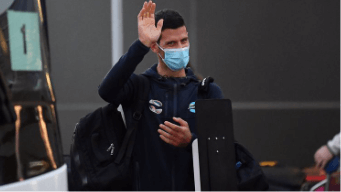
In tennis, the grand slam tournaments, which include the US Open, French Open, Wimbledon, and Australian Open, are considered to be the most prestigious for many reasons including their history, size, prize money, and ranking points. Novak Djokovic, the current top ranked tennis player in the world, has won an all-time record of 20 grand slam titles, tied only to tennis legends Rafael Nadal of Spain and Roger Federer of Switzerland. Another Grand Slam title would be particularly momentous for Djokovic, putting him in contention to be considered the greatest tennis player of all time. However, Djokovic relinquished his bid to win a 21st grand slam at the Australian Open after refusing to get tested for COVID-19.
The Australian Open is the first grand slam tournament of the year, held annually in Melbourne Park throughout January. In late 2020, Australia announced that they would be imposing a vaccine mandate for all of those entering Australia who weren’t citizens or permanent residents. This meant that most players participating in the Australian Open would be required to be double-vaccinated.
Djokovic had publicly expressed his anti-vaccination status before the vaccine mandate, saying in one instance: “Personally, I am opposed to vaccination, and I wouldn’t want to be forced by someone to take a vaccine.” It was not until January 4th that Djokovic announced that he would be playing in the Australian Open with a medical exemption allowing him to remain unvaccinated. However, it was only after Djokovic landed in Australia that the 10-day Djokovic vaccination saga began.
Upon arriving in Australia, Djokovic was informed that his visa was canceled after he had “failed to provide appropriate evidence” for receiving a vaccination exemption. Without a valid VISA, Djokovic would be deported from Australia and would be unable to participate in the Australian Open. In an attempt to keep his Australian Open hopes alive, Djokovic put together a legal team to challenge his VISA cancellation. While Djokovic’s case was being deliberated, he was granted a temporary stay in a quarantining hotel in Melbourne.
Djokovic’s lawyers explained in court that the tennis player’s medical exemption was granted on the grounds that he had tested positive for covid-19 on December 10th and thus couldn’t get vaccinated for 90 days. After three days of deliberation, the court finally overturned Djokovic’s VISA cancellation. Djokovic subsequently left his quarantining hotel for the Australian Open tennis grounds.
However, this court decision did not mean that Djokovic was in the clear. Australia’s immigration minister still had the personal power to cancel Djokovic’s VISA if he felt it was necessary, which he did soon after. Djokovic placed a second legal challenge against the government minister’s decision, but it was to no avail. The High Court of Australia decided unanimously that Djokovic had to go. And so that was it. Just as Djokovic had entered Australia, he was forced to leave.
Djokovic’s extensive ten-day legal battle sparked a great deal of global controversy regarding vaccine mandates in sports, with many athletes split over Djokovic’s deportation. The scope of this controversy could even be seen among the different perspectives of members in the Newark Academy Community. For instance, Saif Prabhu’22, boys varsity tennis captain at Newark Academy, asserted,“Djokovic demonstrated a lack of judgment in certain scenarios when he failed to isolate after testing positive. At the same time many players who didn’t want to get vaccinated did just to play the tournament so I can definitely understand why people were unhappy with Djokovics’ actions ”. On the other hand, tennis enthusiast and NA community member Alejandro Lorenzo’23 states that “Djokovic, like many other tennis players, knew about the COVID-19 vaccination requirements long before the Australian Open and so I don’t think he should get any preferential treatment, if he willingly chose not to follow the rules.”
Leave a Reply
You must be logged in to post a comment.