By Navyaa Jain ‘23, Social Justice Editor
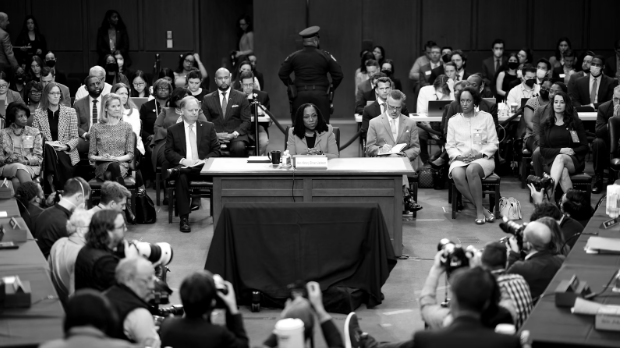
History was made on Thursday, April 7th, as Judge Ketanji Brown Jackson officially became the first Black woman to be confirmed to the Supreme Court. However, if you’ve tuned in to any of the previous confirmation hearings, you’ll know that other than the candidate, nothing much has changed about the confirmation process. The course of the questions that the candidates are subjected to has strayed further away from the real conversations about legal procedure to interrogations about partisan political conflicts. In fact, confirmation hearings have been labeled as “empty rituals,” as citizens critique the candidates for their lack of substance and the Senators for their immature questions. However, these empty rituals will still continue, and since the power lies with the Senators and Congress, nominees and their teams need to prepare for the constantly evolving rules and criticisms.
Supreme Court confirmation hearings have been consistently challenged for lacking substance, and while the Senators’ current shortcomings might be a product of the country’s growing partisan conflicts, the blame placed on candidates like Judge Jackson is misguided. Judge Robert H. Bork’s hearings in 1987 were the last hearings where a candidate was only asked relevant questions about being on the Supreme Court. But Judge Bork’s hearings were also special for another reason: his confirmation was rejected by the largest voting margin ever (58 for vs. 42 against). And while these two facts may seem unrelated, they are closely tied. When Senators ask candidates relevant issues regarding their legal knowledge, the candidates must appear knowledgeable and provide thorough responses. But these responses also reveal more of the candidates’ flaws, and ultimately, lead to the candidates’ rejection. Therefore, to prevent the rejection of more candidates, confirmation hearings over time have become less about legal skill. Instead, Senators have begun to ask questions regarding a nominee’s political affiliations, which Judges try hard not to comment on. April’s hearings are the biggest example of this, where Senators like Ted Cruz only asked questions about whether the country should teach critical race theory or not. So, while Judge Jackson might be the least responsive candidate of the decade, it is because she had practically no law-based questions to respond to.
In a partisan affair where Jackson’s confirmation was almost guaranteed thanks to a Democratic majority in the Senate, neither of the parties focused on questioning the candidate at all. Instead, they used the time to air their grievances about their own parties’ issues and sidelined Jackson as if she was a witness to her own confirmation hearings. Nevertheless, even without the opportunity to speak, she used the time that she had to her advantage by appealing to Republicans and attempting to secure any votes that would make her confirmation bi-partisan. It seems to have paid off, as she secured 3 Republican Senators’ votes, along with a comment from Senator Murkowski who praised “her demonstrated judicial independence; her demeanor and temperament; and the important perspective she would bring to the court.”
With an ever-changing system where one can never predict how “cooperative” the Senators will choose to be, we need to have candidates who are ready to make successful arguments. Judge Jackson did exactly that, proving that regardless of how certain your confirmation is, the hearings must be tackled with skill and courtesy. With Jackson, we see a nominee who is unfazed by partisan politics and the conflicts it brings, suggesting her strong future impact on the Supreme Court.
Leave a Reply
You must be logged in to post a comment.