Claire Wong ‘25, News Staff Writer

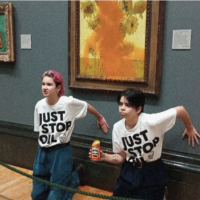
Image Courtesy of Just Stop Oil / EPA
On October 14 2022, climate change activists from Just Stop Oil made headlines when they dumped a can of Heinz tomato soup on Van Gogh’s famous painting “Sunflowers.” Ten days later, members of Just Stop Oil’s sister organization, Last Generation, threw mashed potatoes on Claude Monet’s renowned “Les Meules” and then glued their hands to the wall. Three days after that, a man tried to glue his scalp to Vermeer’s “The Girl With a Pearl Earring.”
So far, none of these paintings have been seriously damaged, as all three are protected by layers of glass. These climate change activists aim to accuse people of focusing too much on physical objects and not enough on global warming. “People are starving. People are freezing. People are dying,” said one activist after gluing her hand to the wall of the Museum Barberini in Germany. “We are in a climate catastrophe and all you are afraid of is tomato soup or mashed potatoes on a painting. You know what I’m afraid of? I’m afraid because science tells us that we won’t be able to feed our families in 2050,” she finished. Her fellow activist joined in, shouting, “What is worth more? Art or life?”
While it may seem odd that these activists are targeting art as a way of garnering attention to climate change, they believe that there is no other way of getting people to act. Despite the presumption that these activists intend to permanently damage these paintings, Just Stop Oil acknowledged on their website that “art is precious.” They simply want to salvage a future where “human creativity is still possible” since we are “terrifyingly close to losing that.” Consequently, they feel the need to “break the rules, push cultural buttons and challenge and shock,” as “there is no other way to get the conversation going so we can ask questions that matter.”
Despite the controversy, these protests have succeeded in bringing attention to some necessary questions: Are we focusing enough on the effects of climate change and how they’ll impact us in twenty or thirty years? And what can we, as the future generation, do about it?
Ian Bell ‘23, a former IB Environmental Systems and Societies student, offered an answer to these questions. Bell started by saying, “Many don’t understand how serious climate change is at the moment.” Last year, he wrote a paper about what would happen if climate change continued at its current rate, where he explained that if half of the arctic’s ice melted—which it’s on track to do—then the ocean would rise 128 feet, enough to completely submerge major cities such as New York and Tokyo. He mentioned other repercussions too: cities far inland could flood, one-third of all plant and animal species could potentially go extinct and agricultural production could be severely impacted, preventing food production for generations to come. Nonetheless, Bell believes that “throwing food on paintings is not the answer,” as “it makes activists seem crazy. It takes away from the seriousness of climate change since extremely radical demonstrations cause people to focus less on the message that is trying to be communicated and more on the action itself.” Regarding what the next generation can do, Bell said, “To be brutally honest, there isn’t much that we as consumers can do other than voting for the officials that promise to help.”
Unfortunately, Bell is correct, as there are few ways that our generation can contribute to stopping climate change. Only large corporations and representatives have enough power to make a difference, so when one is of age, voting for officials who will devote their time to passing legislations that will stop climate change is arguably the most beneficial action. However, there are several other ways that the youth can indirectly combat climate change, such as attending or organizing protests and/or boycotts. Although, hopefully these demonstrations are less extreme than that of Just Stop Oil’s or Last Generation’s, who proved that drawing attention to pressing issues through radical methods can cause a negative light to be shed on the topic. Furthermore, trying to reduce one’s carbon footprint, supporting local businesses, drawing attention to the climate crisis, writing letters to representatives demanding change and donating to or participating in groups such as the Sunrise Movement, Extinction Rebellion or Greta Thunberg’s Friday for Future are just a few options that can make a small but cumulative difference.
Leave a Reply
You must be logged in to post a comment.