Emily Qin ‘25, News Section Editor

Image courtesy of Marshall Ramsey
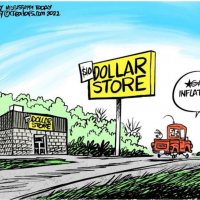
If you turn on the news anywhere, you might hear that recent inflation has been at an all time high, or that in the coming years, America is at risk of an economic recession. You may also have noticed that dollar store items are now more like a dollar fifty, or that many voters mention inflation as the number one issue in the U.S. when voting for representatives in office. But what do these phrases and words actually mean, and how do they affect us?
These terms have significance in our lives, even outside of Economics class. Inflation can be described as the general increase in the price of an economy’s goods and services, which become more expensive as a result of the dollar having lesser value over time. Inflation is also dependent on a number of different geographic and periodic factors that can change the value of currency.
A low rate of inflation is normal in the economy, but a high rate of inflation makes it difficult for low-income families to afford everyday necessities. Today, inflation is significantly worse in the U.S. than it has been in the past few decades. According to Dorothy Neufeld from the Advisor Channel, between 2000-2020, America’s inflation rate peaked at 4.3% in 2018, and, after declining steadily between 2018-2021, this rate nearly doubled in 2022 to 8.4% — eight times as high as it was last year. The only other times in US history that inflation suddenly climbed so high were before the Great Depression (reaching a nearly 20% inflation rate), in the 1940s (about a 17% inflation rate), and the 1970s (around 13% inflation).
Of course, inflation rates are affecting our daily lives. It is nearly 13% more expensive for us to buy groceries than it was a year ago, while going out to have dinner is about 8.5% more costly than last year. Natural gas has also increased in price, meaning heating our houses in the chilly New Jersey winter will be more expensive this year than it was in previous years.
The reasons why inflation has been so high in this past year can be attributed to several different factors. During the pandemic lockdown, many goods that usually shipped from overseas were no longer able to reach the U.S., causing their prices to rise. Moreover, labor shortages occurred as a result of many workers leaving their jobs both voluntarily and involuntarily, and in response, the government distributed stimulus checks to those in need. These checks increased the amount of money chasing after fewer goods and services, further causing higher prices.
Economic activities must be slowed down in order to prevent prices from becoming too high. This, in turn, may lead to a recession, or a contraction in the economy. For example, in 1929, the Great Depression saw a huge increase in unemployment rates after massive inflation rates. Although inflation is not yet as bad as it was before the Great Depression, many economists, such as Taylor Tepper at Forbes Advisor, mention that America may fall into an economic recession in the near future. Many recall the very recent Covid recession, in which unemployment rates skyrocketed as a significant number of workers in the service industry lost their jobs during the pandemic.
Another recession may occur soon, meaning we may see increasing unemployment rates across the nation. Many people who were affected financially by the pandemic could face a high risk of being affected by this potential recession. However, regardless of status or occupation, we are all paying more for everyday necessities because of inflation, even if we may not be aware of it.
Leave a Reply
You must be logged in to post a comment.