Jayden Zhou ‘23, Sports Writer

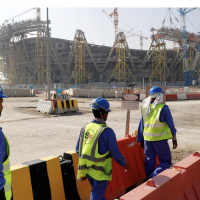
Workers on the construction site of the Lusail Stadium, one of eight stadiums being constructed for the 2022 World Cup
Image Courtesy of NBC News
On the 20th of November, the 2022 FIFA World Cup began in Qatar, marking four years since the last one took place in Russia. Qatar is the first Middle Eastern country to host the World Cup, and the event is one of the largest, if not the largest, events to ever take place in Qatar. After winning the bid in 2010, the global community raised concerns about whether a country like Qatar would be fit to host such an event, given its small size (2.9 million people), its inexperience with hosting events like these, and the sweltering heat that permeates the summer months. Not only that, but Qatar was accused of bribing FIFA officials upwards of $3.5 million to support their bid. However, they were cleared of wrongdoing after a lengthy two-year investigation. Needless to say, the public opinion regarding Qatar’s ability to successfully host the World Cup was shaky from the start.
After winning the bid, Qatar launched arguably the largest undertaking in the country’s history, both financially and physically. According to a report from Deloitte, the country has spent over a massive $200 billion on various infrastructure and development projects, in efforts to accommodate the expected 1.5 million spectators. These projects include a new airport, roads, seven new stadiums, a metro line to connect the stadiums, and upwards of 100 new hotels. Qatar can afford to spend this much, however, as its abundance of oil and natural gas makes it one of the richest countries in the world.
However, while they were able to cover the financial costs themselves, they were forced to look overseas for laborers, as there weren’t enough people domestically to meet the incredibly high demands of the project. Qatar’s government says that over 30,000 foreign workers were hired to help with the infrastructure projects, most coming from countries such as Bangladesh, India, Nepal, and the Philippines. On the surface, this project seems like a good thing, as it creates a plethora of jobs for workers in foreign countries who may not have access to well-paying jobs. However, upon closer inspection, the inhumane working conditions and corruption within labor agencies reveal a much darker reality.
Foreign workers needed to pay upwards of $4,000 in recruitment fees, which, for most of them, either drained a large amount of their savings or even put them in debt. When they arrived in Qatar to work, they had little to no money and were completely reliant on the labor system in place in Qatar. This system essentially meant workers’ visas were sponsored by an employer, who had complete control over not only their job, but also their immigration status. In some cases, workers had their passports confiscated, were prohibited from changing jobs, or even denied exit visas. Furthermore, this system was often late with paying or dismissed the workers’ wages entirely, which is absurd when remembering the entire reason why they were there in the first place – to provide for their families.
Beyond corruption, the working and living conditions in Qatar were deplorable. Numerous investigations revealed that living quarters often had insufficient supplies of water, too many people in one area, and unsatisfactory healthcare standards. Furthermore, workers would work in temperatures upwards of 110° F, performing back-breaking manual labor. These conditions ultimately led to the deaths of over 6,500 foreign workers. Additionally, the salaries promised by the Qatari government were just slightly higher than what the foreign workers would make in their home countries, incentivizing them just enough to keep going to Qatar. While it’s unknown if the Qatari government knowingly exploited workers this way, it is entirely possible they did, considering the atmosphere of corruption surrounding the event.
So, with all of that in mind, you may have wondered whether or not it was ethical to watch and cheer for your favorite teams and players during the month-long tournament. Luckily, however, Newark Academy’s own Mr. Stilliard believes that depriving yourself of football this World Cup would not have benefited anybody. FIFA earns the money from viewership through its contracts with broadcasting networks, not the viewer themselves, so turning off your TV wouldn’t have hurt them. Instead, he thinks that the way to bring “lasting change” is to “educate yourselves about the tournament” and “demand change through our elected representatives.” He believes that by urging our elected officials to place heavier scrutiny on Qatar and other countries, we can send a message that the human rights abuses and capitalistic tendencies exhibited by FIFA for decades are unacceptable and must be corrected.
Leave a Reply
You must be logged in to post a comment.