Trishna Inampudi ’28, Arts & Entertainment Editor
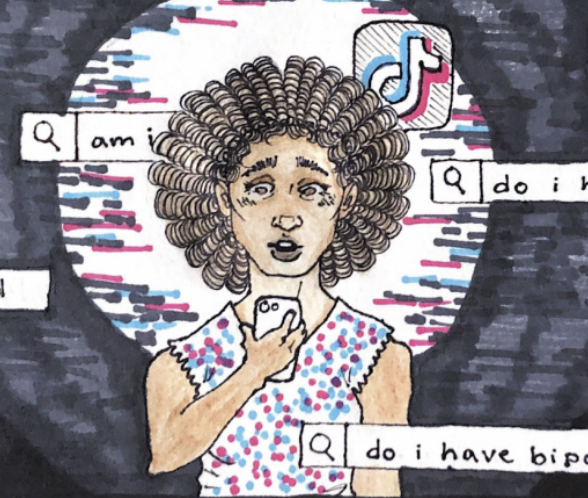
The internet—especially social media—has made information readily available like never before. Concepts that once required decades of formulation and development are now at our fingertips with the click of a button. One area that has seen a surge in accessible knowledge is health and wellness, specifically mental health, so much so that some critics argue the gravity of these issues has been diminished.
Some claim that social media has caused serious mental conditions to be viewed as quirks or, even worse, encouraged people to self-diagnose based on incomplete or misleading information. Others argue that widespread access to mental health information has been beneficial because it raises awareness and encourages people to seek professional help. Some even say they would have never recognized symptoms of a mental condition—such as autism or ADHD—within themselves without social media pointing them out.
One social media user commented on the YouTube video “TikTok Gave Me Autism: The Politics of Self-Diagnosis” by Alexander Avila, “I clicked on the link and read through it. I cried because every symptom was so… me! Every symptom and uncomfortable feeling I felt was right there on the page. I didn’t feel crazy anymore.” Many users like this describe self-diagnosis as empowering, validating suspicions that they may have a condition that has not yet been professionally diagnosed.
In addition, people who are unable to receive a professional diagnosis due to financial limitations, time constraints, or parental restrictions may turn to self-diagnosis as a way to better understand their experiences and take steps toward managing them.
Still, skeptics argue that self-diagnosis has gone too far, causing people to misconstrue serious mental conditions as something diagnosable through oversimplified online checklists. Many online spaces tend to trivialize mental illness by labeling everyday or “quirky” behaviors as disorders. For example, people who are simply clean or organized may claim to have obsessive-compulsive disorder (OCD), which can be invalidating to those who are actually diagnosed with the condition.
OCD is characterized by intrusive thoughts and repetitive behaviors that significantly interfere with daily life, and it should not be confused with being a so-called “neat freak.” An anonymous user featured in Avila’s video explains, “My issue with the obsession with self-diagnosis is that we begin to pathologize EVERYTHING. Like, it’s okay to just have a personality. You might just have quirks and preferences; it’s really most likely not a disorder—unless it interferes with your ability to function.”
Many people online conflate symptoms of mental illness with common human behaviors, assuming that procrastination before a big assignment is ADHD rather than a natural response to stress.
Ultimately, it can be difficult to draw the line between normal habits and legitimate mental health struggles, especially in a fast-paced, stress-filled world. While it is crucial not to undermine those facing real difficulties and to ensure they receive the help they need, it is equally important not to minimize the seriousness of mental health conditions.
Within the Newark Academy community, this means recognizing both the value and the risks of self-diagnosis. While it can empower individuals who might otherwise go unnoticed, it can also blur the seriousness of actual conditions. The challenge—and responsibility—is to engage with mental health conversations online thoughtfully, balancing awareness with accuracy so that understanding does not come at the cost of trivialization.
Leave a Reply
You must be logged in to post a comment.