By Joanne Zhou ’28, Feature Staff Writer
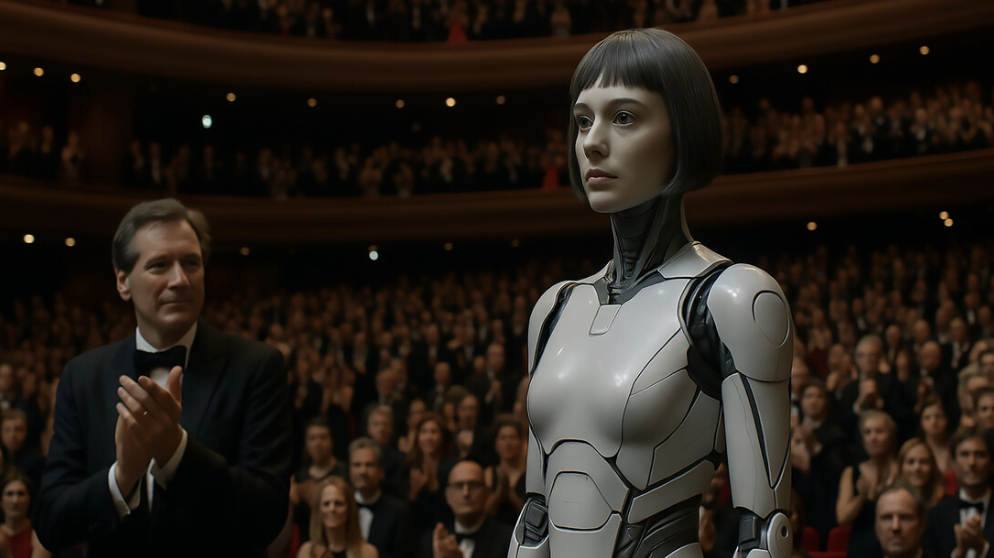
For decades, artificial intelligence has played a starring role in the entertainment industry. Even before the term “Artificial Intelligence,” or AI, was coined in 1956, movies had already begun to feature concepts similar to AI. This was seen as early as 1927 in the German film “Metropolis” which depicts human-like technology wreaking havoc on society, becoming one of the first of many movies that exhibited the idea of technology with human capabilities on the screen.
However, in a new twist, AI has begun to step behind the scenes, playing a role in acting, generating scripts, and parts of movies. For example, in 2016, “Star Wars” used deepfakes, which are AI generated images, videos, or audio recordings that look and sound realistic, to recreate Princess Leia and Grand Moff Tarkin for their film “Rogue One: A Star Wars Story.” More recently, award-winning films “The Brutalist” (produced by NA alum Andrew Morrison ’11) and “Emilia Pérez” used AI to change voices of the actors and actresses. For an industry historically successful due to its creativity and humanity, how much will the increased use of AI actually help? I sat down with members of the NA community to get their opinions on this topic, and here are some responses.
“Now, AI is able to do that.”
Surbhi Choubey ’28 notes that AI is already changing the way the entertainment industry operates by “generating images and videos that look real” as well as being able to “generate music.” As AI gets more advanced, Surbhi believes that “people are going to have to come up with a way to use AI as a tool and make their art their own.”
“It will cause people to consider the value of person-to-person connection and where they feel like that can be replaced or augmented.”
For Mr. Jim Knable, an Upper School English teacher, art is about human connection. He believes that letting AI take center stage will defeat the point of art. However, Mr. Knable thinks that, as “a tool that is used artistically by a human who is connecting with other humans,” the use of AI is more acceptable because the artist or writer will “still [manage] to use their original abilities and thoughts.”
“The future of filmmaking lies in artists leading the technology, using AI not as a substitute for creativity, but as a partner.”
Ms. Stephanie Hammond, NA’s Director of Digital Learning and Literacy, believes that, as a tool, AI has the potential to “bring previously impossible visions to life.” She refers to actress and director Natasha Lyonne’s AI film studio, which uses a clean video model trained “exclusively on copyright-cleared data rather than content scraped illegally from the web to create animation, fiction, and non-fiction films along with television shows” as an example of how maintaining transparency and boundaries in the use of AI can be beneficial to the future of the entertainment industry.
“I believe that people are actually invested in other people”
Ms. Rachel Shapiro Cooper, NA’s Director of Theater Arts, has a similar argument to Mr. Knable, saying that “people go to the movies knowing it’s an actor that they know, that they recognize, that they’re invested in,” and that the humanity of artists is what makes art fundamentally appealing. Nonetheless, she also believes that there are “a lot of really wonderful things” AI will help with like “[speeding] up the process of creation,” especially in organizing time and editing videos.
As technology becomes more advanced, it is inevitable that AI will play an increasingly important role in entertainment. But, at the end of the day, our appreciation of art is subjective, and your opinion on AI in entertainment can be extremely different from that of your peers because of what draws you in — crazy special effects, an addictive plot, the humanness of the characters. So, as the line between humanity and technology becomes more and more blurred, perhaps the question you ask yourself shouldn’t be “what do you think about AI in entertainment?” Instead, maybe it’s time to start asking yourself: “what is it that you truly value in your favorite films?”
Leave a Reply
You must be logged in to post a comment.