By Zach Epstein ’14, Staff Writer
As election day creeps closer and closer, both President Barack Obama and former Governor Mitt Romney are kicking their campaigns into high gear. With polls not indicating any clear advantage for either candidate, the final push could prove the deciding factor.
According to Gallup’s Daily Tracking Poll, Obama’s support has jumped to 49% after an impressive Democratic National Convention, while Romney’s has stayed constant at around 45%. Although this is a positive for the Obama campaign, one could easily point to the natural “convention bump” in support as a source for skewed data.
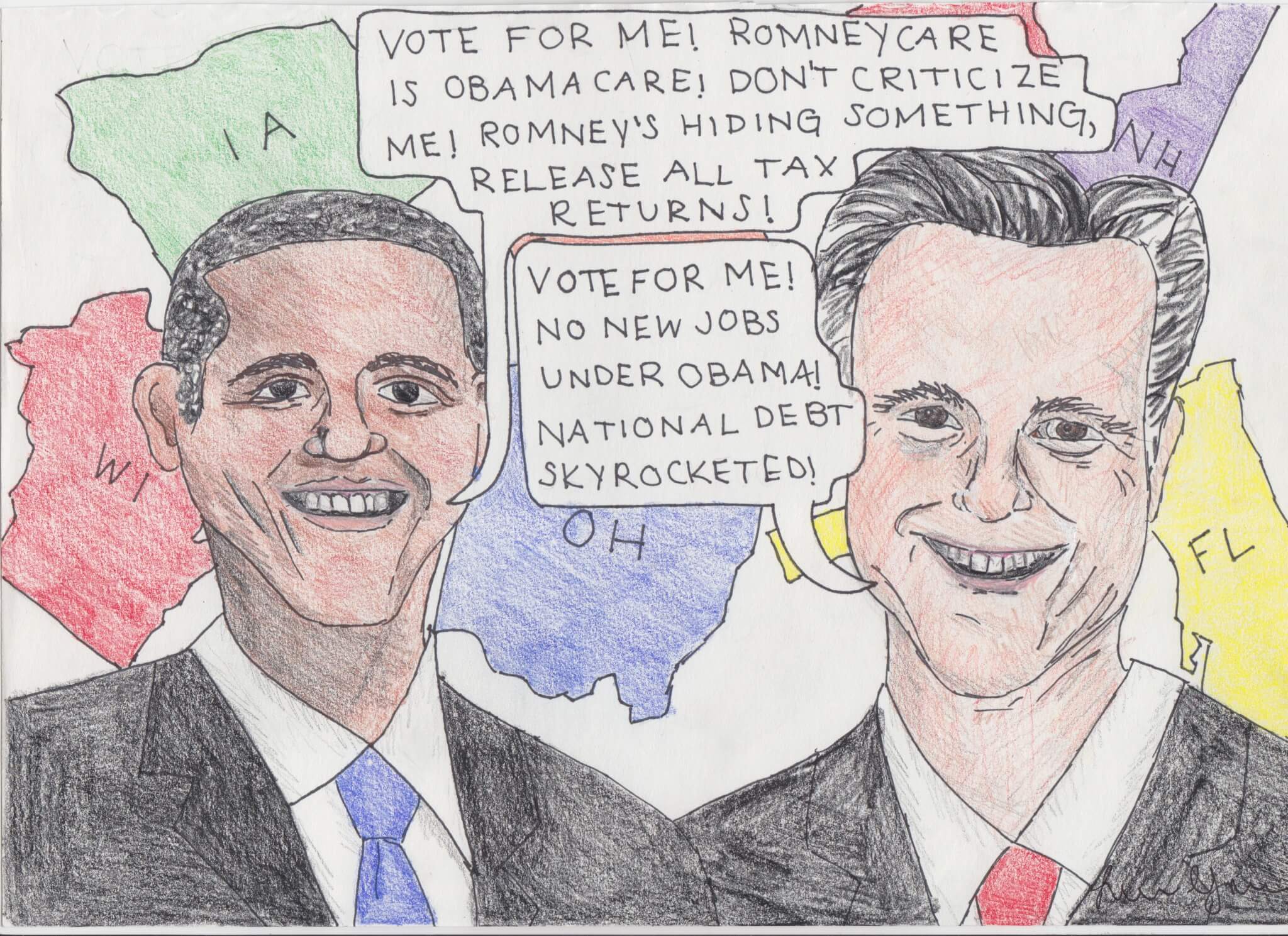
Regardless of the exact numbers, the general closeness of the race has made it clear that the fate of each candidate will rest upon the shoulders of independent voters. Romney was the majority favorite among independents throughout the summer, but Obama has recently closed the gap. A large portion of that group is still undecided (as high as 40% according to Fox News), meaning there are still “votes to be won” with final campaigning. Expect much of that campaigning to be focused around key battleground states like Ohio, Florida, New Hampshire, and Wisconsin.
A lackluster August Jobs Report (which reported more than 30,000 less jobs created than expected) will be another factor that could stifle Obama’s recent momentum. Although Democrats point to the drop in unemployment (from 8.4% to 8.1%) as a sign of economic improvement, Republicans counter that the decrease is just a reflection of the 368,000 people who’ve dropped out of the job market by giving up on their hunt for work.
Many of the issues in this contentious race directly affect members of the Newark Academy community. With tuition costs continuing to rise and college on the mind of many students and families, the issues of education and college aid is especially prevalent. Obama has emphasized the rebuilding of a lackluster education system (now ranked ninth in the world at obtaining college degrees, despite our former stranglehold of the top spot). In addition, he points out that roughly one quarter of American students do not receive a high school diploma, never mind the college degree that has become a sort of prerequisite for employment in our changing society. Obama prides himself on promising affordable education, pointing to his successes in office, which include the passing of a $10,000 tuition tax credit and an increase in Pell Grant scholarships. Matt Cowen ’13 said, “I feel Obama’s strong desire to eliminate the need for student loans is very important when looking at the candidates.”
Romney’s approach to higher education reform is different. He counters Obama’s policies by stating that they will result in a “lost generation” of college graduates who are deeply in debt by the time they graduate. Student loan debt has reached $914 million dollars and Romney is determined to lower it. He believes that a strong economy will solve the problems with student loans. In a response to a college student’s question on how he planned to address the student debt crisis, Romney said, “I’m not going to promise all sorts of free stuff that I know you’re going to end up paying for. What I want to do is give you a great job so you’ll be able to pay it back yourself. And I want to get the government off your back, so you can keep more of what you earned.” Romney hopes to create an economy full of job opportunities for recent graduates. Romney also wants to emphasize the ideals of school choice and charter schools, while constantly using standardized tests to ensure students are meeting academic standards. Athletic director and former American History teacher Mr. Gilbreath disagrees with Romney over the role of standardized testing. He said that he is “not a strong believer in the idea of standardized testing and its role in education.” Romney also says that strong teachers should be rewarded more generously, but also that the Federal Government should step out of education for the most part, as he believes that it is a state and local matter.
The wide gap between each candidate’s policies combined with the tight race in the polls will result in an increasingly contentious final month of campaigning. Despite the tendency for such races to become vitriolic and petty, it is important for members of the Newark Academy community to stay engaged and educated on the real issues that affect us.
Leave a Reply
You must be logged in to post a comment.