By Jeffrey Frankel ’13, “Arts & Entertainment” Editor
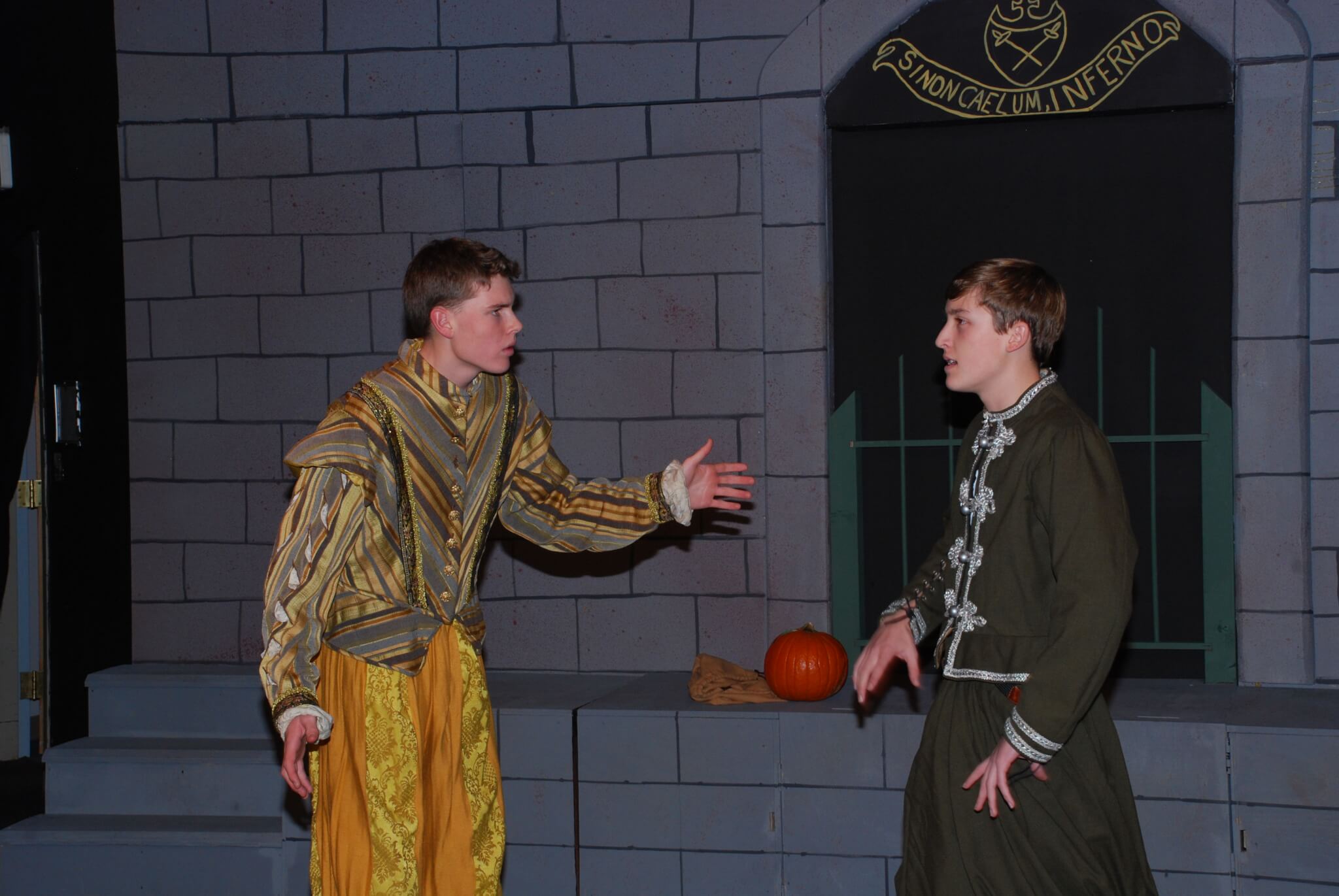
After a turbulent week of hurricanes, snowstorms, and postponements, Fortinbras finally filled the Black Box Theatre last weekend for three impressive performances of the Shakespeare sequel. This year’s fall drama, the thirty-first for Director Mr. Jacoby and the second Shakespearean one—he put on Twelfth Night in 2001—was originally set to be performed on November 1, 2, and 3. The nine-day “hurricane break” and subsequent “blizzard day” forced the cast and crew to defer until November 8 and two performances on November 10 with a decrease of expected rehearsal time. Audiences were doubly pleased and impressed with the company’s accomplishment, however, and the incessant laughter and applause brimmed from the doors of the theatre.
Fortinbras, written by Lee Blessing, playwright and Head of the graduate playwriting program at Mason Gross School of the Arts at Rutgers University, immediately picks up its plot where that of Hamlet concludes: everybody in the Danish royal family has killed each other, and Fortinbras (C. Reid-Dodick ’13), the Prince of Norway arrives at the event, perplexed as to who will assume the Danish throne. He appoints himself to be the new king of “Denway” or “Normark,” and he falsifies the Danish mass regicide with the help of a courtier Osric (C. Mooney ’13), while Hamlet’s best friend Horatio (Z. Huber-Weiss ’13) attempts to thwart him and properly honor his friends.
It doesn’t help Fortinbras’ baffling circumstances that the ghosts of those killed in Hamlet, which is basically everyone—Hamlet, Ophelia, Claudius, Gertrude, Polonius, and Laertes—loom around the castle. However, Blessing turns Shakespeare’s tragedy on its head by playing with some of the inside jokes of Hamlet. Zoe Huber-Weiss explains that “a lot of the jokes are directly related to Hamlet.” When characters die and reappear as apparitions in the sequel, the defining traits of each’s personality are transposed; the innocent and foolish Ophelia becomes manipulative in death, a role which Sydney Persing ’15 fills brilliantly in her ability to sinuously shift between compassion, rage, lust, and a range of other complex emotions. Polonius’ officious nature in life prevents him from being able to speak in the first act of Fortinbras. Though a lot of the comedy comes from the unexpected nature of each person’s idiosyncrasies, the actors’ ability to convey these polarizing characteristics was still enjoyed by much of the audience. Nothing in the play stood out as something that could only be understood by those who have read Hamlet.
The accessibility of this story for a large, diverse audience was crucial in ossifying Mr. Jacoby’s choice for this year’s fall drama. He stated, “I [chose] this [play] because I felt a certain pressure from within to go Shakespearean.” The particularly incomprehensible nature of Shakespeare’s plays for a larger audience threw a wrench in this plan to an extent, but the modernity of Blessing’s writing gave Mr. Jacoby a little bit of wiggle room. Also, he explained, “When I pick a play, I always have in mind who I am going to have audition.” The cast this year was without a doubt filled with a strong group of comedic actors who he evidently believed could take on the challenges of reviving Shakespearean characters.
This year, Cody Reid-Dodick ’13 finally joined the rank of those who have played Fall Drama title roles including Jourdan McGhee ‘11 as Antigone in Antigone (2008), Bethany McHugh ’11 as Heidi Holland in The Heidi Chronicles (2010), and Clara Mooney ’13 as Anne Frank in The Diary of Anne Frank (2011). It was no surprise that Reid-Dodick, one of the IB Acting class’ most prolific actors—with roles such as Peter van Pels in The Diary of Anne Frank and Mitt Romney in the class’ political debate morning meeting—was chosen to play the title role. Reid-Dodick did, however, clarify that Fortinbras is a totally different character from any other that he has played. “I was Peter in [The Diary of] Anne Frank last year, and he was the absolute opposite of this character; he was very serious, demure, and almost shy on stage. [As Fortinbras,] I have to be on from the very beginning, and I become almost destructive throughout the entire play.” This seems to benefit the actor as well, as he elaborates, “It’s a play that allows me to take a lot of risks on stage because the character is inherently verbose and full of energy. I can really just go all out.”
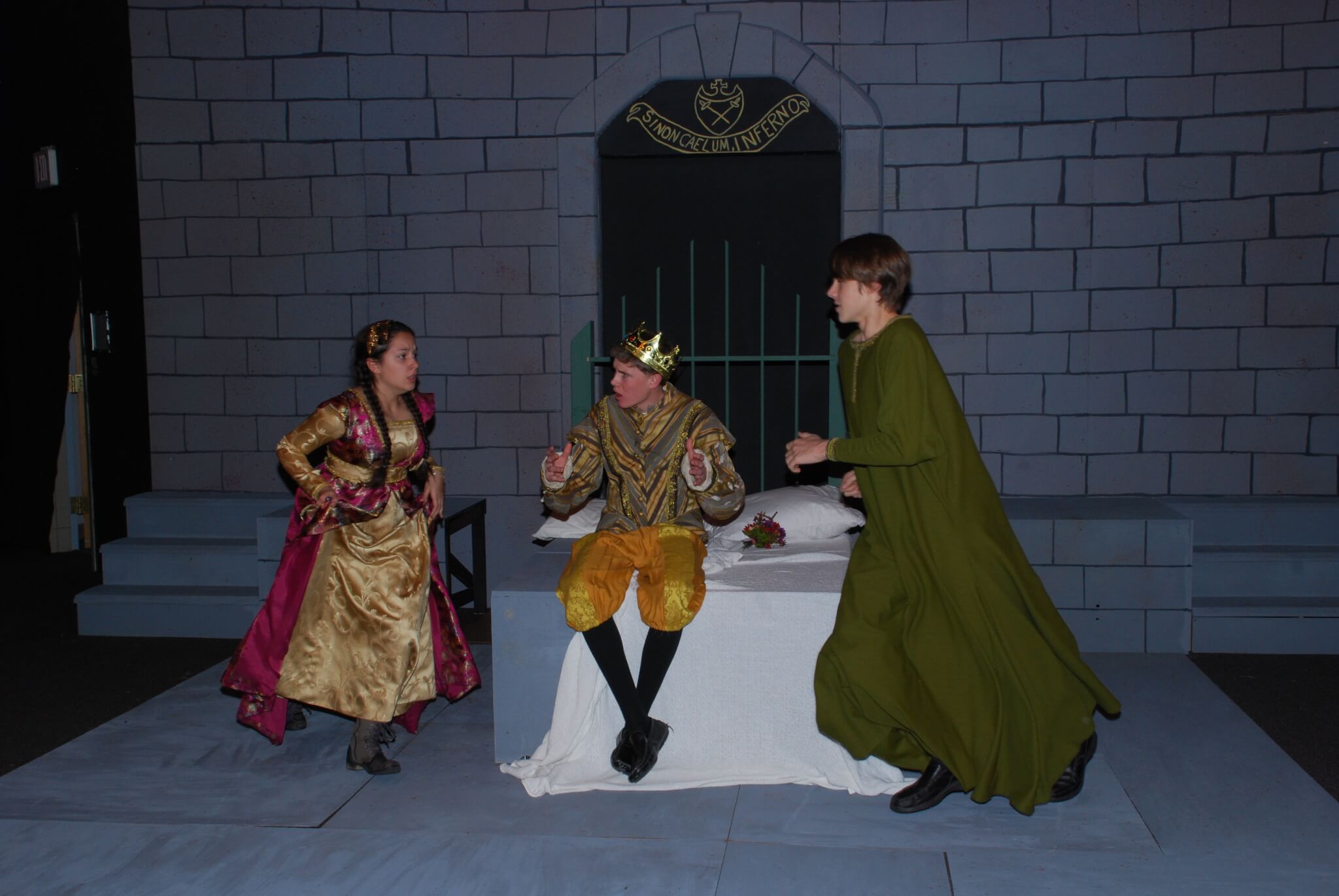
Audience members responded positively to the performances across the board; the words “comical,” “clever,” and “modern twist” surfaced more than once in interviews. Most importantly, though, as Eliza Huber-Weiss ’13 put it, “it seems like everyone’s having a great time on stage.”
Director Jacoby declared to Reid-Dodick about his performance, “You’ve got talent. You’re delightful in the show.”
Though hesitant at first, it seemed as though the company came to enjoy the play. Zoe Huber-Weiss explained, “[Fortinbras] has grown on me. The cast has been really awesome, so it’s been a really good time.” They definitely worked diligently, and the lack of rehearsal time did not demonstrably hurt the show at all. Magnificent acting, impeccable sound, and interesting uses of stage all assimilated into one—make that three—stellar performances that undoubtedly livened up the community’s weekend.
For anybody interested in being a part of the winter musical The Drowsy Chaperone, remember that auditions begin Monday, December 10th, 2012.
Leave a Reply
You must be logged in to post a comment.