By Soven Bery ’15, Staff Writer
It’s a cold October Monday morning and sophomore football player Dan Kwiatkowski painfully opens the doors and trudges into Newark Academy. A week earlier he had lined up at nearly every position for the Minutemen on the gridiron. But today he faces something much tougher than the Sussex County Tech defense: Spanish class. Along his walk, the pain becomes too unbearable and he darts into the nearest bathroom. Dan clutches his head and pops another Tylenol pill before enduring a full day of taxing, rigorous classes.
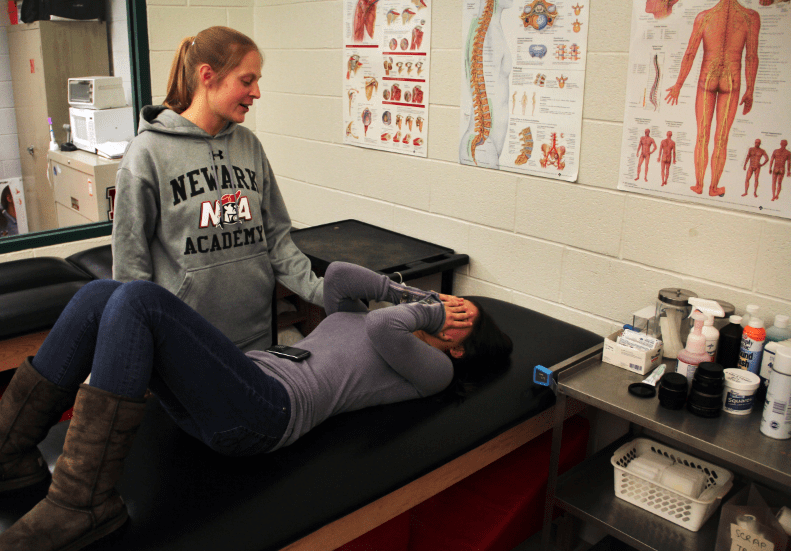
Kwiatkowski suffered a concussion after playing lights-out football and missed a week of school; an obvious deterrent to his academic performance. These brain injuries are a far too common reality for many of Newark Academy’s student athletes and are an evident problem in athletics. “Concussions are probably more frequent now than several years ago partially due to the increased awareness of them, so they are getting diagnosed more. They are extremely prevalent in high contact sports such as football, soccer, and lacrosse,” says the school’s athletic trainer Jayme Kaczanoski.
A concussion is an extremely severe injury, particularly for an adolescent. “The problem with a teenager getting a concussion versus an adult, is that their brain is not completely matured yet. Because their brain is still developing in teenagers, injuries to it can be more serious than an adult who suffers the same injury,” explains Kaczanoski.
No one understands that problem more than Kwiatkowski who, after multiple visits to the doctor, considers himself an expert on the topic. “You have a bruise on your brain. Everything hurts as you use your brain for every function of daily life. So all you can do is eat and sleep but your brain hurts like no other”, he explains.
Eric Liao, a close friend of Kwiatkowski’s, has also suffered multiple concussions while valiantly representing the boy’s soccer team on the pitch. “I suffered headaches, dizziness and fatigue as well as lack of concentration. When diagnosed, it is best to stay away from bright lights and loud noises. This is hard because there is pretty much nothing you can do when you have a concussion,” Liao describes. Athletes like him know that concussions are a part of the game and they will do anything to get back on the field with their teammates. At the same time, they have learned the importance of concussions and take them very seriously.
“The worst part of being concussed, by far, is not being able to be out there to help out my teammates. At the same time, a concussion is a brain injury, and thus must be taken very seriously, as long term repercussions are very possible,” star running back Tyler Park ‘14 tells me. Park missed most of the season after suffering his second concussion early in the year. “When I got my first concussion, my sense of time was thrown off and when I got my second one, I was very sensitive to light,” he continues describing the side effects suffered from this horrible brain injury. But, as he tells me how he had trouble focusing in school, I wondered if there was a way to prevent his concussion. Park quickly batted away that idea, as he made it clear that both concussions happened in the heat of the game.
Kwiatkowski echoed that notion.That fateful Saturday he marched on the field as he would on any other play and lined up opposite his opponent. The ball was quickly snapped and before his enemy had even stepped out of his stance, the speedy Kwiatkowski was already in the backfield and got a hit on the runner, knocking the ball from his hands. Dan then watched as Kenny Zhou ’13 dove in the air and recovered the fumble for Newark Academy. It was the last thing he saw before his extremely fed up opponent planted a hit on him and Dan flew around like a rag doll, with his head finally nailing against the hard ground. After a moment, he got up and slowly walked to the sideline. The great competitor was ready to tell the coaches that he thought he was concussed. But before he could get a word out, the offensive coordinator relayed the next play to Dan. He realized that he would finally get the ball and decided that his head didn’t hurt too much. He would play the rest of the game. Dan cited his dedication throughout my interview with him and while it is a trait that is key for great athletes, it can also be a serious risk. His tenacity is incredibly admirable but one has to wonder what would have happened if he had given up.
Dan will heal, though. So will the rest of his fellow student-athletes stricken by this terrible injury and Newark Academy is playing a huge part in the healing process. “Return to play guidelines for athletes that sustain a concussion consist of the completion of a step-wise exercise progression. This allows the athlete to return safely by gradually increasing the amount and type of exercise they do. The school also gives academic considerations for those athletes recovering from a concussion. Examples include additional time to take a test and a decrease in the amount of homework. This is important because mental rest is also part of the healing process from a concussion,” explains Kaczanoski.
Park tends to agree when he tells me “the healing process is like any other injury. The symptoms fade until they’re gone, and then you have to go through concussion protocol until the trainer decides that you’re back to normal and can be worked into sports again.”
Concussions are a tough obstacle for student-athletes to face as they hope to return to scoring goals and getting “A’s”. But they are the nature of such high-contact sports that these players sign up for. The school is doing everything it can to prevent concussions as Kaczanoski and her department inform parents, coaches and athletes on the danger of brain injuries. However, concussions will continue to happen and they are a pain that the entire community must fight together. We can’t leave athletes like Eric Liao or Tyler Park alone on the ground. Otherwise, concussions will continue to torment the brains of our young athletes. We must provide a helping hand and lift players like Dan Kwiatkowski up, so his bruise will become a thing of the past and he can trade headaches for handoffs and concussions for completions.
Leave a Reply
You must be logged in to post a comment.