By Siddarth Kannan ’14, News Editor
Barack Obama’s reelection as president comes in one of the most important elections in recent history. With the current dissatisfaction concerning the state of the economy, polarized parties, and perceived socioeconomic divide, the president has a huge role to fill.
The election results have now been projected to a conclusive degree, with Obama carrying 336 electoral votes to Republican challenger Mitt Romney’s 206. The popular vote is in Obama’s favor by a small margin, but not all states have finished counting votes.
Obama’s second term means that the Patient Protection and Affordability Act, or Obamacare, will have at least a trial period, rather than the instant repeal promised by Romney. This act, harried by challenges of its constitutionality and congressional repeal attempts, serves to increase overall insurance coverage of the American populace through devices such as the individual mandate and tax credits and subsidies for employers. Many Republicans question the extent to which Obamacare fits within the capitalist, free market economy, especially the insurance mandate. Obama’s reelection confirms, however, that the mandate will be given a chance when it goes into effect in 2014.
Taxation policy has been an important part of this election, as it underlies the nation’s slow economic recovery. Obama has repeatedly stated his intention to shift more of the tax burden onto the rich – defined as individuals making more than $250,000 a year. He has stated that this shift will put more money in the pockets of the middle class. Many Republicans, however, have signed the Taxpayer Protection Pledge, refusing to support any attempt to raise taxes, and creating gridlock in Washington.
Another important issue following this election is government spending. As fundamentally liberal, Obama generally supports a higher degree of public spending on government programs than conservatives. This goes hand in hand with taxation, as Obama wants to make up for the shortage of funding for Medicare through increased taxes on the rich. Republicans generally want to cut government spending, pointing to the huge amounts of public debt amassed over the past decade. The budget deficit is also a problem, as it exceeds $1 trillion. Obama proposes to deal with the debt by cutting spending on some domestic programs and on the military. He also hopes that ending certain military operations, such as the Afghanistan War, will eventually lead to a fall in government spending and in the deficit. Republicans believe that defense spending is crucial, even at the expense of domestic programs. This speaks to a fundamental ideological divide that must be bridged in order to bring down the national debt.
Obama faces a need for compromise with the looming “fiscal cliff”. This “cliff” is actually a series of tax increases and spending cuts, which, according to IB Economics teacher Ms. Lifson, would “cause a recession”. This financial problem was caused by previous legislation, such as the Budget Control Act of 2011 and the extension and eventual expiration of the Bush Tax Cuts. Ms. Lifson adds that with the continued division in Congress, it is her “great hope that the country turns to the business of learning how to solve problems together.” She perfectly articulates the need to bypass partisan gridlock for the best interest of the nation.
Mr. Gertler, a fiscally conservative and outspoken member of the faculty, expressed his concern with the looming fiscal cliff. He says the upcoming cliff “will no doubt affect the economy in a negative way” because people will obviously have “less money to spend”. However, he adds that there will have to be a compromise because the fiscal cliff is “that bad”. As a conservative, however, he opines that the most important part of any compromise would be cutting irresponsible government spending.
Newark Academy’s administration and student body have supplemented the excitement of election season. There are students from both sides of the political spectrum at the Academy, and the administration officially allows for political discourse through student-led avenues such as the Young Republican and Democrats clubs and Think Tank. Besides these clubs, students can find opportunities for debate with many of their peers, a testament to the informed nature of the community.
The mock election held by the IB Computer Science class quantified the political leanings of the student body, and it became clear that it is a liberal one. As indicated by the table below, the election enjoyed a 71% voter turnout, trumping the national turnout by about 11%. Mr. Vinikoor, a mainstay in the humanities department who helped organize the mock election, is impressed by the voter turnout. He says that the high turnout “reflects the extent to which members of the Newark Academy community are politically engaged,” and that the results of the voting reveal “the variety of political beliefs held by members of the Newark Academy community.” With the school’s perceived liberal leanings now quantified, Young Republicans member Zach Gross ’14, points out that while the Academy “is generally liberal, (it does have) a small, dedicated contingent of conservatives.”
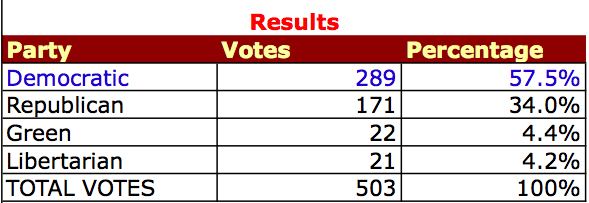
While the Academy may represent a variety of views, concerns have been raised as to the extent both sides are accepting of the other. Senior John Carl Gibbons, leader of the Young Republicans club, voices an issue with the extent to which students are respectful of the conservative ideology. He says, “While Newark Academy insists that it is a global academy that prides itself on acceptance, this acceptance does not extend to the conservative point of view. A large portion of students at this school treat conservatives with scorn, which is truly unwarranted.” Even Tyler Dohrn ’14, a leader of the Young Democrats club, believes that certain aspects of political discussion at the Academy can make conservatives uncomfortable discussing their opinions. He adds, “because a large portion of the NA community subscribes to a liberal agenda, many Republicans and Libertarians feel uncomfortable sharing their political beliefs, leading to a NA community that feels as if it leans even further to the left.” Students need to take it upon themselves to make others feel more comfortable with political discussion. Increased respect for a variety of opinions will only improve the educational experience.
The election presented a crossroads for the nation, and Barack Obama will be given a chance to use liberal policies to spurn economic growth, increase health care coverage, and help the middle class. The Newark Academy community, while generally liberal, has used the politically informed nature of its students to create an educational political discourse. It is clear however, that a common need for both the Academy and the United States government is to express a deeper respect for the other side of the spectrum, so that the school can further encourage the development of tomorrow’s leaders and the nation can truly confront the problems of today.
Leave a Reply
You must be logged in to post a comment.