
By Zachary Gross ’14, News Editor
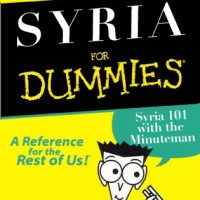
For those in the Newark Academy community who might have questions they were too embarrassed to ask, The Minuteman has provided an explanation of the basics of the conflict.
Where is Syria?
Syria is located in the Middle East, south of Turkey, north of Jordan and Israel, east of Lebanon, and west of Iraq. The country came into being in the 1920s, with its borders carved out on the whims of the British and French. It has, according to the CIA World Factbook, a population of more than 22 million, of which three-quarters are Sunni Muslims. There are also significant minorities of Alawites (a sect of Shia Islam) and Kurds.
Why is there fighting?
The Arab Spring of 2011 awakened pro-democracy movements throughout the Middle East, but especially in Tunisia, Libya, Egypt, Syria, and Yemen. When peaceful, pro-democracy protests started against Syrian President Bashar al-Assad, they were forcibly dispersed with many casualties. The reason why Assad was so hesitant to allow any sort of opposition is because he is an Alawite, and any widespread protest from the country’s Sunni majority would be disastrous for his hold on power, and ultimately, his sect.
Now, more than two years into this bloody civil war, the conflict has escalated. As much as it was about Syrians agitating for representative government in the beginning, it is now about a vicious sectarian conflict between the majority Sunnis and minority Shias. Protesters have formed armed rebel brigades and the regime has enlisted the support of Russia, Iran, and the Lebanese Shia group Hezbollah, as the conflict has deepened.
What are chemical weapons? Who used them? Why does it matter?
Chemical weapons can quickly and indiscriminately kill by causing lung paralysis and thus suffocation. Their usage had been confirmed in small attacks since March, but a large-scale attack in the Damascus suburb of Ghouta killed, according to an American intelligence assessment, over 1,400 people. It is the official assessment of western intelligence agencies that the regime was the only faction capable of executing a chemical attack of that scale. However, both Russia and the Syrian government deny the allegation, saying that the rebels used chemical weapons themselves.
The use of chemical weapons is considered a more significant offense than the use of conventional weapons because the Chemical Weapons Convention, an international treaty that has been ratified by 189 countries, outlaws chemical weapons. Syria, however, has only this month made an attempt to join.
How does the war concern American national interests?
The Newark Academy community is split on whether a possibile military intervention, such as the limited cruise missile strike floated by the Obama administration in early September, would be justified and in the national interests of America.
For some, including Young Republican club mentor Mr. Bitler, the war is primarily a proxy war for the United States’ two major international enemies: al-Qaeda and Iran, and thus he would be hesitant to intervene decisively for one side.
Many Americans want nothing to do with the prospect of another Middle East war. In a Reuters/Ipsos poll conducted in September, 65% of respondents said Syria’s problems were “none of our business.” William Ulrich ’14, Vice President of the Model United Nations Club, echoed this sentiment when he said, “I don’t think we are in a position as a military or economic power to get involved in another war.”
Others in the Newark Academy community, however, think that the chemical attack in Syria necessitates a response. Ms. Lifson, advisor to the Young Democrats club, said, “I believe that someone in the world needs to stand up for the principle that you are not allowed to gas your people. If nobody else is willing to do that, I think we have to take ownership for it. Having said that, I prefer diplomacy. If other options fail, I would be reluctantly willing to use our military. It hurts to say, but I don’t think it’s tenable in this world when so many people have these weapons to have the message out there that you can use them.” In a comment that highlights how the Syrian crisis has subverted traditional political paradigms of partisanship, Young Republicans co-President Jai Ghose ’14, also agreed that intervention could be justified and in America’s interests, stating, “Allowing the Syrian civil war to continue on in its current state would just create more instability in the Middle East, as well as causing a humanitarian disaster.”
What is the solution to this war?
Unfortunately, there don’t seem to be great answers as to how to untangle this mess. An agreement between Russia and the United States on destroying Syria’s stocks of chemical weapons has abated the recent crisis, but it is still unclear how such a deal would be enforced. Further, even if Syria were to give up its chemical weapons, it wouldn’t do much to solve the fundamental issues on the ground: the growing extremism in the rebel ranks, the human rights violations committed on both sides, and how to piece back together a country torn asunder by sectarian strife.
Leave a Reply
You must be logged in to post a comment.