
By Jocelyn Tolpin ’17, News Staff Writer
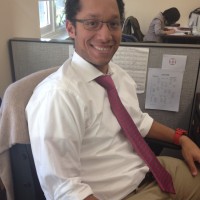
“Communism, in theory, [means] everything belongs to everyone, but in practice [means it] belongs to no one,” said Señor Romay, Newark Academy’s newest Spanish teacher, when describing the political climate of his native country of Cuba.
To conclude their study of Cuba’s government and history, the 8th grade got a chance to hear Romay’s inspiring story of growing up under an authoritarian Communist regime and eventually moving to the United States. The following is a brief synopsis of that story.
When he first entered kindergarten, Romay said, he knew nothing of individuality, just as the government wanted it. Every morning, kids would chant, “Pioneers for communism; we will be like Che!” referring to Che Guevara, the radical Argentinian Marxist revolutionary, known for his role in ousting the US-backed dictator, Fulgencio Batista.
In middle school and high school, Romay attended state-mandated boarding school. He called this separation from home a “logistical nightmare for families.” The only cars in Cuba had a hard time traveling the 70 to 100 miles to the boarding schools and the gas, for these families, was too expensive.
Boarding school for Romay was split into two sections. For 45 days, he worked on a farm doing hard labor. He spent the rest of the year in the classroom learning Cuban revolutionary propaganda. Romay said he was treated with extreme cruelty during these years.
Later, after high school and university, he became a teacher. At first he taught in a Cuban school, where the students were, in his words, “dedicated and a joy to work with.” To reward Romay’s success with these students, the government sent him to teach in a run-down school, where the kids did not care about their studies or, in his opinion, about him.
His first trip outside Cuba was to Spain, and what he saw stunned him. On the front page of a newspaper was a caricature of the current Spanish president. He immediately ran away because he was afraid he would be arrested. In Cuba, a similar caricature of Fidel Castro would have resulted in the mysterious disappearance of the artist.
Romay was startled by the foreign freedoms that the Spanish people had, so much that when he came back to Cuba he did not “know what left or right was anymore.” All he knew was that he “wanted to be as far away as possible from the Castro regime.”
He moved to America in 1999. Right after his move, he remembers being in Fairway Market and being shocked by the variety of apples. Though seemingly trivial, for the first time in his life, he had choices.
World Cultures teacher, Mr. Ball, was happy with the way Romay’s presentation went, saying, “it was the perfect way to end our unit on Cuba. The students had lots of questions and we were lucky to have someone to answer them from firsthand experience.”
The 8th grade was equally positive in their reaction. Charles Pan ‘18 said Romay, “ helped clear up a lot of things about Cuba and it was interesting to hear about life in Cuba.” Similarly Ashley Sun ‘18 asserted that Señor Romay’s presentation, “was interesting because we read about [Cuba] in the CultureGrams [country reports 8th graders use to understand basic facts about different countries] but never really had someone who experienced it.”
It now appears that someone who was voiceless and powerless in Cuba finally found an audience in America.
Leave a Reply
You must be logged in to post a comment.