By Courtney Cooperman ’16, Commentary Editor
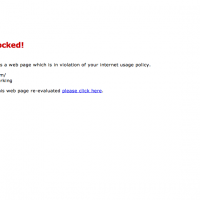
Everyone knows the feeling of restlessness that accompanies long study sessions or hours of intense focus on homework. Eventually, we all need at least a few minutes to grab a snack, watch an episode of TV, play a game, listen to a song, or quickly scroll through our newsfeeds. However, for drained studiers or habitual procrastinators hoping to take a quick Facebook break on campus, the message that appears onscreen can be disappointing and frustrating. Notoriously, the Newark Academy student network restricts certain websites, including Facebook, Tumblr, and Spotify.

Despite the frequent grumbles about lack of access to particular websites, many students misconstrue the reasons behind the blockage. Filtering is mainly a method of conservation, not a defense again inappropriate use – even when the Academy did not filter, there were no notable problems with explicit content. Mr. Scott, Director of Information Technology, clarified that the primary goal is “not to block sites with the aim of ensuring that kids are academically focused, but to protect the Academy’s resources.” The most logical way to harness Newark Academy’s resources for their intended purposes is to block nonacademic websites.
As System Administrator Mr. Ionescu explained, “Bandwidth is not infinite […] we mitigate that through various means on the firewall itself, and academic resources take precedent.” Contrary to popular belief, the technology staff does not select individual websites to block, but blocks them by general category, allowing teachers and students to utilize the network for valuable purposes without bogging it down. The system also protects Newark Academy’s relationship with the Internet provider. Mr. Ionescu stated that the technology staff must do everything it can to limit unnecessary traffic, since the corporation providing Internet access can investigate and evaluate the sources of excess traffic, potentially shutting down our connection.
Yet, reducing overall bandwidth consumption is not the technology department’s primary objective. Since the technology administration has recently noticed increased use of the Internet for academic purposes, it has reevaluated the system and significantly upped the bandwidth. Mr. Ionescu pointed out that even with increased bandwidth: “People are already saturating that […] and we’re proud of that, people are really using the resources.” He hopes to evolve the network to meet growing needs for technology and to accommodate the countless unique tools that the Internet provides.
Despite the logic behind filtration, many students still resent some websites’ inaccessibility. At home, a large number of students listen to music while studying, and many get their music on Spotify. As sophomores Sam Okinow and Asia Moore reasoned, “Some people need to listen to music while they study, and Spotify makes it easier to access. There is actually research that shows listening to different music for different subjects helps some people focus.” Other students have pointed out that Sporcle, a popular site full of “mentally stimulating diversions,” as its logo displays, is blocked, although it can be a valuable way to take a break.
But music lovers and trivia enthusiasts should never feel that they are oppressed by an inflexible system. Mr. Ionescu established, “If people can make a good academic case for something, we are always open to that,” and encourages anyone with a good reason for unblocking a website to speak to the technology staff. In the past, students have called attention to blocked websites with potential value, and the technology staff has reevaluated their restrictions. A few years ago, some students noted that a website with academic merit, a site similar to Dropbox called Cubby.com, was inaccessible. It was soon reassessed and unblocked on the network.
Overall, filtration on the Newark Academy student network exists to maximize valuable use of the Internet, not to minimize distractions or diversions. Assiduously controlling student online activity is not the technology staff’s priority, nor is it entirely in their power. If students feel the urgent need to scroll through Facebook or Tumblr, most students can check using data on their smartphones, negating the anti-procrastination byproduct of a restricted network. Some even use circumvention services, a risky method to dodge the network’s limitations. Although the technology department strongly discourages the use of circumvention services, maximizing student productivity is not one of the technology staff’s main concerns. As Mr. Scott concluded, “We’re not out to Big Brother anyone.” Although network restrictions often thwart our procrastination, or in some cases inhibit our ideal working environments, filtration exists for a reasonable purpose: to make room for more academic resources. Yet expanding access as well as restricting it can meet the technology staff’s overarching goal of academic gain. The primary purpose of the network is to meet community needs, and if students take initiative as these needs develop, over time the network will adapt accordingly.
Leave a Reply
You must be logged in to post a comment.