By Megha Poddar ’15, News Editor
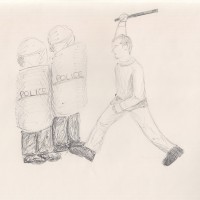
In the span of only a few weeks, protests in Ukraine have deepened to the point where former Ukrainian President, Leonid M. Kravchuk, warns that the country is “on the brink of civil war.” Gaining far more media attention as the uprisings begin to grow deadly, the protests started in the capital of Kiev about two months ago when President Yanukovych rejected an expected deal for greater economic integration with the European Union. The deal was popular with Ukrainians; however, the protests are about much more than a trade deal. They also have roots in the authenticity of the government, as Yanukovych and his entourage have mismanaged the economy and have been increasingly seen as corrupt. In fact, the protests had actually been dying down until January 16, when Yanukovych signed an “anti-protest law” that also deeply restricted free speech, media, and a sense of privacy across the country.

Image Courtesy of Media Staff
Symbolically, Yanukovych’s decision was seen as a turn away from Europe and one towards Moscow. Both regions have vied for dominance in Ukraine for centuries, fostering deep cultural differences between the western and central regions that yearn for ties with the West, and the eastern and southern regions that look to Russia for support. Jake Cohen ’14, Co-President of the Think Tank, asserts, “Russia’s grip over the entire nation of Ukraine has truly pushed the Ukrainian people over the edge. Personally, I think that the European Union would be a better decision for Ukraine because it is much less controlling and restrictive than Russia.” As a matter of fact, Putin effectively rewarded Ukraine for rejecting the trade deal with the E.U. with a “stimulus” worth billions of dollars and a promise of cheaper gas exports. That being said, however, Ukraine is “deeply, deeply divided by language, by history, and by politics,” as Mrs. Schottland, teacher of Politics of Change, explained. “There is no black-and-white solution. Someone will lose no matter the outcome.” With one half of the country Russian-speaking, and the other half Ukrainian-speaking, the country is split down the middle.
The spark of the recent protests lay with the increasingly undemocratic characterization of the Ukrainian government. In addition to the recent “anti-protest law” that limits the sociopolitical and human rights of citizens, the Ukrainian government is also tainted with claims of corruption from all ends. Protestors are even calling for Yanukovych’s resignation and early elections. At the Academy, the Political Action Society (P.A.S.) has been working with Amnesty International in hopes of advocating for social justice across the globe, including Ukraine. Co-Founder Halle Abraham ’15 highlights that, “to limit freedom of speech, press, and association is to deprive people of their fundamental human rights. We have seen governments overstep their powers in this regard over and over, and the situation in Ukraine, as well as the rest of the world, must come to a permanent end.” Abraham, along with the rest of the club, plans to continue to advocate for Ukrainian’s rights in future letter-writing events.
While protests in recent years have seemed detached and distant from our small community, they serve as a stark reminder of the importance of cultural ties and human rights globally. As the situation in Ukraine grows in the coming weeks, it is important that the Academy maintains an encompassing perspective of the events that alter the world we live in.
Leave a Reply
You must be logged in to post a comment.