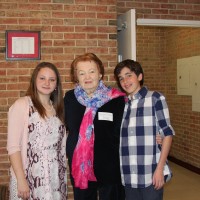
Last year, humanities teacher Ms. Schottland began a new speaker series aligned with the freshmen Ancient World curriculum. This April, the class of 2017 was lucky to welcome Marsha Kreuzman, a Holocaust survivor, to the Kaltenbacher Hall as the second annual NA Dialogues speaker. As anticipated, Ms. Kreuzman’s visit was a powerful and memorable experience. Below, Jason Suh ’17 and Megha Gupta ’17, respectively, reflect on the impact of Ms. Kreuzman’s story.

Reflection on Marsha Kreuzman’s visit, by Jason Suh ’17
Holocaust survivor Marsha Kreuzman visited Newark Academy to recount her riveting, yet horrifying story as a World War II concentration camp captive. Her arduous struggle to survive began from the moment of her incarceration, in the year 1939 when the Nazis invaded Poland and sent her family to the Krakow ghetto; less than a year later, her mother was taken to the Majdanek camp and killed. Shortly after, her family was taken to the Plashov labor camp on the outskirts of Krakow, where the prisoners were forced to do strenuous work or be mercilessly punished by the Nazis. At one point of the talk, she recalled a time when she was actually hung upside down on a door for attempting to visit her brother. This occurrence, along with a multitude of other trials she was forced to undergo (such as walking for five straight days to Auschwitz), imposed so much torment that she eventually found herself yearning for death. Fortunately, she was rescued at the Mauthausen concentration camp in 1945, and was literally swept off her feet by U.S. soldiers and whisked away to a hospital.
Personally, I genuinely found Ms. Kreuzman’s story to be extremely intriguing and perturbing. While I have heard the tales of many Holocaust survivors, the depth and detail of Ms. Kreuzman’s account truly shocked me. I was particularly unsettled by how the Nazis treated her, as they not only subjected her to countless painful experiences and trials, but also ruthlessly killed her family members as well. Such cold-bloodedness brings me to question the Nazi’s sense of morality. Did they even have a sense of ethics? Were they at all fazed as they tortured these innocent people, who are human beings – just like them – that only differ from their captors in religious belief? Did they even think to question their leader, who promised them peace and prosperity? Judging from the story of Ms. Kreuzman, it seems that the answer to these questions is a blatant “no.” And although I cannot understand the minds and thought processes of these Nazis, it at least helps to gain knowledge on the perspectives of the survivors, who are courageous enough to revisit this time of unfathomable hardship and provide the children of this generation with insight. For this, I thank Ms. Kreuzman.
Thank you to Marsha Kreuzman, by Megha Gupta ’17
Thank you, Ms. Kreuzman, for coming to speak to us. I was really interested in all of the things you talked about, and if I could, I would like to give you some insight into what you taught me.
First, you taught me that there are two sides to every story. I never thought that people who survived the Holocaust would say that during the Holocaust, they wanted to die. But your honesty showed us the real emotion people felt at the time. Since none of the students lived during the time of the Holocaust, we don’t really know the reality of the situation. When you said that the Nazis “broke us completely,” I was instantly brought to the realization that this tragedy was real, and affected so many people. I am not saying I did not believe that the Holocaust was real, but I couldn’t picture something so horrific happening, only 50 years ago. After learning about your experiences in the five different camps, I felt like I could vividly paint a picture of what was happening, and I have never been able to do that with any of the other witnesses we have seen. So thank you so much for that.
In addition, I wanted to say that I loved the final message you gave us: “tolerate everyone.” You didn’t even ask us to love everyone, but simply to tolerate others. Thinking about tolerating people on a broad scale is easy; if people tolerated other people’s religions, none of the horrific tragedies that occurred during World War II, for example, would have happened. But that’s only half the story. As humans, we must learn to tolerate everyone. Everyone, as in our classmates, our teammates, our neighbors. Only after learning to tolerate the people that surround us will we learn to tolerate whole nations, and different religions, and the “big stuff.”
Ms. K, thank you so much for everything you taught us. I am happy to say that I feel like a witness (to a survivor) of the Holocaust. As Ms. Schottland said at the beginning of your talk, this is truly a moment in my life that I will remember.
Leave a Reply
You must be logged in to post a comment.