The Minuteman

The Official Newark Academy Newspaper

A Reflection: “Congress shall make no law”… until Newark Academy does

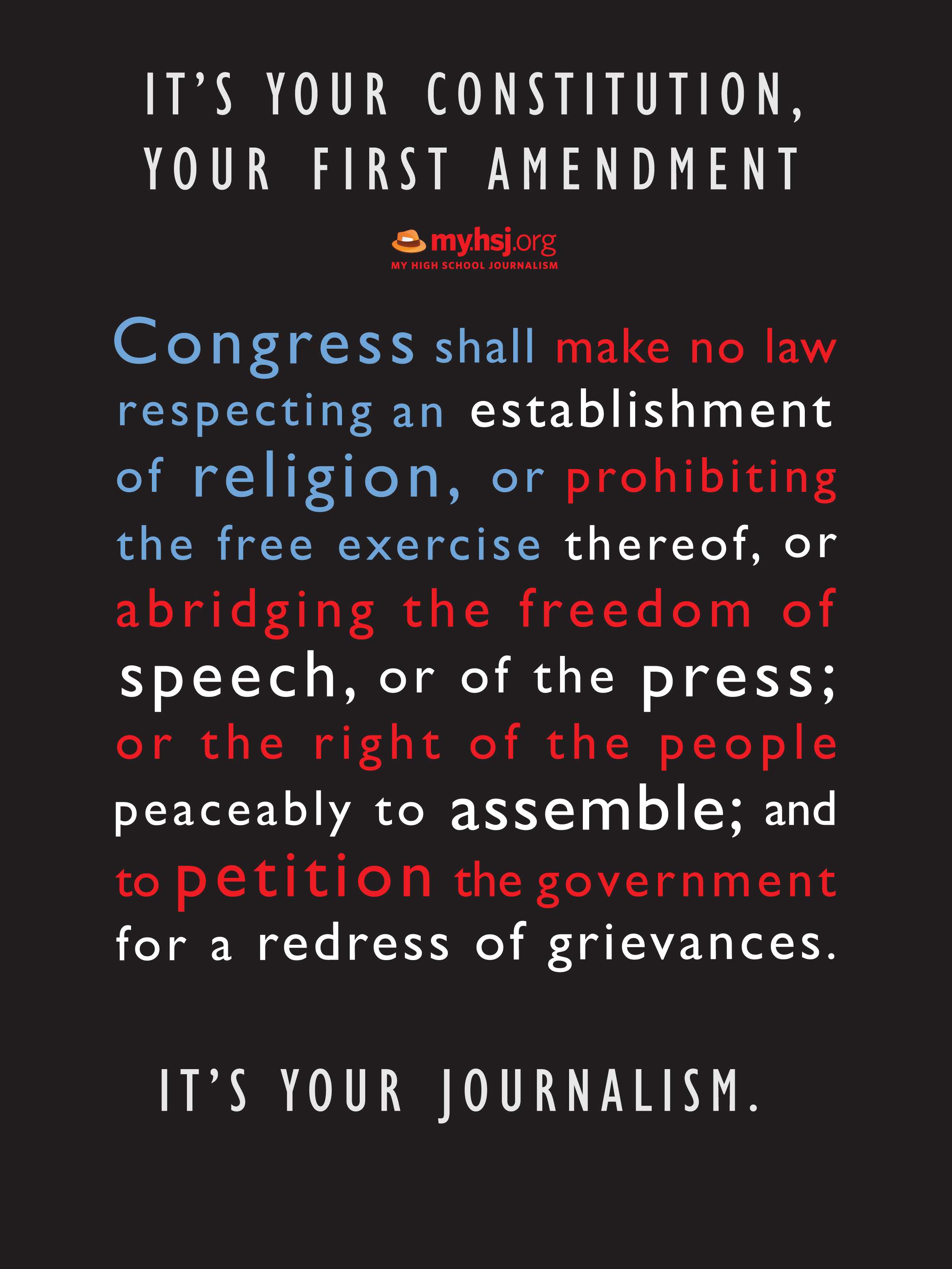
A promotional poster encourages public high school journalists to exercise their First Amendment rights to the freedom of speech and the press. Image courtesy of the American Society of News Editors (ASNE) High School Journalism Initiative at hsj.org.

The First Amendment to the Constitution of the United States of America: we’ve reviewed it repeatedly, been versed in its implications, been made to memorize the countless examples of its violation, and have been urged to exercise our so described rights. And certainly at Newark Academy, only strict and righteous endorsement of these rights has been expected and experienced. Or so it seems.

Mlle Obydol was readily allowed to deliver a Morning Meeting presentation on identity and race; the Newark Academy community recently welcomed what some considered a controversial and at times even offensive Global Speaker, Faraj Faraj. The plethora of review committees and student-led clubs stands as a testament to the Academy’s dedication to free speech, particularly when it promotes progress. All in all, members and guests of the school community are encouraged to voice their opinions.

For this, the staff of The Minuteman should be grateful. And yet, in early November, as participants in the Columbia Scholastic Press Association’s annual journalism conference, we were once again reminded that unlike in public schools where student journalists’ rights are protected under the First Amendment, those of private school students are not. The Minuteman, unlike public school publications, cannot go to press without first being reviewed by the oft-grumble-inducing “Administration,” represented in such cases by the Dean of Students, Ms Galvin.

We understand and appreciate the administration’s desire to preemptively ensure the protection of the newspaper’s readers from insult or libel and the protection of the staff from ill-repute. As a result, we have, over the years, learned to self-regulate. Through a hierarchy of staff writers, columnists, editors, editors-in-chief, and advisors, we have learned to self-censor, and in effect have been bred to do so. But at what cost to our journalistic liberties, to the very essence of journalism, and to our community?

In this newest article set, for example, we could not publish the names of the students who compromised the Newark Academy email system, though doing so would have allowed for greater elucidation as to the problem’s causes. As we on the Minuteman‘s staff often are, we were hard put to fill our Commentary and Humor sections with “appropriate” material, especially when contending with reactions to Global Speaker Faraj Faraj’s remarks. And in a way, we have seen this self-censorship extended beyond the staff of the school newspaper to the school community at large. Through casual conversation we have heard of students and faculty members with rather strong opinions regarding various school-wide issues and incidents. Yet, when urged to express their opinions in print for The Minuteman, either in article or comment form, they quickly decline, claiming (whether sincerely or not) that their work will either be censored or, if published, damaging. Damaging, that is, in terms of the community members’ sensitivities and sensibilities.

So the question arises to be reflected upon, and can conveniently be applied to both the Newark Academy community and American society. What is more damaging to a community and a people, to the propagation of discussion-worthy opinions, and to the adventurous independence of the intellectual: an administration (or government) that explicitly denies free speech and free press to its citizens’ through conspicuous, written legislation, or a society that outwardly commends itself for upholding its members’ rights to free speech and free press and yet discreetly does otherwise? Perhaps certain written pieces in this newest article set, and perhaps this very editorial, are a step in a new direction, one in which the desire for security and conformity is replaced by the desire for frankness and truly practical and valuable dialogue.

-The Minuteman Editorial Staff


Comments

5 responses to “A Reflection: “Congress shall make no law”… until Newark Academy does”

  1. Charles Gormally Avatar
    Charles Gormally

    Bravo Editorial Staff! The thought that an institution that promotes a ‘global view’ would not foster the freedom of expression within your publication has always troubled me. Your restrained but right on article is hopefully the beginning of a refreshing dose of freedom to write what you think, rather than conform to the views of others.

    1. Mr. Bitler Avatar
      Mr. Bitler

      I agree wholeheartedly with Mr. Gormally. – – – To wit – It’s uncharitable to offend others on purpose. However, in this world, people have widely divergent views about morality, religion, politics, worldviews, ‘the truth,’ etc. In a true global academy, that should be recognized, and people should be allowed to state their honestly-held views about anything, even if someone, somewhere, gets upset. One can’t have it both ways. Either you have a rule that no one should ever be allowed to be offended or upset by anyone else’s view – in which case, you don’t get a real education about divergent views in this world. (And you do not have true diversity of thought…) The alternative is that people freely express their views, and some people get upset. I’m a believer in the unalienable freedoms which are guaranteed in our Constitution – which comes down forthrightly on the side of freedom: free speech, freedom of religion, freedom of the press, freedom of assembly, freedom to protect one’s family with arms, if need be, etc. etc. One of the greatest things that young people can learn is this truth – that people around the world disagree – often vehemently – about all sorts of things. To truly understand the world – one needs to understand that – and why such deep disagreements exist. Otherwise, one is not truly educated about this world.

      -Mr. Bitler

  2. Ms. Acquadro Avatar
    Ms. Acquadro

    The Second Amendment to the Constitution states: “A well regulated Militia, being necessary to the security of a free State, the right of the people to keep and bear Arms, shall not be infringed.” It does not guarantee the freedom to, “protect one’s family” with a gun. Paraphrasing requires that the writer capture, as accurately as possible, the intent of the original writer. The commas in this amendment are of particular importance as well. While some may read the amendment as a blank check for any kind of gun ownership, the commas–put there by those smart Founding Fathers–indicate that “arms” are necessary for a “well-regulated Militia.” Why else would the Militia even be mentioned in the amendment?

    1. Mr. Bitler Avatar
      Mr. Bitler

      People owning guns, as in a well-regulated militia, are the last defense of a free nation – for otherwise, a tyrannical government may take the inalienable freedoms of the people away by force. Such has been done in innumerable places at many times – as a cursory check on history will attest (and often after government gun confiscation took place). Indeed, without such militias, such as those led by George Washington, the United States would not have been brought into existence. This country was formed by people fighting for their inalienable freedoms with guns. And given that inalienable right of people to own arms, guaranteed by the US Constitution, I, for one, would certainly protect my family with such if required to (as would millions upon millions of other Americans). Freedoms are not free, and there are many would be tyrants in this world who would like to take them away by force or coercion. Whether in defending the freedoms of the citizenry from tyranny, or defending ones family from violent destruction, the principle is the same – that your free pursuit of life, liberty and happiness may not easily be taken from you by force.

    2. sglassman19 Avatar
      sglassman19

      There are different versions of the second amendment with different commas. The one ratified by the states, and approved by Secretary of State Thomas Jefferson, so for all intents and purposes the active one reads, “A well regulated militia being necessary to the security of a free state, the right of the people to keep and bear arms shall not be infringed. I read in both versions that people have the right to bear arms and form a militia. It never says to bear arms in a militia, it says to maintain and militia, and then separately to bear arms. I agree the comma is important because it shows that we can bear arms outside of a militia. You also made the point that guns are to protect ones family, which is true, but not the most important reason why we have gun rights in America. Today, Obama is politicizing the deaths of nine innocent people, and him saying that we should politicize it isn’t a reason why we should. None of his solutions would solve the problem, and it would take away from what our founding fathers intended. Mr. Bitler had it correct when he said that the right to bear arms is to protect ourselves from a tyrannical government. The United States is the only country in the Western world, maybe even the whole world that has never had a tyrannical government. Ben Carson has been widely criticized recently for saying that less people would have died in the holocaust had the jews had guns. A lot of jewish organizations have been mad at him for that because they consider the holocaust such as hallowed event, not for being good but for how horrible it was, that they don’t think it should be politicized. They are exactly right the massacre of people shouldn’t be politicized, but that doesn’t mean Ben Carson is wrong. I am sure that if I had a gun and someone tried to send me on a train to my death like a cow I would shoot them before I died. If all of the jews had guns they could’ve stage a large rebellion, many could’ve fled and they could have survived until the Russians invaded Poland and fought with them. Many jews still may have died but there would be a second thought and chance in the final solution. On a separate point I don’t understand why your comment would be the criticism of a constitutional right on a different amendment than the one at hand. I am embarrassed that my comment on this article wasn’t praising the first amendment and the bill of rights, when that’s what it should’ve been, instead it was defending the bill of rights. When I read through the tenths amendment I understand what makes our country so great. Anyone is allowed to criticize, condemn, or complain about it. But they should not that all the freedom they have to even hold or express an opinion, comes from that document.

Leave a Reply