By Courtney Cooperman ’16, Feature Editor

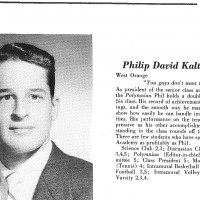
Nearly 60 years ago, the position of The Minuteman feature editor was held by Mr. Philip Kaltenbacher ‘55, whose name we now associate with the grand multi-purpose room in the New Wing. His name has already passed into our everyday vocabulary, but when the hall was christened, Mr. Kaltenbacher was sure that it would remain obscure. “I figured no one would call it Kaltenbacher all the time, they’ll call it the K or something. It’s a mouthful,” he chuckled. Although the student body commonly refers to the Kaltenbacher, few of us know about the committed individual that made its construction possible.
Mr. Philip Kaltenbacher made the donation for Newark Academy’s recent capital campaign, but the hall is named for his father, Joseph Kaltenbacher ’24. Joseph Kaltenbacher went to Cornell, struggled in the arts college and succeeded in chemical engineering, as the younger Mr. Kaltenbacher explained. His uncle, Richard Kaltenbacher ’31, was a hurdler in his days at Newark Academy, and also went on to Cornell.
Joseph Kaltenbacher’s passion for Newark Academy encouraged his son to attend. Philip Kaltenbacher described himself as a “rambunctious, undisciplined adolescent” when he entered the school. The Newark Academy faculty defined and transformed his educational experience and lifelong attitude towards learning. He recounted, “I guess I was smart enough, but wasn’t very well-directed until Mrs. Catherine Lynham tutored me. I was about a year behind when I went from public school to Newark Academy. She made me a deal. She said, ‘What do you like about school and what don’t you like?’ I said, ‘I like learning, but I don’t like doing things over and over. I don’t like homework.’ She said, ‘When we go over things, I’ll give you an easy question and a hard question, and if you get them right, no homework.’”
Mrs. Lynham, who Kaltenbacher frequently referenced when discussing the impact of Newark Academy on his life, instilled the value of hard work in him. Through his work with Mrs. Lynham, Kaltenbacher was “diagramming sentences in his sleep,” and to this day, he makes few grammatical mistakes because he still imagines “Mrs. Lynham with her thumb and finger pulling on [his] ear and telling [him], ‘no laddie!’” Even after attending Yale and Yale Law, he still considers Mrs. Lynham to be his greatest teacher.
Overall, Kaltenbacher wholeheartedly appreciates the advantages that a Newark Academy education gave him, and the many possibilities to which it exposed him. Kaltenbacher stated that he “went to college well-prepared,” explaining, “The intellectual rigor that was instilled in the early years was probably the most important educational tool that I had for the rest of my life […] my other schools were terrific, but nothing was greater than being a teenager and being taught by these wonderful people, having this intellectual rigor and kindness and caring at the same time.”
Kaltenbacher certainly took advantage of the unique opportunities at Newark Academy, which propelled him into future success. Besides serving as Minuteman feature editor, Kaltenbacher was editor-in-chief of the Polymnian, class president, and a varsity tennis player. After his Minuteman career, Kaltenbacher became editor of the Yale Daily News. In this position, he got to spend time with various well-known personalities, including Robert Frost and Harry Truman.
One of Kaltenbacher’s highlights of Newark Academy was the ability to individualize learning experiences. “If your mind itched [in an area outside of the course], they let you scratch it. They let you go and nurtured you,” he explained. When his teachers sensed his interest in an upcoming Newark election, he was allowed to explore and study the political scene with support from the school.
“Did that have anything to do with my going into public life later? You never know,” Kaltenbacher mused. After Yale Law, Kaltenbacher went on to join the state legislature, become the state Republican chairman (“back when they had liberal Republicans,” in his words), and become chairman of the Port Authority. Regarding his career, Kaltenbacher, now retired, commented, “If you’re well-prepared and do something you like doing, you’re blessed. I can remember getting up every morning and saying ‘I can’t believe I get paid to do this.’ I just love working. I’ve been very happy and lucky and thankful, and Newark Academy is a piece of that.”
“It’s been fun,” he reflected.
Much of Kaltenbacher’s passion for giving back comes from the zeitgeist of the period in which he attended Newark Academy. A decade after World War Two, America was at the height of world power and stability, and going to a prep school was “a great running start, and we knew it,” as Kaltenbacher stated. “It was always emphasized that we were going into a wonderful future, and we were going to do well…we’d go to good schools, we’d get good jobs, and the only question was, ‘How are we going to give back?’”
Millennials have been referred to as the “me generation,” a sharp contrast from the prevailing sentiments of Kaltenbacher’s generation, even when he and his peers were teenagers. “It wasn’t a me generation,” he commented, “It was given that you owed. I think the thing that I remember most is the wonderful feeling we had, that wonderful re-emphasized charge that we were happily going to give back. It wasn’t just the Academy, it was America at the time.” Perhaps our Kaltenbacher Hall is more than the result of an individual’s generosity and the embodiment of his legacy, but also the product of Newark Academy’s ongoing ability to shape hardworking and dedicated students. When we enter Kaltenbacher Hall, we should be reminded of the successful, committed person that made it possible, and inspired to appreciate and fully gain from our experiences here.
Leave a Reply
You must be logged in to post a comment.