By Rakhi Kundra ’17, News Editor
In an era of student protests and growing racial tension on America’s college campuses, the confrontations and protests occurring among the student body at Yale University don’t seem to stand out. The conflict first arose when the university’s Intellectual Affairs Committee sent out a school-wide email asking for students to be sensitive in their Halloween costumes this past October; essentially suggesting that students avoid wearing “culturally unaware and insensitive” costumes that could offend students coming from racial and ethnic minorities. The email advised that students refrain from wearing feathered headdresses, turbans, or blackface. How can something that seems very culturally and racially sensitive be so controversial?

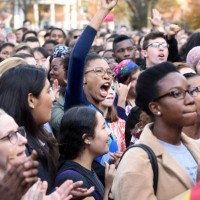
In response to this email, frustrated faculty members and students spoke out, arguing that students should be able to wear whatever they want, even if they ended up offending people. Erika Christakis, a faculty member and administrator on campus, wrote, “Is there no room anymore for a child or young person to be a little bit obnoxious….a little bit inappropriate or provocative or, yes, offensive? American universities were once a safe place for maturation….increasingly, it seems, they have become places of censure and prohibition.” This email provoked severe condemnation and countless protests and rallies amongst students across the Yale campus. Joining students from the University of Missouri, Dartmouth, Princeton, and countless other universities, Yale students are crying for an end to marginalization and cultural appropriation.
The reoccurring protests have caused people to debate the balance between upholding free speech and protecting students from racial profiling and cultural appropriation. Erin Viola ’16, president of Young Democrats, said, “In regards to the protests going on now, there is often a fine line between political correctness and censorship. For instance, removing the N word from Huck Finn in an attempt to not offend. These protests, however, are not an infringement on freedom of speech. They are an example of civic engagement at its most fundamental level, and they should be celebrated.” On the other hand, some argue that these student demonstrations are not effective and are not fighting for change. Elias Neibart ’16, president of Young Republicans, commented, “These demonstrations are not meant to be catalysts for meaningful change, in fact, they seek to shutdown discussion and force upon the university a dangerous, toxic left-wing ideology. American universities are supposed to be bastions of intellectual thought, and what we are seeing at Yale, Mizzou, and so forth, is the abandonment of logic and reason, and the adoption of a very emotional agenda, an agenda that seeks to stifle discussion and free discourse rather than promote it.”
Although the necessity and effectiveness of the student demonstrations occurring throughout Yale University is debatable, it cannot be ignored that racial and ethnic minorities throughout America still feel targeted and discriminated against. As Erin Viola ’16 noted, “While racial inequality has declined throughout history, there is still a ways to go. Institutional racism is evident everywhere you turn; whether you look at the disproportionate amount of people of color in jail, the stories of slurs and bigoted statements slung at people of color on the street, or the countless number of them who are killed by rookie cops. There are immense steps to be made.”
Leave a Reply
You must be logged in to post a comment.