By Kiran Damodaran ’17, Section Editor
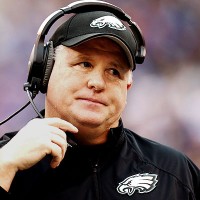
As a Philadelphia Eagles fan, it hurt to watch head coach Chip Kelly disassemble the team I had come to know and love. From Desean Jackson to Jeremy Maclin to Nick Foles to Lesean McCoy, Eagles fans trusted in Kelly’s every move, despite their instincts. The hashtag, #InChipWeTrust, rose in popularity among many fans who were hoping that there was an end game to his personnel overhaul through seemingly ill-advised deals. Yet as the season approached, Eagles fans, no matter how concerned, kept this trust tight to their hearts and prayed that Chip Kelly was right all along. See, Chip Kelly tried something different than the blueprint that coaches across the National Football League (NFL) have followed since its inception; Chip Kelly tried to push talent into the backseat.

Kelly, an NFL coach in his third year in both the Eagles organization and the league as a whole, is a former college football coach. At Oregon, where he coached previously, Kelly was famous for his system; Kelly had a vision of football where the system of the team was more important than the talent – and for the most part, during his tenure at Oregon, this vision was successful. When Kelly arrived at Oregon, his impact was felt immediately. Replacing Gary Crowton as offensive coordinator in 2007, Kelly entered the organization following a poor stretch in Oregon football, which culminated in the 2006 season where the team finished with a 7-6 record. In his first season as offensive coordinator in 2007, the team started 8-1 with Kelly’s new offensive system before being decimated by injuries. After Kelly took over as head coach in 2009, there was no stopping Oregon. They had cemented themselves as a college football power and had an astounding total record of 46-7 with Kelly as a head coach and appeared in a BCS Bowl each of his four seasons. How did he maintain such consistency? Although admittedly the teams were very talented, above the talent, which fluctuated every year, Kelly emphasized the up-tempo, spread system as the backbone of his team and it worked – in the college game at least.

When in 2013, Kelly accepted the Philadelphia Eagles offer to become head coach, many people questioned whether his same college system would be successful in the NFL. Initially, it appeared so. The Eagles maintained many of the same very talented players in Kelly’s first two years as head coach, and his system and team saw success in the form of two 10-6 seasons. Following the playoff berth in his first year, many people around the league began to wonder whether Kelly was right – whether a single system of football could transform the NFL. At the beginning of this past offseason, Kelly was granted full abilities as head of football operations, thus giving him the freedom to manage the roster how he saw fit, a power only granted to two other coaches in the NFL. Their names? Legendary Patriots’ coach Bill Belichick and Super Bowl champion Pete Carrol. With this power, Kelly made a number of trades, including one that traded All-Pro star running back and longtime Eagle, Lesean McCoy, away and another that dished away star quarterback, Nick Foles. Moreover, he allowed Jeremy Maclin and Evan Mathis, two well-known Eagles, to walk away from the team, the former by choosing not to re-sign him and the latter by cutting him. When the dust settled, the team had lost its all-time leading rusher, emerging quarterback, and top receiver.

With a roster that hardly resembled the one that former Eagles coach Andy Reid left in 2012, there was a lot of pressure on Kelly’s “new and improved” Eagles to be successful, especially in arguably the weakest division in the NFL, the NFC East. He had in many ways built a team that fit into his system, the same way he did in college through recruiting. Instead of focusing primarily on the talent on the roster, he focused on the system. Despite a promising preseason, in which the Eagles held a 3-1 record, the team struggled out of the gates, losing their first two games. Unfortunately, it didn’t get much better from there. Kelly’s Eagles had difficulty finding consistency and ultimately saw the plan that Eagles fans had placed so much trust in crumble within a matter of weeks. The team simply didn’t look good; something wasn’t right. As Anthony Giachin ’17 put it, “He was a college coach coaching an NFL team, and he treated it as if the two were the same.” The Eagles finished the year 7-9, but Kelly himself didn’t make it all the way there. After Week 16, in which the Eagles were eliminated from playoff contention, Jeffrey Lurie, the Eagles owner, announced that he fired Chip Kelly as head coach; the experiment was over. After two successful years as an NFL coach, Kelly had attempted to fully implement his system and circumvent the necessity for talent within the NFL; instead, he proved once more that talent is the ruling factor.

When all is said and done, Chip Kelly will have left his mark on the Philadelphia Eagles’ franchise – and it won’t be a good one. As Zach Keller ’17, a longtime Eagles fan, said, “Chip Kelly never really respected the talented stars on his team, and so they didn’t respect him back. You can’t successfully run a team when your players don’t want to play for you.” The team took a chance on Kelly, placing full trust in his inexperienced hands, and the fans followed suit. When the former college coach attempted to transfer his fast-paced, spread system into the NFL, football fans around the country sat nervously, waiting to see whether maybe, just maybe, Kelly’s system would prevail. But when the dust settled at the end of the Eagles’ season, one thing was clear: in the NFL, systems cannot drive a team. Talent trumps all else.
Leave a Reply
You must be logged in to post a comment.