By Abbey Zhu ’18, Staff Writer
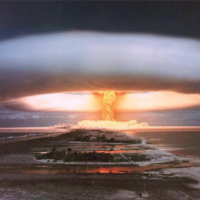
On January 6, 2016 at 10:00 AM, North Korea declared that it successfully detonated its first hydrogen bomb. An hour earlier, detection devices had picked up a 5.1 magnitude earthquake on the northeast coast of the country, seismic activity being indicative of a nuclear explosion.
This is not the first time North Korea has tested nuclear weapons, despite international objection and the country pledging to denuclearize itself. Over the past nine years, North Korea has conducted a total of three nuclear tests. The first of the tests dates back to October 9, 2006, and its impact was minimal, raising doubts about the sophistication of North Korea’s nuclear weapons. The size of the bomb was also one-tenth of the size of the atomic bombs used during World War II. However, a subsequent test, which took place on May 25, 2009, detonated a blast whose size was equivalent to the bombs dropped on Hiroshima and Nagasaki. The final test occurred on February 12, 2013. Unusual seismic activity was detected, and the North Korean government mentioned that the weapon tested was “miniaturized.” A miniaturized nuclear weapon could fit onto a long-range missile, which could be fired towards the United States and other countries, raising international concerns.
History teacher Mr. Hawk says North Korea justifies its behavior because it “legitimately believes it is vulnerable to US invasion or attack, and atomic weapons are the only feasible deterrents against American imperial aggression.” While it is easy for Americans to view North Korea as a hostile, belligerent nation, Mr. Hawk says we feed our own misconceptions: “The fact that the movie The Interview was made means that North Korea fits into our imagination and misconceptions.”
In response to North Korea’s nuclear testing, the United States has imposed UN approved military and economic sanctions. These initiatives, however, have failed to stop the country from continuing its testing of weapons. For example, in 1994, the United States and North Korea came up with the “Agreed Framework”: North Korea agreed to stop its plutonium production in exchange for fuel oil, economic cooperation, and the construction of two nuclear power plants. The agreement stated that eventually, all of North Korea’s nuclear facilities would be dismantled. However, the implementation of this agreement did not go smoothly. The US supplied North Korea with insufficient funds and late oil deliveries, and never lifted economic sanctions. For failing to keep up its end of the bargain, the US cited suspicions that North Korea continued its undercover nuclear program, which North Korea denied. The agreement finally fell apart in 2003 following US accusations that North Korea had a uranium enrichment program. Also in 2003, North Korea announced its revocation of the Nuclear Non-Proliferation Treaty, which it had signed in 1985. The treaty was created during and in response to the Cold War, and is committed to the prevention of the spread of nuclear weapons.
Despite the imminent danger of North Korea’s claims of successfully testing a functional hydrogen bomb, this danger becomes apparent only if the country’s claims prove to be true. Scientists doubt North Korea is telling the truth because the US detonated a hydrogen bomb beneath the Alaskan tundra in 1971, and it produced a 6.8 magnitude earthquake. In North Korea, seismic activity was measured to be 4.8 (5.1 at most).
When asked why she thinks North Korea continues to test nuclear weapons, history teacher Ms. Fischer offered, “It is an attempt to stay relevant in world politics. North Korea wants to use the fear of their ‘extreme’ government to the best advantage possible. This desperate ‘nothing to lose’ mindset scares me more than anything else because it creates unpredictable behavior that flies in the face of reason and self-preservation; it makes it harder to prepare for and respond to, thus making effective American foreign policy very difficult to create.”
Regardless of whether or not North Korea actually possesses a functioning hydrogen bomb, the fact that it continues nuclear testing despite international objection and US sanctions demonstrates the country’s growing desire for international power and prestige.
Leave a Reply
You must be logged in to post a comment.