By Spencer Wang ’19, Staff Writer
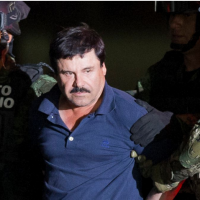
Joaquin Guzman, the notorious drug lord known around the globe as El Chapo, was again captured by Mexican authorities on Friday, January 8th. This marks the third time Mexican authorities have detained El Chapo in the span of nearly 3 decades.
Joaquin “El Chapo” Guzman has been Mexico’s top drug kingpin since the early 2000s. He has run the Sinaloa cartel in the Mexican state of Sinaloa, one of the biggest cocaine dealers to the United States. The New York Times reports that the cartel has smuggled anywhere between 200 to 23,000 kilos of cocaine to the United States alone. In 2013, Forbes Magazine ranked El Chapo as the 61st most powerful person in the world and 1153rd richest, with a net worth of over 1 billion dollars.
Interestingly, the stigma surrounding El Chapo has been somewhat controversial. The Sinaloa cartel has long been seen as one of Mexico’s most violent and gruesome gangs, and wars with rival gangs and authorities have led to the death of thousands of Mexican citizens. On the other hand, El Chapo has donned a Robin Hood persona. Stories of him helping the poor and funding roads, schools and other infrastructure are being told throughout Mexico. However, his main claim to fame is his three outrageous escapes from Mexican prisons; most famous is his escape last summer from a maximum security prison through the shower floor of his cell.

After 6 months of a nation-wide search, Mexican authorities located El Chapo in a house in the city of Los Mochis through a taco order made by one of his associates. On January 8, Mexican marines raided the house, and a wild gunfight broke out. Although five of El Chapo’s men were killed and others were arrested, the drug lord himself was nowhere to be seen. Further investigation by the Mexican marines found multiple secret exits in the house, and officials say that El Chapo yet again escaped through a secret tunnel hidden behind a bathroom mirror. This tunnel led to a sewage system where El Chapo and his lieutenant walked almost a mile before exiting through a manhole, only to finally be captured by the authorities. Once the marines arrived, El Chapo was paraded in front of the media before being ushered to the same prison he escaped six months earlier.
A few hours after the raid and El Chapo’s subsequent capture, Mexican President Peña Nieto celebrated the Mexican forces, saying,“Today our institutions have demonstrated one more time that our citizens can trust them, and our institutions are at the level that has the strength and determination to complete any mission that is granted to them.” Though El Chapo’s capture is indeed a success, it has been viewed as an example of the Mexican government’s ineptitude and corruption in Mexico’s judicial system. El Chapo might now be moved to the United States for safekeeping. Senator John McCain tweeted out after knowledge of El Chapo’s capture: “Congratulations to the Mexican Navy on the capture of El Chapo. Now let’s extradite him to the US,” feeding questions that have arisen about whether or not the U.S should be allowed to extradite El Chapo and decide his sentence. Senior Elias Neibart, president of Young Republicans, said, “Essentially, if the Mexican justice system or police forces are exhibiting inadequate enforcement of their own laws, then El Chapo is obviously a harm to the United States and Mexico. The United States has the moral and military imperative to aid in Mexico’s enforcing of their laws and aid in the adjudication of El Chapo.”
In the larger scope of things; should the United States be allowed to interfere in criminal and judicial matters in foreign countries where they see fit? Blackie Parlin, archivist and much-esteemed humanities teacher, briefly commented, “Whenever there is a person who has broken US law and is held by a foreign country, I am in favor of extradition. In the case of Jouquin Guzman, where he heavily violated United States law I believe the U.S should have him extradited.” Talks of El Chapo’s extradition come a few months after Antonio Reynoso Gonzalez, another member of the Sinaloa cartel linked to El Chapo, was extradited to the United States on numerous drug trafficking charges. The United States is now working with the Attorney General of Mexico, Arely Gonzalez, who has shown an agreement to the extradition of El Chapo. However, there still may be a few years until El Chapo is ever brought into U.S custody. El Chapo’s lawyers have been trying to stop El Chapo’s move to the United States, saying he will not get a fair trial and citing anti-Mexican sentiment fueled by presidential candidate Donald Trump. This defense by El Chapo’s lawyers may in fact just be a desperate ploy in order to stall so that El Chapo’s men can plan and execute a third escape.
In a controversial article written by actor Sean Penn, who gained access to a brief interview with El Chapo before his capture, the drug lord commented, “Drug trafficking is already part of a culture that originated from the ancestors. And not only in Mexico. This is worldwide…it’s a reality that drugs destroy. Unfortunately, as I said, where I grew up there was no other way and there still isn’t a way to survive, no way to work in our economy to be able to make a living.” It is a sad reality told by the drug lord and evidently one that heavily involves our lives as Americans. In countries with high levels of poverty and uneven distribution of wealth, drugs and various illegal services are an easy outlet for the poor to get rich quickly. But, this does not take importance away from the fact that the trade has led to thousands of deaths around the world and has cost the global community millions of dollars in attempts to prevent it from occurring. The responsibility to end this illicit, dangerous trade falls into the hands of government officials. Evidently the busting of drug dealers and gangs will not end drug trafficking; officials must first fill in economic gaps and deficits that lead people to resorting to these illegal activities.
Leave a Reply
You must be logged in to post a comment.