By Chris Pyo ’17, Staff Writer

When I heard the rumors that Frank Ocean was possibly releasing a new album, one that fans have been waiting for ever since he dropped Channel Orange, I honestly laughed and completely disregarded them. After all, I was used to being disappointed by the unreliability of every Frank Ocean rumor that appeared on social media. Whenever someone famous within the music industry advertised Frank’s new album and said that it was coming along, the news was soon dispelled by the silence that followed. For a year, the R&B community legitimately feared that Frank Ocean had disappeared from the music scene altogether, and apart from the extremely occasional update on his Tumblr blog to ensure that the music industry still knew that he was alive, it seemed entirely possible that Ocean had disappeared.
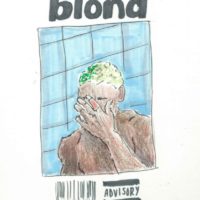
And then Blonde set the music world in a frenzy. Stylized as Blond on the cover of the album, Blonde was released on August 20th, 2016 exclusively to the ITunes Store and Apple Music, although it was later released on Spotify as well. Accompanying Blonde was a visual album entitled Endless, which was released two days before Blonde. The music was and still is only available to stream on Apple Music, making it even more exclusive. There is widespread speculation that Endless was created and released by Frank Ocean solely in order to fulfill his contractual obligation to record label Def Jam so that he could release Blonde on his independent label, Boys Don’t Cry. This decision has proven to be a financially successful move for Ocean, as he is reportedly receiving around $5 to $7.50 per album sale, as opposed to the $1.50 to $2 he would receive if he were still signed to Def Jam.1 Catherine Benoit ’17 agrees with Ocean’s decision to use his own label: “I can understand why he did this and left Def Jam, because music companies and labels control so much and it stifles the music-making process. I think that if Frank Ocean wants to be able to make the type of music that he wants, he has to do it independently. Also, he’s making a lot more money as an independent artist than he would have as a Def Jam artist.” The album topped the Billboard 200 Charts and sold the equivalent of 276,000 album units in its first week, which was the third-largest debut week of 2016, behind Drake’s Views and Beyoncé’s Lemonade. To go along with the release, Ocean also spawned four pop-up shops in Los Angeles, New York, Chicago and London which all carried a magazine created by Ocean to accompany the album.
Blonde in itself is truly a masterpiece, carefully written and polished down to each beat and note. It features musical artists such as Kendrick Lamar, Beyoncé and James Blake, although one would not be able to definitively recognize their voices in the songs they appear in; for example, “Pink + White” credits Beyoncé as a backup vocalist, making her one of the most overqualified backup singers in history. The only easily recognizable featuring artist in the entire album is on the song “Solo (Reprise),” where André 3000 offers up his most substantial rap verse in recent years. Songs such as “Ivy” and “Self Control” tug at emotional strings, while “Nikes,” the lead single on Blonde, speaks on the shortcomings of materialistic self-indulgence. As an album, Blonde has a pleasant mix of fast-paced songs and slow, mellow songs, along with two short skits to fill in the gaps. However, the album received mixed reviews. While many critics praised the album for its innovation, intense emotion and intoxicating beauty, others were unimpressed. Neil McCormick of The Telegraph described Blonde as “relentlessly mid-tempo, obscure and indulgent, wandering inconclusively through snatches of half thoughts and vague ideas.”2 Ishan Gadde ’18 shared comparable sentiments. “I thought that it [Blonde] was too abstract, and most of the songs took a long time to develop. Also, Channel Orange was so good and he (Ocean) had such a long time to make a new album, but it didn’t meet my expectations.” No matter how anyone feels about Blonde, there is no denying that it was still a successful financial and emotional release for Ocean, as he was handsomely rewarded for the music that he was able to create without the pressure of a record label weighing down on his shoulders.
What distinguishes Ocean’s musical hiatus from that of other artists is the near-complete silence he directed towards his fans, which easily made him one of the most scrutinized and polarizing figures in pop culture in recent history. Apart from the occasional Tumblr tease, Ocean was (and still is) completely inactive on Twitter, Facebook and Instagram. These are the most prominent social media networks celebrities utilize to communicate with fans and give them information on upcoming projects; one must wonder why Ocean did not take advantage of these major platforms. While Ocean did in fact appear on a couple of songs for Kanye West, Beyoncé and Earl Sweatshirt in between his album releases, these appearances were in no way substantial enough to satisfy any Frank Ocean fan for too long. This conundrum led some fans to nearly abandon Ocean with the assumption that he would never produce or release a significant piece of music ever again.
However, now that he has released Blonde, people are slowly coming to the realization that Ocean simply needed some privacy. After Channel Orange blew up in 2012, and after his coming out as a gay man, Ocean was overwhelmed by the national attention that he received. Perhaps he may not have dealt with it in the best way by enclosing himself within his own tiny social circle, but Frank Ocean fans should be immensely grateful that he returned at all, especially with an album as eccentric and fantastic as Blonde, even if Ocean was annoyingly secretive to the very end of his album-creating and releasing process. Only time will tell if Ocean will choose to retreat again, or if he will go on tour, and perhaps create another album in the near future.
Leave a Reply
You must be logged in to post a comment.