By Kendall Fawcett ’12, Feature Editor
From a very young age I was surrounded by adults discussing current events and politics. The dinner table was my CNN. My parents never hid their views on American politics from me. In fact, they encouraged me to take an interest and to develop my own opinions, whether I agreed with them or not. I was allowed to say anything on my mind, but in the end, it was to stay at the dinner table. My dad insisted that I did not know enough to share my thoughts with my friends or classmates. His point was unless I wanted to make a fool of myself, I best keep my mouth shut. So, since I was old enough to think for myself, my thoughts concerning politics have stayed under lock and key. However, this is not the case with many Newark Academy students.
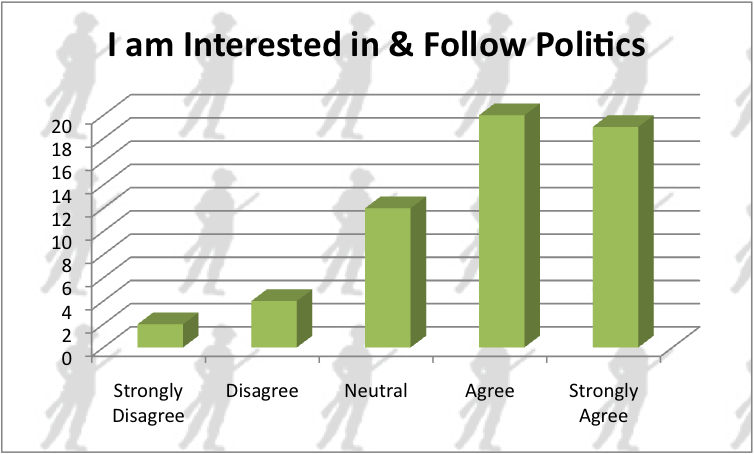
The Newark Academy community encourages its students to have a more than superficial knowledge of current events and politics. All are given equal opportunity to express judgments, even if those opinions ruffle a few feathers. A recent Feature Section survey polling Newark Academy students and faculty showed that 35% of NA students are interested in or follow politics, and 32% keep up with the national news. Yet these statistics do not represent the students’ actual knowledge. From The Colbert Report to The Simpsons, American politics are hard to avoid but that does not mean people take advantage of all the information that is available to them. It is very easy for individuals to persuade themselves that their strong opinions can make up for their lack of specific knowledge, but society cannot function based on such an illusioned belief.
At a recent Newark Academy Think Tank club meeting I attended regarding gay rights, it was overwhelmingly apparent that participants were letting their feelings interfere with fact. I am a strong supporter of people’s freedom to convey their opinions in a receptive environment, but it was surprising to see how many people were simply making up points to back up their strong feelings. This may have been a strategy, but in reality, as an observer, this read as ignorance.
It is important to be conscious of current events and to form one’s own outlook on them. The problem is that politics learned at home are skewed and politics taught in school are presented with a neutral attitude. It is a part of everyday life that will continue to be the talk of the workplace, of school, and of family get-togethers. So until one knows all aspects to a political situation, it’s probably best left said at the dinner table.
Leave a Reply
You must be logged in to post a comment.