By Chris Pyo ’17, Staff Writer
As one of, if not the most influential street artists in the world, the UK’s “Banksy” has influenced every part of the world, with his work being considered the quintessential example of what street art is supposed to embody. Controversial, thought-provoking and mysterious to a certain extent, Banksy’s politically and satirically-motivated street portraits are sometimes overshadowed by his stealth and slyness, as his true identity is still generally unknown. However, there is no doubt that he has been an inspiration to street artists all over the world, including Abu Malik al-Shami, a 22-year-old rebel fighter from Syria.
Around the world, al-Shami has been known as the “Syrian Banksy” for his provocative yet inspiring murals, which he paints on the fallen walls of buildings that have been torn up and ravaged for the past four and a half years, as a result of the Syrian Civil War. Over the past two years, al-Shami has painted 30 different murals, with local Syrians offering suggestions as to what he should paint, and where it would be safe for him. In an interview with Syria Direct, al-Shami outlined the help he has received from locals, as well as the motivation they give him: “People started asking about these murals. They started giving ideas, tips, and good locations. They give critiques for the paintings to be more beautiful and complete, and people’s advice and comments gave me a lot of motivation to keep going.” As al-Shami continues to gain worldwide fame as a symbol of hope for the Syrian Civil War, his safety will become increasingly difficult to preserve, as he has become a target for ISIS as a famed member of the Free Syrian Army; this is why he relies on locals to advise him on where and when to paint.
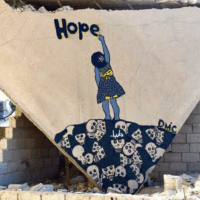
As far as al-Shami’s paintings go, he primarily focuses on the dissonance between normal life before and during the outbreak of the war. The mural that garnered him worldwide fame in the summer of 2014 depicted a little girl standing on a pile of skulls while writing the word “Hope” on a wall, as shown below.

This next painting depicts a regular living room with a TV, clock, and other household items inside an apartment that, in actuality, has been repeatedly destroyed by bombings.

Unlike Banksy, al-Shami’s identity is known; however, the similarities in their messages and style of painting cannot be denied. Jocelyn Tolpin ’17 agrees with these sentiments and appreciates the similarities between both of their styles: “I think that al-Shami’s work is incredibly powerful because, like Banksy, it communicates a relevant, eye-opening message in the form of everyday art. His work definitely captivates audiences that wouldn’t otherwise be aware of the strife of a population.” While the similarities between the two artists are unquestionable, it is admirable that al-Shami is still painting under the dangerous circumstances in which he is living; nevertheless, under any circumstance, the work that both of these artists produce is remarkable.
Named the most influential street artist of all time by Complex, a popular New York-based magazine, Banksy’s global influence is spreading like wildfire, and there are more people drawing from his famed murals and interpreting them in their own manners. Christina Lu ’17 says, “As an artist, I firmly believe that art should always be used as a form of self-expression. I really admire how provocative Banksy’s work is, and I think it’s wonderful that he has been able to inspire the same drive and passion in other artists, such as Abu Malik al-Shami.” Banksy’s influence can also be found in other parts of the Middle East, where artists are utilizing street art to convey messages of hope and optimism in a time where violence is engulfing the region.
As the Syrian Civil War continues to devastate the Syrian population, locals can find comfort in the Banksy-inspired works of al-Shami and remember a time where daily life wasn’t as difficult. His works will continue to be a symbol of promise for the future of the Syrian people, as well as a representation of hope to the millions of people around the world who are looking in on the Syrian Civil War. As for Banksy himself, no one knows for sure when and where he will strike next. But, as long as the world keeps on giving him inspiration to paint, we can continue to count on his presence in the street art scene.
Leave a Reply
You must be logged in to post a comment.