By Kiran Damodaran ’17 and Rakhi Kundra ’17, Editors-in-Chief
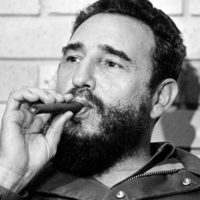
On November 25, 2016, Fidel Castro, known to many as the anti-democratic pillar of the Western Hemisphere, passed away in Cuba. Castro, considered by many to be a leftist dictator, led Cuba for 47 years officially as both President and Prime Minister, the longest period of time any living ruler has led a nation, aside from Queen Elizabeth II. In 2006, he became seriously ill, and decided to pass his power along to his younger brother, Raúl Castro, Cuba’s current leader.
When Fidel Castro overthrew Fulgencio Batista in 1959, he was greatly admired and revered by the Cuban people. Acting as a symbol of optimism and strength, he provided hope to a despairing nation; poverty and unemployment rates were skyrocketing, the United States was an overbearing and controlling force over the Cuban economy, and Batista’s corrupt and unstable government was becoming aggressively authoritarian.

But nobody was expecting Castro’s forceful and tyrannical grab of power–he quickly established a single-party state, ridding Cubans of basic human rights such as freedom of expression, befriended communist Russia, and permanently damaged relations with the United States. We are more familiar with this side of history: to us, the Cuban Missile Crisis and Bay of Pigs Invasion are both representative of the rise of totalitarian rule and the United States’ attempts to prevent it.
Yet what we don’t know as well is that Castro made healthcare in Cuba completely free, making its system a model for the rest of the world. We also don’t talk about how under Castro’s rule, Cuba’s literacy rates became the highest in Latin America, or how gender and racial equality were not only promoted, but instilled in the law. With low reported crime rates as well, it is difficult to argue that his reign did not bring along any positive changes. Some see him as a determined and principled leader who championed the rights of the poor, and feel that he stayed true to his convictions.
However, it is important to recognize the serious human rights violations that came along with his actions, and the repression of freedom of speech that he instilled in his country. While Castro promised to free his people from the constraints of the Batista regime, he imposed even greater restrictions on the livelihoods and rights of Cuban citizens to express themselves, and is widely considered to have been a dictator, despite his official title as “President.” In his desire to make Cuba a stronger and more independent nation, he pursued an isolationist economic policy that destroyed Cuba’s overall economy. Despite his attempts to free Cuba from foreign control, in many ways he led them further into it, as Cuba remained a puppet state of the communist Soviet Union for many years. Castro denied basic freedoms to the 11 million people in Cuba, and exiled millions of others, taking many political prisoners in his route to power.

He was and remains a polarizing figure who leaves behind a mixed legacy, with cult-like praise from those who benefited from his system and disdain and hatred from the many wronged by it. Justin Trudeau, the Prime Minister of Canada who is often lauded for his progressive ideas, recently received backlash for paying homage to Castro as “a legendary revolutionary and orator” and “a larger than life… [and] remarkable leader.” Although he has backtracked on his comments since then, conceding that Castro was a dictator, his response shows that Castro’s death has elicited mixed feelings across the world, despite his cruel tactics.

In reality, Fidel Castro has not been active in Cuba since 2008, and some believed at the time that he was dead. Nonetheless, his death marks the end of an era for Cuba and the beginning of a new one. With President Obama taking the first step to normalize relations with Cuba in 2014 in meetings with President Raul Castro, for the first time in over five decades, the United States and Cuba are interacting with one another once again. Some trade and travel are now acceptable between the two nations. In fact, the first commercial flights from the United States to Cuba just began on November 28. However, President-elect Donald Trump has threatened to end the US-Cuba deal, which would place the two countries at odds again, unless Cuba agrees to new conditions proposed by the US. With this type of pressure and the death of longtime leader and figurehead Fidel Castro, US-Cuba relations may either continue to improve under the precedent set by President Obama, or a new one to be set by President-elect Trump, or deteriorate, as threatened. Nonetheless, regardless of the implications of Castro’s death on these relations, it marks an important point in both Cuban and international history. Fidel Castro has died. Some will rejoice and some will mourn. At the end of the day, however, both sides are left wondering, does his death indicate the beginning of the end of a repressive Cuba? What next?
Leave a Reply
You must be logged in to post a comment.