By Dean Tan ’18, News Editor
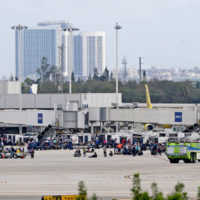
On January 6, 2017, Esteban Santiago-Ruiz arrived at Fort Lauderdale-Hollywood International Airport on a one-way flight from Anchorage, Alaska. Mr. Santiago retrieved his semi-automatic pistol from his baggage and loaded it in the bathroom, then proceeded to open fire in the crowded airport for over a minute. Panic quickly ensued as crowds of people rushed to escape during the chaos – Mr. Santiago, however, was reported to have remained calm as he fired through three magazines of ammunition before throwing his gun down and lying on the ground. Officers quickly apprehended Mr. Santiago, who was unharmed, as emergency medical services responded to the victims. In the aftermath of the shooting, a total of 5 people were killed and 8 were seriously wounded, while dozens others were injured in the panic.

Born in New Jersey, Mr. Santiago moved to Puerto Rico at age 2, where he spent most of his life. Mr. Santiago enlisted in the Puerto Rico National Guard in 2007, and was deployed to Iraq in 2010 as part of the 130th Engineer Battalion. Mr Santiago then went on to serve in the Alaska Army National Guard as a combat engineer and a private first class, but was discharged in 2016 for “unsatisfactory performance.”
Earlier last year, Mr. Santiago reportedly sought help at an FBI office in Anchorage, where he complained of hearing voices in his head telling him to commit violent acts, and that he was being controlled by the CIA. Prompted by his disturbing remarks, officials sent Mr. Santiago to a mental health facility and had his firearm temporarily withheld. However, without criminal charges and further mental health treatment, Mr. Santiago was released and had his gun returned. Tyler Kung ‘19 commented on Mr. Santiago’s surprising release, saying, “I think that clearly we’re not investing enough money in our treatment of veterans because after coming back from war they are plagued with PTSD and other horrible illnesses that are affecting them everyday.”
The extent of the bloodshed and chaos following the gunfire has revealed critical weaknesses in airport security and communication. Mr. Santiago declared his weapon – a Walther PPS 9mm semi-automatic pistol – at check-in, but once passing through security was able to unpack it from his bag and load it in the bathroom. Additionally, reports of gunfire in another area of the airport were quickly spread online, causing mass confusion and resulting in many evacuating the terminals. Many people at the airport complained of the lack of information given about where to go, while others were angry for being “treated like suspects” as law enforcement conducted pat-downs and ordered people to raise their hands.
At Mr. Santiago’s bond hearing, an FBI agent revealed that Mr. Santiago had claimed to commit the shooting on behalf of the Islamic State. The terrorist group, however, has not announced responsibility for the attack. Mr. Santiago claimed he had been in touch with groups and chat rooms online for like-minded people planning to commit acts of terror. With no direct affiliation with the Islamic State, Mr. Santiago’s attack echoes the attacks in San Bernardino in 2015, where a husband and wife self-identifying as jihadist extremists killed 19 and wounded 22 in a mass shooting. The perpetrators of the San Bernardino attack were not directed by any terrorist organization or network, but instead communicated with each other online about their commitment to jihadism even before the emergence of the Islamic State.
Mr. Santiago’s self-reported identification with the Islamic State raises questions on how to respond to, and even define, acts of terrorism. Cosimo Fabrizio ‘18 commented, “When someone who didn’t go overseas to train with ISIS commits a horrific act of terror in the name of ISIS we do have to acknowledge the greater issue that this group, more so than Al Qaeda or Boko Haram or any other terrorist organization, is able to recruit people indirectly because of the aura they have created for themselves.” When asked if he thought the nature of terrorism has changed, Dr. Thayer shared “I think we are much more likely to call things “acts of terror” now than we were 20 years ago, and the factors that lead up to someone performing that act have changed over time.” He added, regarding motivations behind terrorist acts, “I don’t know how much it matters morally or ethically what the reasons were for why somebody did something or how they got the knowledge in the first place. I think you treat what they did.” With the rise of technology and online communication, it seems the lines between extremist terrorism and isolated acts are becoming harder to define.
Leave a Reply
You must be logged in to post a comment.