By Alena Zhang ’18, News Editor
“Kim Jong Un” may be a well-known Korean name, but fewer have heard of Park Geun-hye. In 2013, she was voted into office as South Korea’s first female leader, with a 51.6 percent approval rating. Two years later, that figure fell to 30 percent. By the end of 2016, she held the worst approval rating in Korean history: 5 percent. On March 10, 2017, the Constitutional Court of Korea unanimously upheld her impeachment and forced her out of office. In just four years, nearly the entire country had lost faith in Park. What had happened?

Park entered Korea’s political spotlight at just ten years of age. Her father, Park Chung-hee, became the third President after staging a military coup in 1961. He rewrote the constitution to secure his power and brutally repressed all opposition, giving him the reputation of dictator. By 1981, both of Geun-hye’s parents had been assassinated. With them gone, she temporarily retreated from the public sphere.
She sought the presidency in 2007, but her Saenuri, or New Frontier Party, instead nominated Lee Myung-bak, who went on to win. In the next election, Park had support from older conservatives who revered her father for Korea’s economic growth. In her 2013 inauguration speech, she declared four guiding principles: economic prosperity, people’s happiness, cultural enrichment, and establishing a foundation for peaceful unification. She is particularly well-known for opposing North Korea’s nuclear provocations.
In October 2016, investigators began examining Park Geun-hye’s relationship with her aide and childhood friend, Choi Soon-sil. The daughter of a cult leader, Choi was accused of having access to and directly influencing Park’s personal and political decisions. She had also used her position to extort $70 million in donations from chaebol — family-owned business conglomerates. The companies involved included Samsung, Hyundai, SK Group, and Lotte.
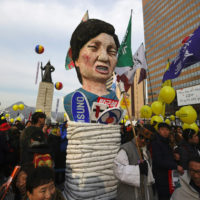
Despite Choi’s arrest and several apologies from Park, Koreans held mass protests calling for her resignation. Over a period of six weeks and twenty separate events, a total of sixteen million citizens participated in anti-Park rallies. On November 29, she offered to resign and invited the National Assembly to arrange a transfer of power. However, opposition parties rejected, accusing Park of attempting to avoid the impeachment process. A protest on December 3 — consisting of 2.3 million people — was the largest in the country’s history. Ezra Lebovitz ’18 notes: “I see it as a landmark event. It’s not their first impeachment, but it is the first one to result in the president’s removal, and required a significant number of people from her political party to vote against her. To an extent, it shows how the democratic process should work — based on personal moral conviction and largely influenced by the sentiments of the people. The votes of the Congress reflect the large-scale protests and the near-unanimous disdain for the president’s actions.”
Park’s administration had already begin facing disaster in April 2014, after the Sewol ferry sinking accident. Over three hundred secondary school students and staff were killed in the tragedy. The South Korean government and media faced heavy criticism for its inadequate disaster response and attempts to downplay government culpability. On the first anniversary of the catastrophe, as part of commemorations for the victims, 4,475 people held electronic candles to form the shape of a ferry. Following Park’s political scandal, candles became an increasingly important symbol of nonviolent protest. Not only were Koreans standing up against her corruption, but they were also rebelling against a longstanding political order that was fracturing under domestic and global pressures.

Chris Pyo ’17, whose IB Extended Essay investigated South Korea, believes that “The impeachment really exposed the governmental issues that exist [there], in terms of the coercion and the duplicitous abuse of authority displayed by Park Geun-Hye and her regime… This is a step forward in the right direction for South Korea, especially as a country with a turbulent political history. However, with North Korea becoming more of a tangible threat to the safety of East Asia in general, it is important for South Korea to act proactively and get back on its feet quickly as to shield itself from becoming even more vulnerable as a country.”
The South Korean constitution requires that a new election be held in sixty days. Currently, the Prime Minister Hwang Kyo-ahn is the acting president. With the conservatives now discredited, the left could take power for the first time in a decade. One poll front-runner is Moon Jae-in, the former leader of the main opposition Democratic Party, who lost the 2012 election to Park by three percentage points.
Dominant campaign issues will include North Korea’s nuclear weapons program as well as relations with the United States and China. If democrats ultimately take power, they may attempt rebuild ties with the North through aid and exchanges; Park’s sanctions on North Korea have failed to stop its nuclear programs in the past decade. Although China particularly favors Moon’s approach, the US would face difficulties in isolating North Korea. When asked if South Korea’s protests could spark rebellion in China, Mandarin teacher Ms. Zhao stated that “People [in China] are afraid to speak out against the government. Especially being in prison and going through the process — it’s not like in the U.S., where you can have a fair trial. They might not be inspired to protest at this point, but who knows what may happen in the future.”
The removal of Park Geun-hye is a historic watershed; Syngman Rhee was the last South Korean leader to be removed under popular pressure. During those protests in 1960, police had fired on protesters. However, the nation’s democracy has evolved immensely since then: Park was removed without major violence. After a long history of subservience to the presidency, the legislature and judiciary have also emerged as crucial South Korean institutions. As Moon put it recently: “We need a national cleanup. We need to liquidate the old system and build a new South Korea. Only then can we complete the revolution started by the people who rallied with candlelight.” He is also a supporter of Korean unification: in time, North and South Korea could eventually become one.
Leave a Reply
You must be logged in to post a comment.