by Alex Chen ’20, Staff Writer
The political climate of our great nation has been filled with the polarization and radicalization of two domineering political parties: Republicans and Democrats. Whether you are right wing or left wing, authoritarian or libertarian, you cannot deny the fact that the notion of a “United States” is being tested on various levels. This can primarily be attributed to the election of our 45th President, Donald J. Trump, as his use of both highly unorthodox political policies and rhetoric have led to many people becoming concentrated in either the pro-Trump or the anti-Trump camps. He has made constructive political conversation even more difficult, hindering our ability as citizens to stay informed about the important issues that face our great country. However, the 2017 NJ Gubernatorial Election lies ahead of us as an opportunity to have political dialogue without conjuring up heated debates of the president.
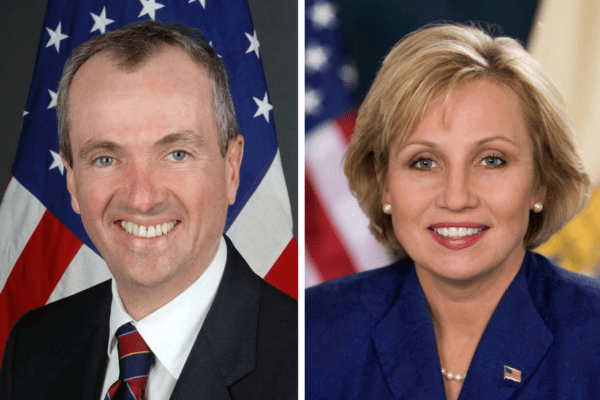
Rep. Kim Guadagno and Dem. Phillip Murphy are running to replace Chris Christie, who has been governor since 2010. Governor Christie’s approval ratings are at an all time low, with a recent Quinnipiac University poll in June listing his approval rating at 15%. Governor Christie’s low approval rating, while he may not have a bother about it, does matter if he wishes the State of New Jersey to continue to have Republican governance. Not only is it because both Kim Guadagno and Chris Christie are both Republicans, but also because she is Lieutenant Governor of New Jersey (the state government’s equivalent of a VP), which has significantly hurt her ratings.
According to nj.com, Phil Murphy leads Lieutenant Governor Guadagno by nearly a 20 point lead in the polls, citing Chris Christie’s low approval rating as the reason. As a result, she has not mentioned her position in any of her ads or campaign speeches. Phillip Murphy is more popular; 62% of voters are unsatisfied with the current state of New Jersey, implying that most would wish for a Democrat governor. Guadagno may have some hope though, with most voters stating that taxes are their primary concern (31%). Her campaigning has mostly consisted of appealing to the Democrat voters by naming a Cuban refugee as her running mate, as well as supporting the Affordable Care Act. However, she has recently preferred to take the path of Trump by denouncing undocumented immigrants, most likely to gain national attention to the election .
Phil Murphy, aside from working for Goldman Sachs from 1982-2006, has, like Kim Guadagno, also worked for the government. He served as National Finance Chair for the Democratic National Committee from 2006 to 2009, and the United States’ Ambassador to Germany from 2009 to 2013. He financed his campaign with $20,000,000 dollars and financially supported other democratic nominees, showing his fervent loyalty to the Democratic Party. Former President Barack Obama’s campaigning for Murphy has boosted, and was meant to boost, his approval ratings.
Kim Guadagno champions the traditional Republican platform: she wants to make New Jersey more military- and veteran-friendly by offering more opportunities to veterans, lower veteran homeless and suicide rates, and strengthen New Jersey’s military economy. She also wishes to fix pension and health benefits as well as lower property taxes so that middle-class families can better afford living in-state.
Phil Murphy’s views emphasize the economic side of governance. He wishes for New Jersey to be like Silicon Valley as it once was by promoting STEM programs in schools. He also wishes for banks to invest in New Jersey rather than abroad. Murphy aims to revamp New Jersey’s government with technological updates and strict reviews of federal grants. Like Guadagno, he wishes to protect New Jersey’s middle-class, but by raising the minimum wage, creating a merit-based pay system, and establishing a child care tax credit to make it easier to raise children in NJ.
All that aside, the most important thing to take away from this election is how little people know about its taking place. Many news articles cite how little coverage and attention that this election is having, perhaps overshadowed by bigger events such as the several hurricanes, North Korea, and the Las Vegas Shooting. I’ve even asked several students within our school about the election and most stating that they were unaware of the election taking place, with the best answer I’ve gotten being that the person in question could name the candidates, their respective parties, but none of their policies.
Examining this election has revealed the underlying factors that underpin elections and the role of news in shaping people’s thoughts. This is why I love politics: it requires the understanding of psychology; it requires playing and manipulating the voting blocs and election processes with use of rhetoric persuasion and clever diplomacy; it requires the balancing of critical key supporters. Every type of government is just a different manifestation of these sets of rules.
Leave a Reply
You must be logged in to post a comment.