
by Andrew Wyshner ’18, Commentary Editor
I had the great opportunity to vote for the first time this year in the New Jersey gubernatorial election. The voting process allowed me to see firsthand how American Democracy works, but what struck me most was the biased and unfairly worded ballot questions. This year, there were two ballot questions. The first question said “Do you approve the “New Jersey Library Construction Bond Act”? This bond act authorizes the State to issue bonds in the aggregate principal amount of $125 million. The proceeds of the bonds will be used to provide grants to public libraries. The grants will be used to build, equip and expand public libraries to increase capacity and serve the public.” The second question read “Do you approve amending the Constitution to dedicate all moneys collected by the State relating to natural resource damages in cases of contamination of the environment? The moneys would have to be used to repair, restore, replace or preserve the State’s natural resources. The moneys may also be used to pay legal or other costs incurred by the State in pursuing its claims.” The way both these questions are worded, it gives the rationale behind a “yes” vote, but not a “no” vote.
These questions are extremely misleading and is one of the primary causes that over 90% of all New Jersey ballot measures have passed. The type of bias in ballot questions is known as response bias, and it causes people to give
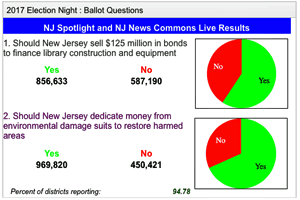
the answer that is believed to be most accepted by the general public. The wording of the questions makes a “yes” vote to appear to be that most accepted vote. As a result, people who do not particularly care about the issue at hand will tend to vote “yes”. The ballot questions completely exclude the opponent’s point of view; for example, in the case of the first ballot measure, Representatives Jay Webber (R) and Michael Carrol (R) opposed the measure saying “this bill’s call for $120 million in borrowing for library capital products comes even as a Pew Research Center survey from September 2015 shows that fewer Americans are visiting libraries in this advancing digital age.” In part because this argument was not included in the question, the measure passed easily.
If the ballot included both the pro and the con argument against the measure, less informed voters would have had sufficient information to make an educated decision on the matter. As is, the uninformed voter is led to blindly voting yes. In my opinion, this issue should transcend party lines. Despite the fact that both these ballot measures were primarily supported by Democrats, and the New Jersey Democratic Party has the most to gain from the withholding of information, this is not the primary issue with ballot measures. To put it simply, a question that is inherently biased to yield a certain response is not characteristic of a democracy. The government should be required to provide both the “for” and “against” arguments on the measure in order for the vote on the measure to be unbiased.
Bibliography
New Jersey 2017 Ballot Measures. Retrieved from https://ballotpedia.org/New_Jersey_2017_ballot_measures
New Jersey Public Question 1, Bonds for Public Libraries Measure (2017). Retrieved from https://ballotpedia.org/New_Jersey_Public_Question_1,_Bonds_for_Public_Libraries_Measure_(2017)
Leave a Reply
You must be logged in to post a comment.