By Carolyn Schachtel ’18, Staff Writer
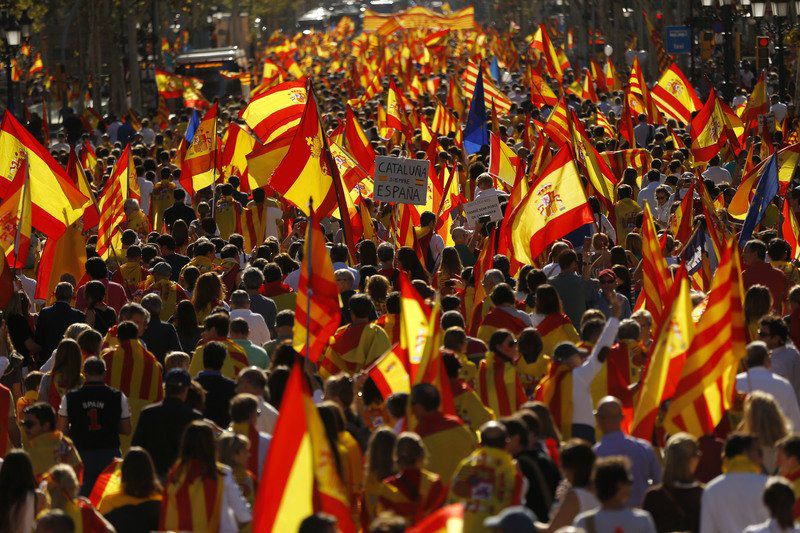
As a student in Barcelona this summer, it was immediately apparent that the city was buzzing with talk of independence. Locals were eager to discuss the newfound prospect of secession, and red and yellow Catalonian flags lined the streets. On October 1st, controversial elections were held regarding the state of Catalonia; the results of the election marked the start of Spain’s current political turmoil.
The region of Catalonia includes Girona, Barcelona, Tarragona, and Lleida. This crucial territory has indisputably been greatly influenced by Spanish tradition, but has simultaneously managed to maintain a unique sense of individuality through language and culture. The debate regarding Catalonian independence is irrevocably rooted in the history of Spain. In 1932, the district officially received a “state of autonomy” and was labeled “Catalan Republic” by both the Spanish government and Catalan officials. 7 years later, Francisco Franco was declared dictator of Spain. He quickly regained complete control of Catalonia, formally reuniting the territories. His reign left many Catalans hopeful to escape Spanish rule, and independence efforts reemerged following his death in 1975.
Pro-separatists argue that their demand for independence is well-deserved. The success of Catalonia has greatly aided the development of the country as a whole, and many Catalans believe that their economic contributions to Spain are unfair or not properly recognized and rewarded. This has led to activism in Spain regarding Catalonian secession. In 2014, over 80% of Catalans voted in favor of independence; still, the country remained under Spanish rule.
However, others are convinced that Catalonia’s Spanish influence is a crucial aspect of its identity. For many, the historical ties and similarities in culture exemplify Catalonia’s unique reliance on its Spanish roots. Additionally, some fear that secession would undo Catalonia’s connection with the European Union, a major political drawback.
On October 1st, an election was held regarding the future of Catalonia. However, it was delegitimized by Spanish prime minister Mariano Rajoy, who said, “There will be no referendum; it won’t happen.” His efforts to discourage voting were widely successful, and included an attempted seizure of ballot boxes and the arrests of influential pro-separatists. Despite this, about 2.3 million Catalans voted. 90% of these 2.3 million voted in favor of independence.
The results of the elections have complicated implications. The country, as well as the continent of Europe, is divided over the current state of Catalonia. Though the outcome of the vote is telling, it is difficult to account for the 60% of Catalans who did not participate in the election. Huge anti-secession protests broke out following October 1st, further upsetting the situation. A key aspect of the controversy was Rajoy’s mention of Article 155 of the Spanish constitution. This article, which has never been used before, states that the Spanish government has the authority to interfere with Spanish territory if the autonomous government “fails to fulfill the obligations imposed upon it by the Constitution or other laws, or acts in a way seriously prejudicing the general interests of Spain.” It is unclear exactly what this article allows or suggests, however, it gives the Spanish government the legal capability to maintain its claim over Catalonia in whatever way they see fit.
Europeans are torn regarding the fate of Catalonia. Those against Catalan secession argue that such an event would cause rise to independence movements in places such as Scotland, Flanders, Padania, Madeira, Bavaria, and Scania. They also cite the similarities in culture between Catalonia and the rest of Spain, which would be impossible to fully erase. On the other hand, some recognize the distinct Catalan identity, proving that Catalonia should not be constrained to Spain’s unwanted influence. Additionally, many want to recognize the voice of the people, who seem to overwhelmingly support Catalan independence.
The NA community is equally conflicted by this controversy. Brahm Wieseneck (18), whose IB Extended Essay was titled, “The Intersection of Soccer and Politics in Spain: How Franco’s Quest for Unification deepened the Schisms,” has become familiar with current Spanish politics through his work. When asked about his opinion regarding the recent elections, Brahm responded, “I spent a lot of time in research and writing my extended essay studying the cultural and historic distinctness and animosity between different regional autonomies within Spain. While this experience doesn’t leave me completely qualified to discuss the legitimacy of any claim, I recognize the current difficulty that Spain/Catalonia is experiencing and I hope that a solution will soon be reached.” Amanda Cohen (18), president of Human Rights Club, responded in a similar manner, stating, “Ultimately, I hope that the voices of the people are heard.”
Leave a Reply
You must be logged in to post a comment.