
By Jackson Powers ’20, Staff Writer
The world never seems to rest; over the past few years, we have seen many instances of attempted secession. For instance, the youngest country in the world, South Sudan, is only 6 years old. In 2014, we saw the Scotland referendum, ending with 55% voting to stay in the union, barely keeping the UK together. Two years later, the vote to leave the European Union, “Brexit,” won with 52% voting to leave. Recently, the international community has faced problems originating in Catalonia and its independence movement. The issues in Catalonia may be tense, but they are by no means a surprise. Catalonia has been pushing for a revolution for years.
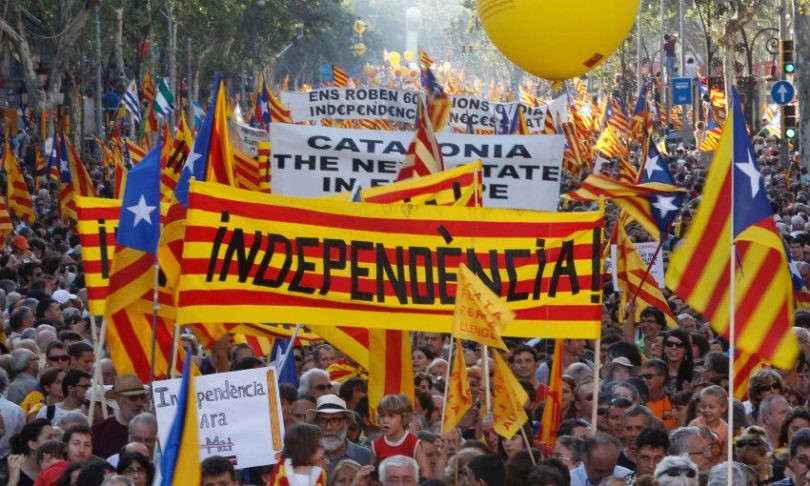
The issues in Catalonia are quite serious. Many Catalonians have expressed their distaste for police brutality, while many other Spaniards, including King Felipe VI, have accused Catalonians of disloyalty. These events have brought up a moral dilemma: does Catalonia deserve to be a country? In situations similar to the region’s, there is no clear-cut yes or no answer. Both Spain and Catalonia are very passionate about their opinions in the matter, and both present valid arguments. Additionally, the EU condemned Catalonia’s actions and the UN has not readily involved themselves. As Seth Levine ‘20 believes, this is likely for the better: “The UN should treat Catalonia as any other emerging country, and it should have no influence from Spain.” However, history teacher Mr. McCall thinks that this problem is Spain’s to deal with: “The issue has to be resolved in Spain before [it faces] the EU. Spain has the most authority over this claim, then the EU, and then the UN.”
Catalonia has extensive history as an independent land separate from Spain. It also has a separate language, Catalan, which is spoken by a large majority of its population. The people have developed their own sense of national identity, and feel as though any of Spain’s decisions cannot thoroughly support their interests. Many Catalonians cite economics as another factor besides national identity in the conflict. As Simon Gorbaty ‘19 says, “The big issue is economics. The fact is, Catalonia is Spain’s largest state by population and region, and it’s the most industrialized. When Spain collects taxes, Catalonia gives more to Spain than Spain gives back.” Spain’s argument also revolves around economics: the loss of Catalonia would be detrimental to Spain, simply because of the financial consequences.
Beyond economics, Spain considers Catalonia to be part of its union, and therefore Catalonia is bound to Spain. As Mr. McCall explains, “Once you are in a constitutional union, if there is not the right to declare removal from the union, you must make that union work.” In other words, Catalonia cannot just secede without first working to address the problems undermining the union.
In each interview I conducted, the interviewee expressed a different stance on the issue. Many important factors were evaluated, such as the Spanish constitution, Catalonia’s economic reaches, and national identity. Considering the valid arguments from both Spain and Catalonia, it is difficult to see which side is right. I believe every group that feels it deserves a nation and proves itself to be capable of running one deserves complete autonomy. The problem with that sentiment, however, is that it is too idealistic. Historically, the question of autonomy can only be answered by whoever controls the land. For instance, Simon believes, “When a land has a right to territorial claim over that region, they have a right to attempt to maintain control over a region. It’s the way it always has been.” To become independent, a nation needs to take control of its land, whether it is through peace or by force. Catalonians should be given a country of their own. But at the end of day, by right, the Spanish government is the only group that can decide whether or not Catalonia deserves independence.
In an ideal world, Catalonia would have its land. However, Spain’s word is law: Prime Minister Mariano Rajoy labeled the campaign for a free Catalonia unconstitutional, and Spain issued arrest warrants for the leaders in the movement. They were arrested in Brussels just a few weeks ago. While Catalonia has a legitimate reason to secede, above all else, Catalonia needs to respect the wishes of Spain. As Mr. McCall states, “It’s an issue of respecting the rule of law… we should let democratic institutions do their duty. Spain has [seen many instances of instability], and Catalonia is [their] wealthiest and most unique state… but Catalonia leaving Spain is like Texas leaving the US.” Many may disagree with Spain’s decision. However, nobody can deny that the decision is theirs, and theirs alone, to make.
Leave a Reply
You must be logged in to post a comment.