by Simon Gorbaty ’19, Staff Writer
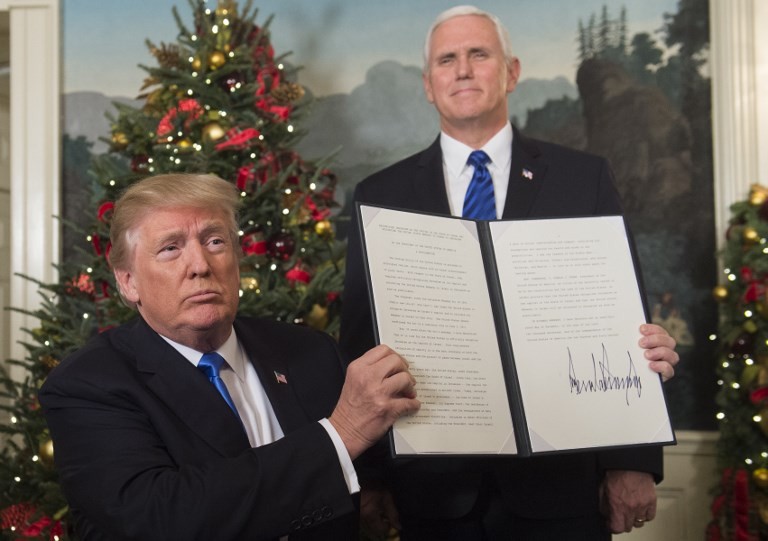
The media exploded with a multitude of headlines when President Trump formally recognized Jerusalem as Israel’s capital on December 6th, 2017. The response has been divided. Israeli Prime Minister Benjamin Netanyahu naturally welcomed the move. International leaders such as the European Union’s chief of foreign policy have sharply criticized Trump’s declaration. The United Nations General Assembly passed a motion condemning Trump’s announcement, and the Arab League deemed the new policy “against international law” after an emergency meeting in Cairo on December 10th. Protests erupted all over the world from the West Bank to Times Square. Militant Islamist groups called for violence shortly after the announcement. Palestinian leader Mahmoud Abbas has canceled talks with Mike Pence.
Evidently, these reactions, combined with the media outcry, may cause wariness. It may seem as if Trump’s decision marks the destruction of stability and the possibility of peace in the Middle East. Following Israel’s takeover of Jerusalem and during the Six-Day War in 1967, the U.S. has held the position that Jerusalem’s status must be determined through bilateral negotiation. Thus, the media has largely addressed the announcement as a controversial, major reversal in U.S. foreign policy.
However, a look back reveals that this move is entirely consistent with previous presidents’ intentions. Bill Clinton, George W. Bush, and Barack Obama all stated that Jerusalem was the capital of Israel during their presidential campaigns. Trump was simply the first to make this recognition de jure, or legally recognized, in his presidency. When Mr. Goldfischer was asked how impactful he thought this reversal was, he clarified that Trump’s announcement is “not a reversal in U.S. policy,” but a “recognition of the facts on the ground” and “an affirmation of existing law.”
In Israel, the 1980 Jerusalem Law states the city is the undivided capital of the nation. In the United States, the Jerusalem Embassy Act, passed by the U.S. in 1995, recognizes Jerusalem as “the capital of Israel” and states it “should remain an undivided city in which the rights of every ethnic and religious group are protected.” Although the move of the U.S. Embassy to Jerusalem has been delayed, it is clear that Trump’s announcement is not a break in U.S. neutrality in the region; this U.S. position has long been encoded in law.
Apart from being dubbed a controversial foreign policy move, Trump’s declaration has received opposition due to the belief that it permits a repressive Jewish ownership of Jerusalem. 170 Jewish Studies professors at American institutions have signed a letter stating that “A declaration from the United States government that appears to endorse sole Jewish proprietorship over Jerusalem adds insult to ongoing injury and is practically guaranteed to fan the flames of violence.” However, as Mr. Goldfischer states, “The fear-mongering [belief] that if Jerusalem is Israel’s capital, [Jews] will kick out all the other faiths is just not true… All faiths are welcome. Can’t say that’s true in many Middle Eastern countries.” Today in Jerusalem, Jews are free to pray at the Western Wall, Christians are free to walk the Via Dolorosa to the Church of the Holy Sepulchre, and Muslims are free to visit Al-Aqsa Mosque.
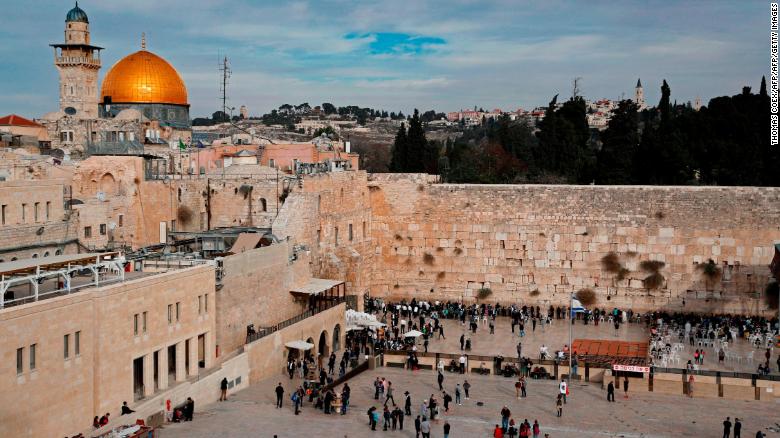
Additionally, the large majority of recent violence that has occurred in Jerusalem was committed not by Israelis, but by Palestinians. The Overseas Security Advisory Council of the U.S. State Department lists all notable attacks, including car rammings, shootings, and stabbings, in Jerusalem and the West Bank in 2015 in its report on Israeli crime. Based on the list, nearly all attacks that year were committed by Palestinians. Only one of the attacks was committed by an Israeli Jewish extremist. Therefore, a statement designating Jerusalem as Israel’s capital should not be considered an endorsement of violence if Israelis are not the cause of violence there.
The violence the Jewish Studies signatories feared may be compared to the protests that arose following Trump’s announcement. Again, the issue with their condemnation is laying the blame on Trump, who was simply affirming American policy. Netanyahu has stated that he has heard “voices of condemnation over President Trump’s historic announcement” but has “not heard any condemnation for the rocket firing against Israel that has come and the awful incitement against us.” Trump’s statement does not justify deadly violence, and therefore it is illogical to oppose it on the grounds that it causes violence.
Furthermore, the Embassy Act and President Trump’s consequent statement, carry logical validity. As Mr. Goldfischer put it, “We don’t tell any other country where they should have their capital.” It is only natural that the same right to self-determination be recognized for the Israeli law that professes Jerusalem as its capital, especially since religious freedom has been guaranteed in the Holy City, and it is already the site of all three branches of Israel’s government.
The future of the peace process remains unclear following Trump’s announcement, but there is clarity with the Jerusalem question. Trump has stated the obvious: Jerusalem is the capital of Israel—the seat of the Jewish state’s government. As Netanyahu has repeatedly said, Israel desires peace with the Palestinians. But it cannot be a peace that rips apart the Holy City, as that will only tear apart Israel itself. Yerushalayim is mentioned in Israel’s national anthem, indicating the unbreakable link between city and country. For the sake of Israel’s survival, it is important that this link is recognized.
Leave a Reply
You must be logged in to post a comment.