by William Corprew ’20, Staff Writer
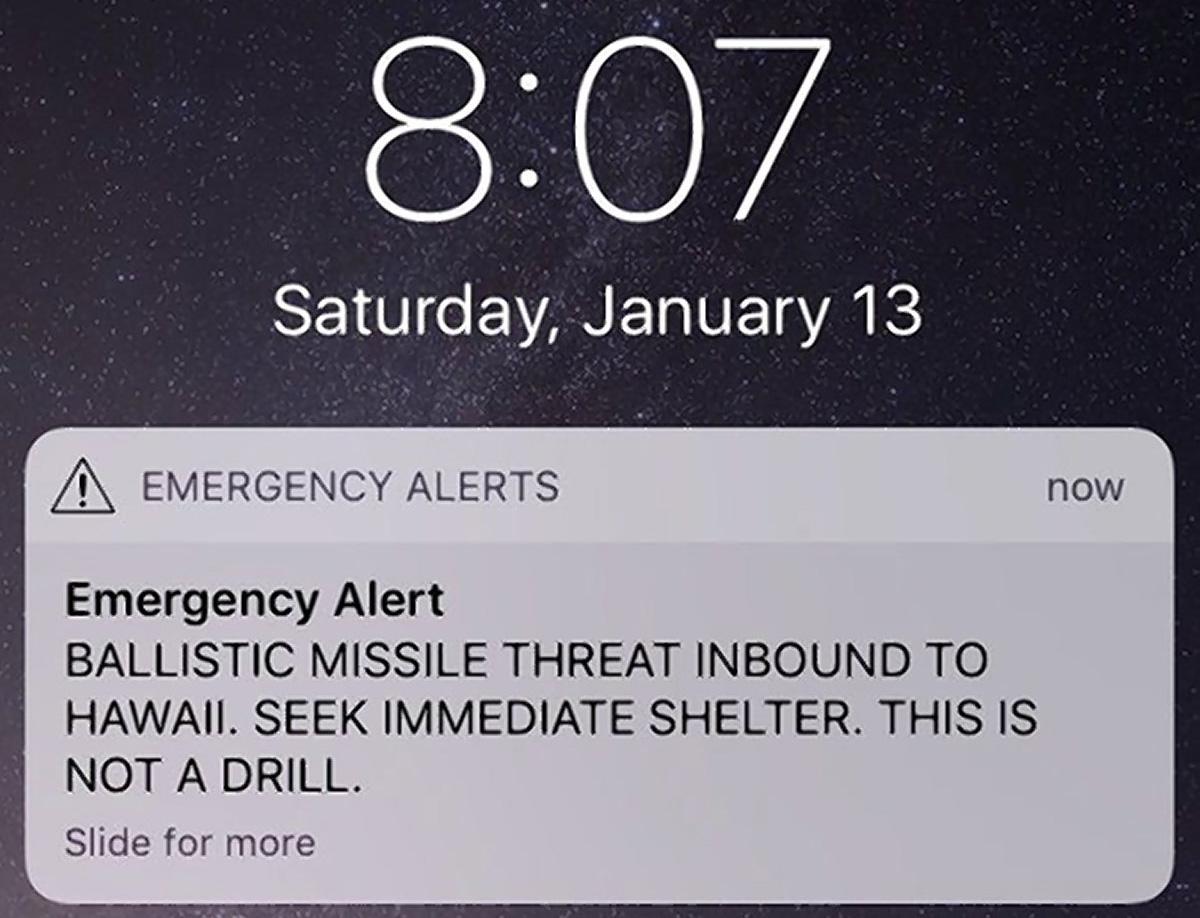
On January 13th, 2018, a ballistic missile alert was broadcasted throughout Hawaii, sending the small island state into pandemonium. The early morning alarm, which left the citizens of Hawaii panicked, confused, and desperately searching for shelter and additional information, came via cell phone notification as well as automated TV and radio announcements. The typical Saturday morning calm was disrupted with the words, “This is Not a Drill.” The rest of the country watched in horror as terrified parents lowered small children into storm drains with additional instructions to seek safety. Hawaii descended into chaos, leading to car accidents, panic attacks, and even cardiac arrest (1). After 38 agonizing minutes, the early-morning crisis came to an abrupt end when the citizens of Hawaii were notified that the missile alert was a false alarm. This notice led to immediate relief, but was soon followed by outrage over the emergency notification system which allowed misinformation of this magnitude to be disseminated. Residents began to demand answers as to the cause of the mix up only to be disappointed to learn that the alarm was triggered by something as simple as human error when a worker selected the wrong option in a drop down menu. American public opinion became even more heated upon learning that authorities deemed the event accidental within two minutes, yet it took over half an hour for the alarm to be formally cancelled. In the end, responsibility for the false alarm rested with the Hawaii Emergency Management Agency, also known as HEMA, and David Ige, the governor of Hawaii, issued an apology.
As a direct result of the steadily intensifying missile threats from North Korea and the daily war of words between North Korean dictator Kim Jong Un and the American president Donald Trump, Hawaii has been evaluating and modernizing its Cold War era bomb threat preparations. There has been endless detailed analysis and criticism of exactly what went wrong. For starters, many experts have questioned why the system was designed so that one person could activate an alarm without confirmation, and why there was no streamlined procedure in place to issue a correction. HEMA ultimately resorted to Facebook and Twitter to retract the alert. In addition, the system used to send notifications to the nation’s mobile phones known as Wireless Emergency Alert Systems, or WEA, was criticized for being too broad and lacking precision.
Thankfully, this time there was no incoming ballistic missile from North Korea or from any other hostile nation. However, Hawaii’s missile alert exposed vulnerabilities in the nation’s civil defense. At the federal level, the White House struggled to immediately address the false alarm, given that the current Trump administration has not issued any detailed plans on how to deal with a missile attack on the United States. TSA and airport officials were unprepared to address passenger concerns at the state’s largest airport in Honolulu and state and city agencies, as well as Honolulu’s 911 system were swamped immediately following the alert. Natural disaster preparation is natural to Hawaii’s citizens but the populous was not prepared for this emergency.
There is no reason to believe that this lack of preparedness is unique to the people of Hawaii. This is particularly true for millennials and younger who up until now have not had a reason to worry about intercontinental missile threats. Sydney Fullilove ‘20 freely admitted, “My family and I have considered the remote possibility of a missile strike but not to the extent where we have made any real plans. However, it might be time to reconsider.” In contrast, missile preparedness was a reality of everyday life for many. History teacher Mr. Hawk reflects on the similarities and differences between the Hawaii missile scare and his experiences living through the height of the Cold War: “It seems to me that there is a significant difference between the two of them. This alarm was not planned, seemingly an accident … There is an element of accident that makes the events in Hawaii unique; in the Cold War, there was an entire system of planned defenses that had a deliberate political purpose.” Unfortunately, emergency missile preparedness is a new reality for all generations.
(1) https://www.thesun.co.uk/news/5353610/dad-cardiac-arrest-hawaii-missile-alert/
Leave a Reply
You must be logged in to post a comment.