By Max Gorbaty ‘22, Staff Writer
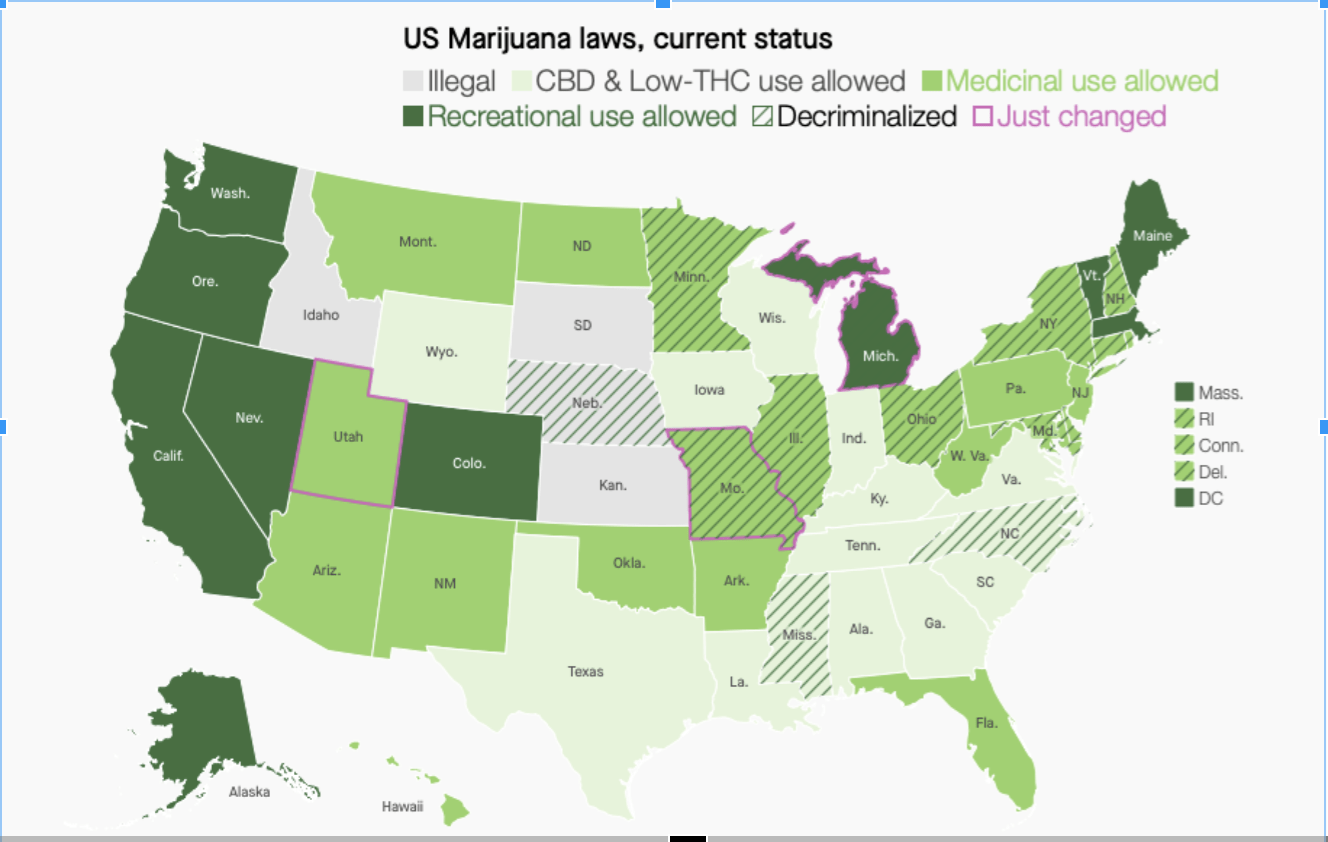
Despite the federal government’s prohibition of cannabis, initiatives for the drug’s legalization have swept over the United States in recent months. Prior to recent action, recreational marijuana was legal in nine states in the United States, including Alaska, California, Colorado, Maine, Massachusetts, Nevada, Oregon, and Washington state along with Washington DC. However, six states took huge strides toward the legalization of pot on November 6 during the midterm elections. North Dakota and Michigan voted on the legalization of the recreational use of marijuana and it was approved in the latter. Missouri and Utah voted on the legalization of the medical use of marijuana and it was approved in both states. The decriminalization of cannabis in Ohio and Wisconsin was also a result of the election. Oklahoma, on the other hand, did not manage to get the recreational use of weed on its ballot despite legalizing its medicinal use in June. New Jersey State Assembly and Senate committees will meet together for a hearing of debate and are expected to vote on the legalization of marijuana on Monday, December 17 as well. The bill would legalize the recreational use of marijuana for adults over the age of 21. On October 17, the recreational use of weed was also fully legalized in Canada and south of the border the new Mexican presidential administration has backed the legalization of marijuana.
According to Investopedia.com, global spending on legal cannabis is expected to grow 230% from $9.5 billion in 2017 to $32 billion in 2020. The blazing marijuana market has made companies such as Canopy Growth (CGC), Cronos Group (CRON), Tilray (TLRY), Aurora Cannabis (ACB) and Aphria (APHA) the Canadian stocks to watch in U.S. exchanges. Tilray CEO has publicly stated the marijuana market can be worth $150 billion while Canopy’s CEO Bruce Linton stated that cannabis could disrupt a $500 billion global market. Canopy Growth Corporation currently has a market capitalization of $4.36 billion. In essence, the marijuana market has seen immense growth recently and the industry may even grow another 25% to 35% per year in the next five years.
In terms of Congress, several incoming committee chairs have called for federal marijuana reforms, including Rep. Jim McGovern (D-Massachusetts), who will be the chair of House Rules Committee. Rep. McGovern’s predecessor, Rep. Pete Sessions (R-Texas), was the reason marijuana reform was unsuccessful in Congress due to his actions as the House Rules Committee Chair. In the past two years, Sessions obstructed almost forty marijuana-related proposals, meaning his departure will be a major win for reformers of the drug. The expected incoming House Judiciary Committee Chair Rep. Jerrold Nadler (D-New York) has affirmed that marijuana and “softer drugs” should be legalized, though regulated. If federal legalization of marijuana will occur, there are multiple, significant implications. The illicit and nefarious trade of the drug would be reduced in criminal gangs, and law enforcement agencies could focus on more influential and dangerous drug pushers. Also, weed could potentially earn the country $18 billion through a combination of taxes from sales and the absence of smokers in prisons costly to the justice system. However, making pot more accessible means even more people would use it as it is highly addictive and can lead to the increased use of harder drugs.
Although studies of the effect of marijuana have had mixed or slightly inconsistent findings, it is known to be quite harmful to the human body unless taken in specific medical circumstances. The long-term effect of the drug includes the impairment of brain development in regard to thinking, memory, and learning functions. Mental health consequences may include temporary hallucinations, temporary paranoia, and worsening symptoms in patients with schizophrenia—a severe mental disorder with symptoms such as hallucinations, paranoia, and disorganized thinking. The drug may lead to depression and anxiety as well.
At any rate, marijuana legalization is somewhat imminent in numerous places as the single plant has caused an enormous market to emerge. The cannabis industry will expand and capitalize in a world filled with anxious users, eager investors, and tenacious legalization reforms.
Leave a Reply
You must be logged in to post a comment.