
By Ariel Hsieh ‘19, Staff Writer
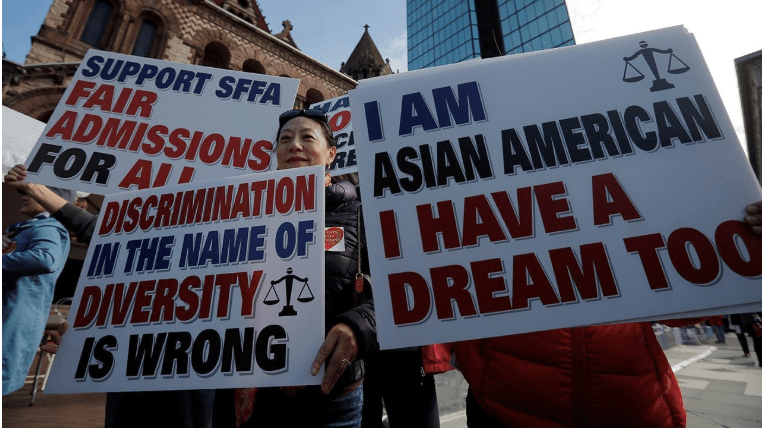

On November 17, 2014, the Students for Fair Admissions filed a lawsuit against Harvard University, claiming that the university was discriminating against Asian-American applicants. The argument of the SFFA is that in order for high-achieving institutions to accept students fairly, they should abolish affirmative action race-based policy, originally established to favor those who tend to suffer from discrimination, allowing them to enter high-achieving institutions or the workforce with more ease. However, the argument of the SFFA is that instead of protecting minorities from discrimination, affirmative action has become a disadvantage to Asian-Americans.
On October 15, 2018, the SFFA v Harvard went on trial. The SFFA is headed by Edward Blum, a one-man legal factory who has filed some of the most influential affirmative action cases in the past decade. Blum believes that race-based policies such as affirmative action violate the principles of equality rather than uphold them. SFFA argues that Harvard engages in “racial balancing” in order to cap the number of qualified Asian-American applicants to maintain a specific racial breakdown on campus. However, these Asian-American applicants may have outperformed other applicants of another race, in essence punishing them for being born into a specific race.
Among those who have stood on the witness stand is Richard Kahlenberg (Harvard ‘89) who argues that Harvard should instead use a “class-based affirmative action” system instead of a race-based one. In this new system, admission officers would use income levels instead of race, when deciding who to help in admissions. To support his argument, Kahlenberg used a model of the Harvard admission process based on the past six years of internal data from over 150,000 applications. By turning off the race-based tip and boosting the tip given to low-income students, Kahlenberg came up with four different scenarios. According to the Harvard Crimson, “All predicted an increased percentage of Asian-American admits. Three of the four scenarios led to increased Hispanic enrollment and decreased white enrollment. Every single one of the simulations predicted a decreased percentage of African-American admits.”
However, Harvard also came up with statistics that supported their current race-based Affirmative Action policy. From analysis done by David E. Card, a University of California Economics Professor, race-blind admissions was projected decrease their acceptance of those who identified as Hispanic, African American, or “Other” by about 50%. Harvard also argued that the school has numerous race-neutral programs that help diversity on the campus such as its financial aid program, its recruitment efforts, and its special consideration of students from “disadvantaged” backgrounds. Furthermore, another argument for race-based affirmative action is that it makes up for past injustices committed upon groups such as African Americans and Hispanics, and to disregard race would be to disregard the history of these people.
On November 9, 2018, the NA community held a meeting in Kaltenbacher Hall, organized by Asian Diversity and Think Tank Club, to discuss the issue. The debate fostered discussion between those who support Affirmative Action and those who would want the policy abolished raised interesting points.
Those who support affirmative action believe that the policy creates diversity in institutions that would otherwise accept very few students of minority. “If there was only 6% of people who looked like you, talked like you, lived like you, wouldn’t you want to see more of your culture represented at the institution where you live and learn?” one NA student says. These students believe that academic records do not reflect the entire person, and “to say institutions should be ‘colorblind’ when it comes to admissions is to erase entire parts of an applicant’s identity and is wrong.” They would argue that race is a factor as important as any other factor when fostering diversity on campus, and taking away the race-based factor would be taking away a part of the “holistic” approach colleges such as Harvard take when considering applicants.
Those who would see racial affirmative action abolished believe that the policy is racist and harms minorities like Asian Americans rather than help them. Aidan Orr ‘20 says, “race is not a synonym for background,” and that “accepting based on appearance would only serve to deepen division.” Instead of abolishing the affirmative action system completely, he believes better factors “to take into account would be access, opportunity, merit, socioeconomic status, whether your parents have degrees, etc.” People who agree with Aidan would argue that race is not a factor that should be considered, because it contradicts the very message of diversity and equality institutions are trying to promote.
A resolution to this debate will be a challenge, but students, especially those who seek an education at high-achieving institutions, follow the rulings and decisions closely, as Harvard may set an example for many other institutions, thereby affecting a huge part of the future generations’ education.
Leave a Reply
You must be logged in to post a comment.