By Vikram Bala ‘20, News Editor
On March 10th, 2019, Ethiopian Airlines (ICAO: ETH) flight 302 crashed near the town of Bishoftu just 6 minutes after takeoff. In total, 157 people were killed in the crash of the Boeing 737 Max 8 variant. Although isolated incidents do occur from time to time, air disasters are rare on such a large scale. What made the tragedy of flight 302 especially shocking was the closeness of the accident to the crash of Lion Air (ICAO: LNI) flight 610, which was a 737 Max 8 that crashed in late October of 2018, killing all 187 passengers aboard. The Boeing 737 is the most popular aircraft in the world, with the first flight of the 737-100 taking place in 1976. Boeing revolutionized the aviation world when it began producing the NG (next generation) models, allowing for the rapid expansion of the short-range flight market. Of the NG models, the 737-700 and 800 are the most popular, and constitute a large part of many major airline fleets. Southwest Airlines solely owns 737s, specifically 513 737-700s and 207 737-800s. United Airlines owns 243 total 737s, including the 700, 800, 900(ER), and Max 9. There’s a good chance that you may be flying on a 737 on your next vacation, and possibly even on a 737 Max 8 (the type of aircraft involved in the Lion and Ethiopian Air crashes). With this in mind, should you be worried about safety the next time you fly?
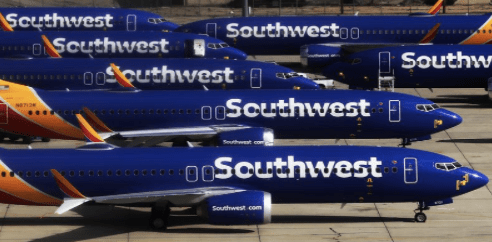
On March 13th, President Trump followed Europe and Canada’s lead by grounding all 737 Max 8 and 9 jets. The move was detrimental to airlines such as Southwest, specifically because almost 4.5% of Southwest’s fleet (the 737 Max 8 and 9’s account for 6% of the airlines capacity) immediately became inactive, meaning that the company had to scramble to either find unused inventory or lease new aircraft. The 737 Max 8 and Max 9 had hundreds of orders from airlines around the world that utilize the 737 as their main aircraft. With the planes grounded, passengers face cancellations and airlines lose thousands of dollars every day; the longer it takes for the 737 Max 8 and 9 to get back into the sky, the 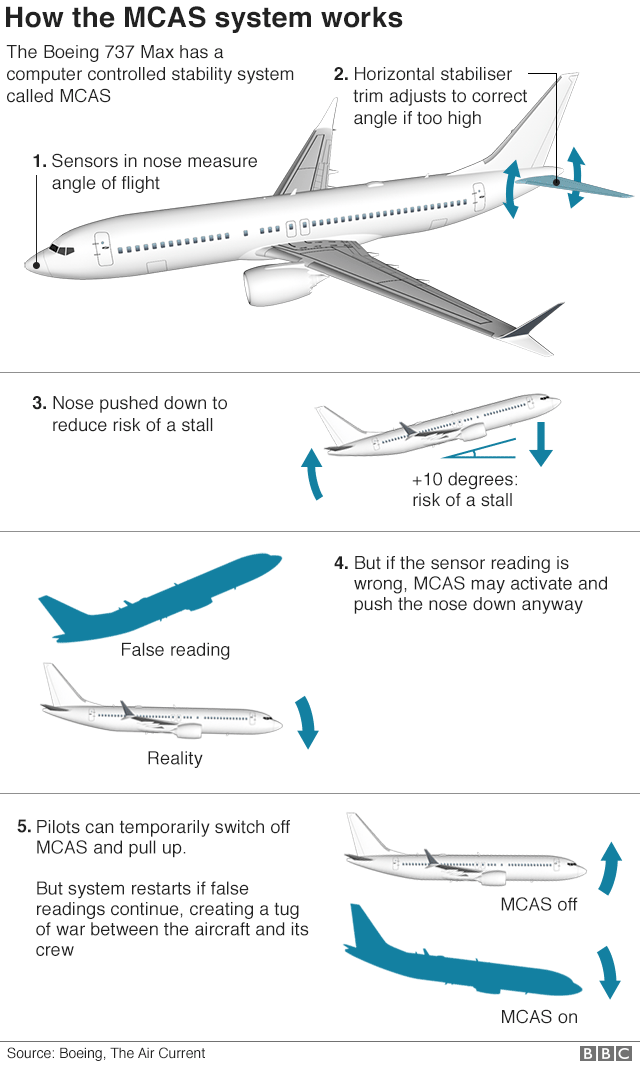 greater the repercussions for passengers, pilots, and airlines. What led to this massive grounding?
In October of 2018, National Transportation Safety Board (NTSB) investigators analyzed data from the black boxes (a misnomer for two orange colored boxes, one of which is a flight data recorder and the other being a cockpit voice recorder) on the Lion Air Flight. They found that a system called Manoeuvring Characteristics Augmentation System (MCAS) had malfunctioned. If a plane loses lift, either due to low speeds, icing on the wings, or a variety of other factors, it can enter a “stall.” The first lesson any pilot will learn is to push the nose down when a stall warning (also known as a stick shaker alert) is activated. Pushing the nose of the aircraft down helps to generate lift and allows the pilot to regain control of the aircraft from the stall. MCAS is designed to reduce the risks of stalls by pushing the nose of the aircraft down whenever it thinks there is a high risk of a stall. However, on the Lion Air flight, investigators believe that a faulty sensor on the aircraft (the angle of attack indicator) caused the MCAS system to repeatedly push the nose downward (causing the plane to plummet into the ocean), believing that it was averting a stall. Boeing issued a bulletin to pilots in late 2018 on how to disable the MCAS system if it malfunctions.
When the Ethiopian Airlines flight crashed last month, many feared that the same problems that brought down Lion Air 610 had caused Ethiopian Flight 302 to crash. On April 7th, a report from the NTSB confirmed such fears. The pilots on ETH 302 had tried to disable MCAS using the procedure published by Boeing after the Lion Air crash, though unfortunately the speed of the plane meant that they weren’t able to disable the system before the plane impacted the ground. These two crashes, along with the grounding of all 737 Max 8 and 9’s, have tarnished Boeing’s credibility for many; some passengers even refuse to fly Boeing, let alone the 737.). In actuality, it is extremely likely that all other Boeing planes are still very safe to fly on. However, many in the public remain misinformed, and often believe that all 737 variants, or even all Boeing aircraft are unsafe to fly on. Boeing knows that it must gain back the trust of airlines, pilots, and passengers fast in order to keeps its place as the most popular commercial aircraft maker in the world.
Furthermore, as the BBC explains, not only is Boeing’s reputation tarnished, but the Federal Aviation Authority (FAA) certification process for planes is now under scrutiny as well. Previously, global aviation authorities such as the International Civil Aviation Organization and the International Aviation Transport Association (ICAO and IATA) accepted FAA certifications, but may now want to conduct certifications of their own before allowing the 737 Max to return to service. Boeing needs to find the specific causes and solutions to these accidents, and make them clear to both passengers and airlines in order to begin regaining trust. In addition, Boeing needs to make sure that even minor mishaps, such as successful emergency landings after an engine failure, don’t occur. These incidents, no matter how insignificant they are or what caused them, will lead to the trust of passengers declining even more. Boeing has taken steps to communicate with its passengers and customers (airlines), specifically with the release of a video statement by CEO Dennis Muilenburg concerning the NTSB preliminary report on Ethiopian Flight 302.
Boeing has faced similar situations before, such as a string of DC10 crashes in the 1970s. However, with the advent of social media and head-line based news, it is more important than ever that Boeing makes it its intentions very clear to its customers (airlines), pilots, and passengers: Boeing is committed to having the 737 Max fleet back in the skies as soon as possible.
Sources:
- https://www.bloomberg.com/news/articles/2019-03-27/how-boeing-faa-plan-to-restore-flying-public-s-faith-in-737-max
- https://www.cnn.com/2019/04/07/politics/boeing-aviation-737-max-aftereffects/index.html
- https://simpleflying.com/737-max-ban/
- https://www.marketwatch.com/story/us-to-ground-boeing-737-max-8-and-9-jets-trump-says-2019-03-13
- https://www.bbc.com/news/business-47824683
- https://www.houstonchronicle.com/business/article/Boeing-s-737-Max-grounded-Southwest-adjusts-13686846.php
Leave a Reply
You must be logged in to post a comment.