By Max Gorbaty ‘22, News Writer

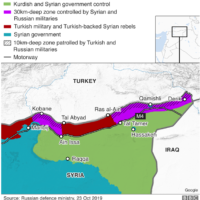
A map conveys where various forces are positioned along Turkey’s border with northeastern Syria (Bbc.com)
Upon the withdrawal of the majority of US armed forces from Syria in early October, Turkey pushed a new offensive against Kurdish troops along the Turkey-Syria border. This event is only the most recent exchange between the Turks and Kurds, and is part of a larger armed conflict enduring in the region for nearly 30 years.
Between 25 and 35 million Kurds inhabit the mountainous region in western Asia along the borders of Turkey, Iraq, Syria, Iran and Armenia. With a population of between 1.6 and 2.5 million people, the Kurds make up between seven and ten percent of the Syrian population. In Turkey, the Kurds represent one fifth of the population.
Kurdish-Turkish conflict originated due to harsh treatment of the Kurds at the hands of Turkish authorities for generations. In response to Kurdish uprisings in the 1920s and 1930s, Turkey suppressed their culture by denying the existence of a Kurdish ethnic identity.
In 1978, the Kurdistan Workers’ Party (PKK) was established with the purpose of gaining full autonomy and establishing an independent Kurdish state. The PKK and other insurgency groups have since been involved in various attacks against Turkish authorities. Tayyip Erdogan, Turkey’s president who is widely unpopular amongst the Kurds, has responded through air strikes and military operations. The conflict has resulted in approximately 40,000 total deaths and 3,000,000 people have been forced to abandon their homes and flee their region.
The Turks are not the Kurds’ only violent adversary. Since 2014, Syrian Kurdish fighters have been combating the Islamic State in Syria (ISIS), largely as part of the Syrian Defense Force (SDF). The SDF is an alliance of Arab and Kurdish fighters backed by the United States-led multinational coalition. The SDF has steadily driven ISIS out of significant territories in north-eastern Syria and established control over a large stretch of the border with Turkey. The last major ISIS-controlled territory in Syria—around the village of Baghouz—fell in March, 2019. After ISIS was expelled from many territories and was captured by SDF soldiers, Turkey, and Turkish-backed Syrian militants, moved to recapture Kurdish-controlled cities.
The People’s Protection Units (YPG) has troops present on the border with Turkey and Turkey believes that the YPG is an extension of the PKK. The YPG, however, is the military wing of the Kurdish Democratic Union Party (PYD), one of the main Kurdish-opposition political parties in Syria. On October 9, Turkish troops and allied Syrian rebels launched an offensive to create a 30km (20-mile) deep “safe zone” along the Syrian side of the border since United States troops had left the region. The Kurds asked Syria’s government and its ally, Russia, to help stop the assault. However, Turkey and Russia subsequently agreed to take joint control of the border area and remove border members of the YPG.
On October 17, President Donald Trump of the US negotiated with Turkey for a five-day ceasefire to allow YPG fighters to withdraw from a 120km-long stretch from Ras al-Ain to Tal Abyad where the fighting was focused (see image above). President Vladimir Putin of Russia also reached a deal with Erdogan. They agreed Russian and Syrian government forces would move into that area immediately to ensure the Kurdish fighters pull back 20 miles from the border. At the end of the 150 hours, Russian-Turkish troops would begin patrolling along the border.
Although these recent negotiations have made progress in the resolution of the conflict between the Kurds and Turkish, there is still a long way to go before the region becomes stable. Even more collaboration and understanding between the Syrian and Turkish governments as well as the Kurds is essential for the creation of lasting, peaceful relationships.
Leave a Reply
You must be logged in to post a comment.